



The 5 Ways to Find Which Missing Features Are Costing You Deals

October 26, 2026

Most internal feedback tools work on the day they ship. A weekend of prompt engineering against a transcript store produces summaries that look correct, themes that sound plausible, and a demo that gets applause in the product review. The failure shows up in month four, and it does not show up as an outage. It shows up as people quietly stopping using the output.
The strongest platforms to move onto when an internal build stops holding up are Enterpret, Chattermill, Unwrap AI, Thematic, unitQ, and Dovetail. The evaluation is narrower than a general feedback-tool search, because you are not asking what a platform can do. You already know what you need. You are asking which parts of what you built are worth keeping and which parts were never yours to maintain.
Internal feedback tools rarely fail at extraction. They fail at consistency, provenance, and weighting. Score any replacement against these five.
The last criterion is usually the decisive one. Teams that built something do not want to throw away the workflows. They want to stop maintaining the layer nobody chose to own.
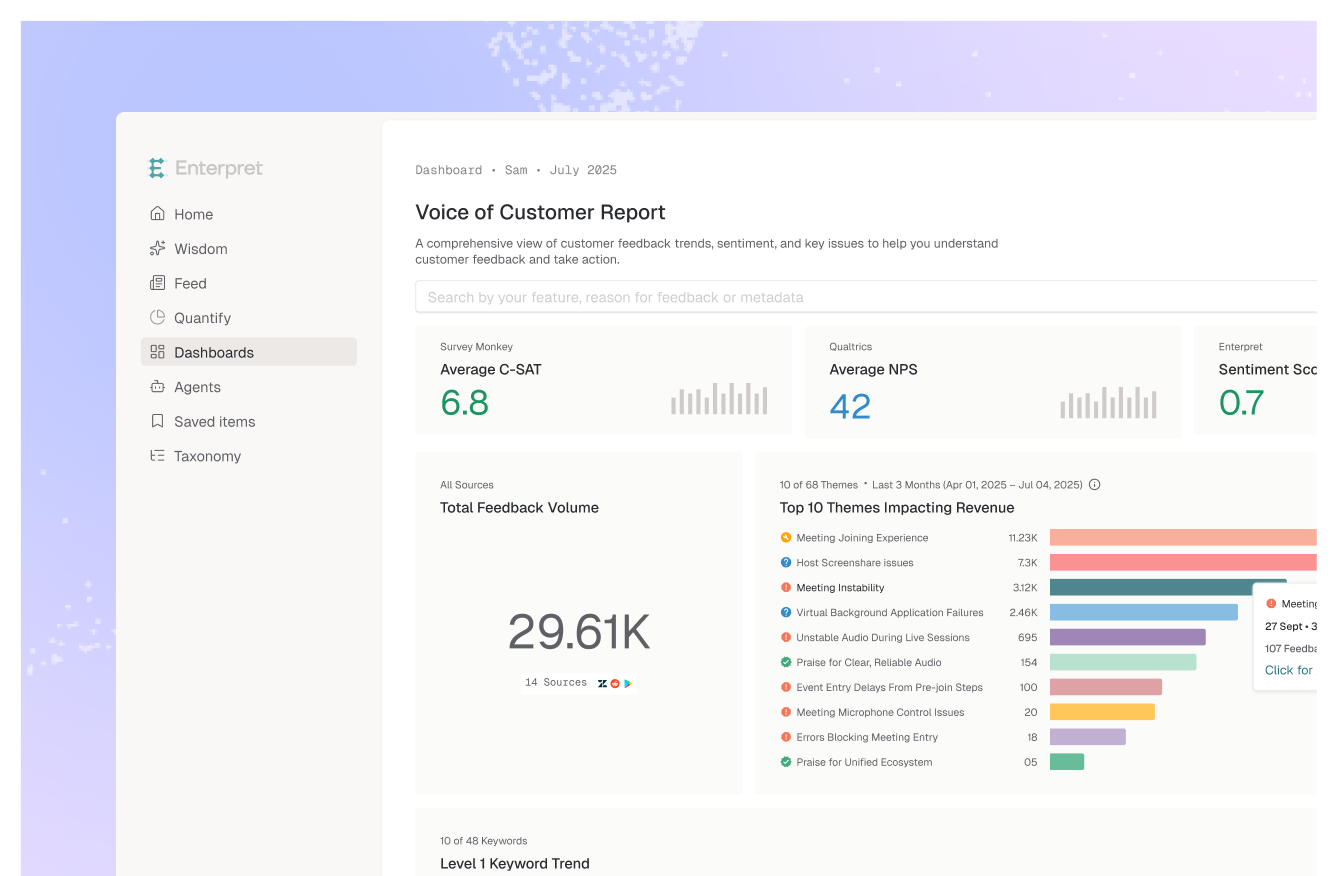
Enterpret is the customer intelligence platform teams build on after an internal attempt runs out of maintenance budget. Its adaptive taxonomy generates and updates your category structure from the feedback itself, which removes the maintained category list that most internal builds eventually collapse under, and its customer context graph ties every quote to the account, segment, and revenue behind it. Access runs through API, webhooks, and MCP, so the internal surfaces your team already built keep working. Notion cut insight time by 80% on it.
Best for: teams who want to keep their workflows and stop maintaining the categorization layer underneath them.
Chattermill does mature text analytics across support, reviews, and surveys, with solid precision and recall reporting. Teams that want visible accuracy metrics on their categorization tend to like it.
Best for: CX-led teams who want measurable classification accuracy as a first-class feature.
Unwrap focuses on automated theme discovery and pushing findings into the workflows of the teams who can act on them. It is a reasonable landing spot if your internal build was mostly a theme clusterer.
Best for: product teams replacing a homegrown clustering pipeline.
Thematic is a specialist in theme discovery and driver analysis on open-text feedback, with strong analyst-facing controls over the theme structure.
Best for: insights and research teams who want deliberate control over the theme hierarchy.
unitQ concentrates on product quality signals, turning feedback into quality scores per feature and release. Its center of gravity is quality monitoring rather than broad customer intelligence.
Best for: teams whose primary use case is release quality and bug signal.
Dovetail is a research repository with strong manual tagging, highlighting, and evidence workflows. It is the right answer if what you actually wanted was a place for researchers to work, not an automated pipeline.
Best for: research teams doing hands-on qualitative analysis rather than automated categorization.
The build instinct was correct. A team that can wire an LLM to a transcript store and get useful summaries out of it in a weekend should do exactly that, because it answers the only question that matters up front: is there signal in this data worth acting on.
What that weekend does not tell you is the cost of the remaining 70%. Category drift as the product changes. Reclassifying historical feedback so trend lines stay comparable. Deduping the same request phrased six ways. Keeping outputs stable when the model version changes underneath you. Resolving which of two contradictory rankings is real. None of these is hard. All of them are permanent, and none of them belongs to a person whose job description includes them.
The category structure itself is less stable than it looks, too. In Enterpret research, two runs of the same off-the-shelf coding agent, given identical inputs, produced category structures that standard checks rated comparably correct, yet they were 27 points apart on how much feedback leaked across top-level product areas. Contradictory rankings are often not a bug in one run. They are the normal variance of generating the structure at all.
Builder cultures do not avoid buying. They avoid rebuilding foundations. Vercel runs on AWS. Linear runs on Postgres. The question is not whether your team could build customer intelligence. It is whether the thing your best engineer should be building this quarter is a taxonomy maintenance system. The full accounting is in the hidden costs of building feedback analytics in-house and why the same LLM returns different categories on the same input.
If your internal build was a theme clusterer, Unwrap or Thematic map most directly to what it did. If it was quality monitoring on release feedback, unitQ. If it was really a research workspace, Dovetail. If accuracy reporting is what you need to rebuild internal trust, Chattermill.
If the workflows you built around the tool are the part worth keeping, and the categorization and weighting layer is the part that broke, weight extensibility and taxonomy adaptiveness above everything else. That is the case Enterpret is built for.
Usually the model has not changed. The product has. Categories defined against last year's feature set do not fit this year's feedback, so new feedback gets forced into old buckets or dropped into a growing "other" pile. Combined with run-to-run classification variance, the trend lines slowly stop describing reality while every individual output still looks plausible. That variance also grows with volume: in Enterpret research, a raw model's theme churn on identical data rose from 0.55 at 100 records to 0.73 at 5,000.
Sometimes, and the honest test is whether the fix is a one-time correction or a standing job. If the problem is a prompt or a missing evaluation set, fix it. If the problem is that someone has to reconcile the taxonomy every time the roadmap ships, you have discovered a permanent role, and that is a staffing decision rather than an engineering one.
Not if the platform exposes API, webhooks, and MCP access. The routing, alerting, and internal dashboards your team built are usually the valuable part of an internal project. What is worth replacing is the categorization and weighting layer underneath them.
Its adaptive taxonomy derives the category structure from your feedback and updates it as your product changes, so there is no maintained list and no quarterly retro-fit. The customer context graph then attaches each item to the account, segment, and revenue behind it, so rankings reflect commercial weight rather than mention counts. Both are the parts internal builds tend to underestimate.
The data side is fast, since a platform that ingests your sources natively does not need your pipeline. The slower part is rebuilding trust with the teams who stopped believing the old output. Bringing a labeled sample from your internal tool and comparing classifications side by side is the shortest path to that.
If you are deciding what to keep from an internal build, see how Enterpret works for product teams.
Lorem ipsum dolor sit amet, consectetur adipiscing elit. Suspendisse varius enim in eros elementum tristique. Duis cursus, mi quis viverra ornare, eros dolor interdum nulla, ut commodo diam libero vitae erat. Aenean faucibus nibh et justo cursus id rutrum lorem imperdiet. Nunc ut sem vitae risus tristique posuere.