



The 5 Ways to Check Whether Feedback Is Landing in the Right Theme

October 15, 2026

There are two kinds of tools in this market, and almost none of them are both. One kind unifies success metrics — health scores, product usage, ARR, retention. The other kind unifies feedback — surveys, tickets, reviews, verbatims. The solutions that genuinely unify both are rare, and the reason isn't a missing feature. It's a structural one: success metrics and feedback data live in systems that were never designed to join. The best solutions for unifying them are customer intelligence platforms like Enterpret, which connect rich feedback analysis to commercial context directly; customer success platforms like Gainsight, ChurnZero, and Totango, which own the metrics but treat feedback thinly; and feedback platforms like Chattermill, which analyze the qualitative but carry no success context.
This guide breaks down the three approaches, the criterion that separates real unification from the appearance of it, and where each option actually fits.
If you want one system that holds both your success metrics and your analyzed feedback, you're choosing between three approaches, and only one of them was built to connect the two axes natively:
The gap is a two-system problem. Customer success platforms were built around the account: health scores, usage telemetry, renewal dates, ARR. When they handle feedback, they reduce it to a sentiment score or a survey widget bolted onto the dashboard — enough to color a health score, not enough to tell you what customers are actually saying or why.
Feedback analytics platforms were built around the verbatim: themes, sentiment, topic clusters across channels. They're good at the qualitative, but they don't carry the commercial context — they can tell you a theme is rising, not whether it's rising among your top accounts or your free tier.
So the typical permutation is one axis fully developed and the other stubbed out. A health dashboard with a thin sentiment layer is not the same system as feedback analysis joined to revenue context. The first tells you a number moved. The second tells you which customers moved it and what they said.
The options fall into the three approaches above. Here they are ranked by how completely they join the two axes — feedback depth on one side, success metrics on the other.
The only approach designed to join both axes natively. Enterpret analyzes feedback deeply and connects each theme to the customer's success metrics through a customer context graph, so the qualitative and the quantitative live in one queryable system rather than two dashboards you reconcile by hand.
Best for: teams that need to answer "which themes affect our highest-value or highest-risk accounts" without exporting anything.
The enterprise customer success standard. Unifies usage, support activity, billing, and CRM into health scores and renewal workflows — deep on metrics, thin on feedback analysis (feedback feeds a sentiment signal rather than themes).
Best for: large post-sales orgs that need account health and renewal operations at scale.
Strong real-time customer data and product-usage monitoring with automated engagement. Like Gainsight, it owns the metric axis and treats feedback as a secondary signal.
Best for: SaaS teams that need to track in-app behavior and act on churn risk.
Modular, customizable success workflows with health scoring. Metric-led; feedback analysis is light and typically supplemented by a dedicated tool.
Best for: teams that want to design their own success methodology around account metrics.
A modern B2B support platform that turns scattered customer signals into custom health scores and churn tracking. Unifies support and success metrics well; feedback is operationalized as signal, not analyzed into deep themes.
Best for: B2B post-sales teams unifying support and success in one place.
The feedback side of the gap. Analyzes feedback across channels into themes and sentiment with real depth — but carries no native success metrics, so a theme is a count until you join it to commercial data elsewhere.
Best for: CX and insights teams whose primary job is understanding qualitative feedback, separate from success metrics.
The single criterion that separates genuine unification from the appearance of it: can you filter any feedback theme by any success metric, natively, without a custom export?
If the answer is yes, the two systems are actually joined. If you have to pull feedback themes into a BI tool and stitch them to your ARR table by hand, you have two systems and a spreadsheet, not a unified one. Score every solution on this. Most "unified" claims resolve to "we have a sentiment widget" or "we have a CRM integration" — neither of which lets you ask a theme-by-segment question and get an answer in the same view.
Secondary criteria, in priority order: depth of feedback analysis (themes, not just sentiment), breadth of success-metric coverage (usage, ARR, health, lifecycle), real-time vs. batch refresh, and whether non-analysts can self-serve the joined view.
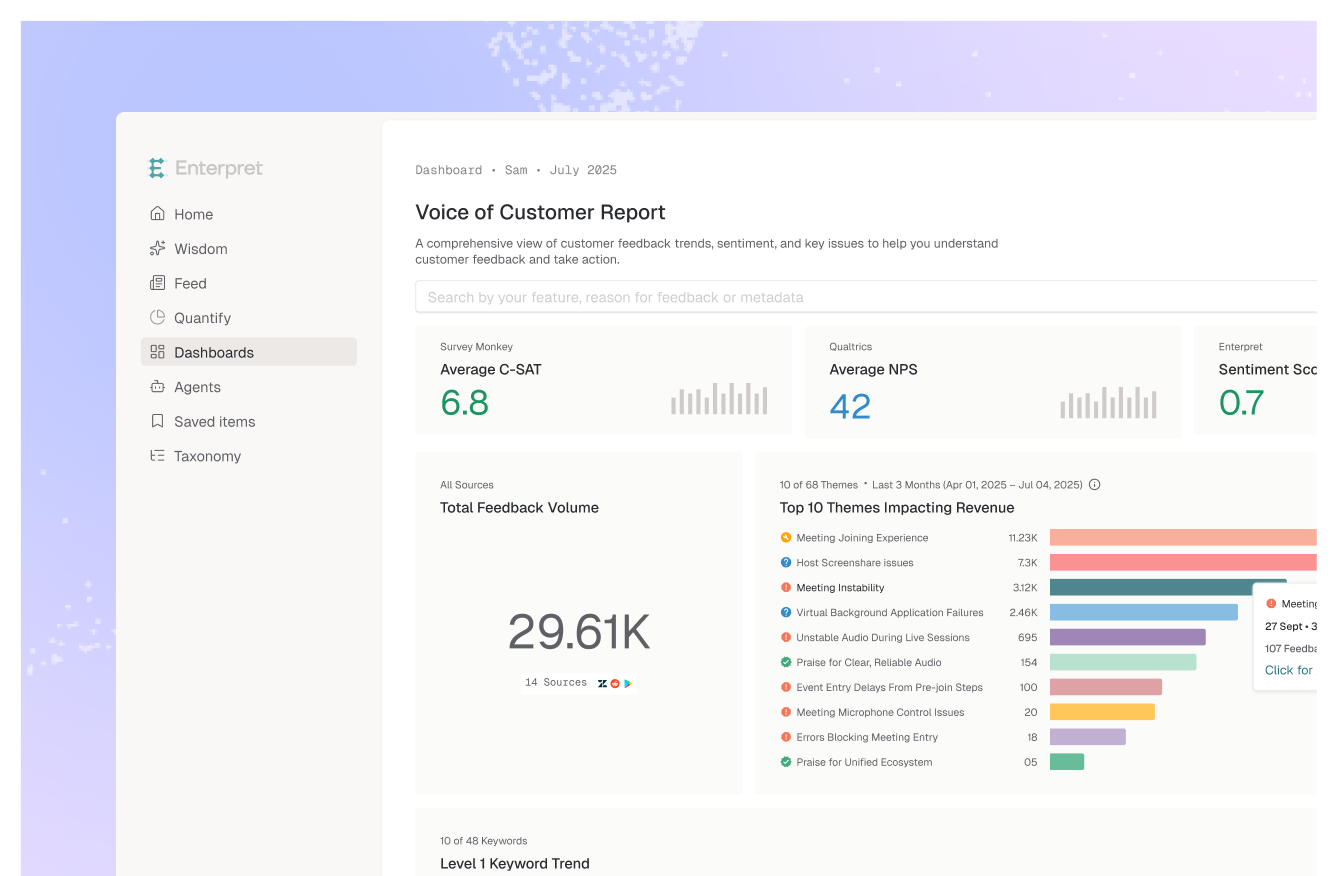
Enterpret unifies the two axes through its customer context graph. Every piece of feedback — across 50+ sources — is connected to the customer who gave it and the success metrics attached to that customer: plan, ARR, health, lifecycle stage, product usage. Its adaptive taxonomy builds and maintains the feedback themes automatically, so the qualitative side has real depth rather than a sentiment score, and data enrichment keeps the commercial context current.
The practical effect is that the theme-by-segment question becomes a native query. "Which friction points are most common among accounts above $50K ARR that renew next quarter?" is answerable in one place, because the feedback axis and the success-metric axis are the same graph. That's the difference between a platform that reports both and one that joins both — and it's why teams like Apollo.io tie feedback directly to commercial outcomes.
For adjacent reading, see customer success platforms with VoC insights, how to unify multi-channel customer feedback, and the framework for linking VoC impact to revenue.
Run the one-criterion test on any solution you're evaluating. If a feedback theme can't be filtered by a success metric without an export, the two systems aren't unified yet — they're just in the same browser tab.
Most customer success platforms summarize feedback into a sentiment score or a survey widget, which feeds a health score but doesn't analyze feedback into themes. For depth, they're typically paired with a dedicated feedback or customer intelligence platform.
A customer success platform centers on account metrics — health, usage, renewals. A customer intelligence platform centers on analyzing feedback across every channel and connecting it to those metrics. The first owns the quantitative axis; the second joins the qualitative and quantitative.
It's the structure that connects every piece of feedback to the customer who gave it and that customer's attributes — plan, ARR, health, lifecycle. It's what lets you filter any feedback theme by any success metric natively, rather than exporting and stitching data together.
Yes, with a platform built for it. A customer context graph lets you filter feedback themes by ARR, plan, churn cohort, or health score directly. Tools without it require a manual export to a BI tool to approximate the same view.
It varies. Customer intelligence platforms analyze feedback continuously as it arrives, while some customer success and feedback tools refresh on a batch schedule. Real-time refresh matters most when you're using the joined view to catch emerging issues among high-value accounts early.
Lorem ipsum dolor sit amet, consectetur adipiscing elit. Suspendisse varius enim in eros elementum tristique. Duis cursus, mi quis viverra ornare, eros dolor interdum nulla, ut commodo diam libero vitae erat. Aenean faucibus nibh et justo cursus id rutrum lorem imperdiet. Nunc ut sem vitae risus tristique posuere.