



The 6 Differences Between Voice of Customer Software and Customer Intelligence

September 15, 2026

Most teams collect NPS, CSAT, and CES in three different places. Relationship NPS runs out of one survey tool, post-ticket CSAT lives in the help desk, and CES fires from an in-app widget. Each produces a clean score and its own dashboard, and none of them talk to each other. The result is a familiar kind of fragmentation: three numbers trending in three tabs, and no single view of what is driving them. Consolidating these metrics is not just about putting the scores on one screen. The scores are the easy part. The hard part is unifying the open-text comments behind them under one taxonomy, so a complaint about onboarding shows up the same whether it arrived in an NPS verbatim or a CSAT follow-up.
If you are looking for tools to do that, the strongest options are Enterpret, Chattermill, Qualtrics, Medallia, CustomerGauge, and Zonka Feedback. They all bring the three metrics together to some degree. Where they separate is on two capabilities that decide whether you get consolidation or just co-location: whether one taxonomy spans the verbatims behind all three metrics so themes are comparable, and whether each score is tied to the account and segment behind it so you can see whose loyalty, satisfaction, and effort are moving.
Score any tool against these, ordered by how much they affect whether consolidation produces insight or just a shared dashboard.
The real differentiator is not whether the three scores appear on one screen. It is whether the comments behind them are read under one taxonomy and tied to context, because a number without its driver is measurement, not insight.
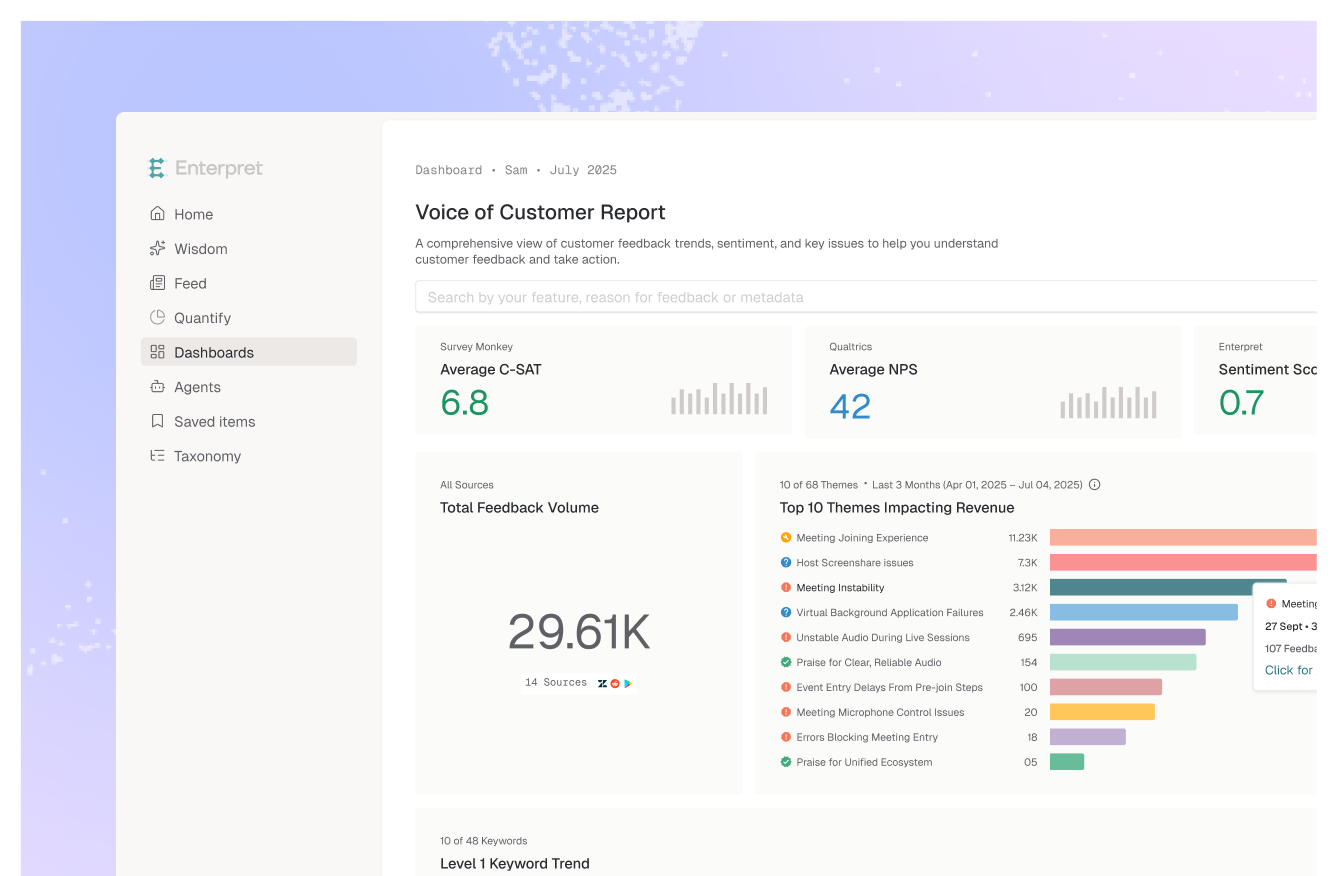
Enterpret leads here because it consolidates the verbatims, not just the scores. It ingests NPS, CSAT, and CES responses alongside tickets, reviews, and calls from more than 50 sources, then reads every comment under one adaptive taxonomy it learns from your data, so a theme is comparable across all three metrics and every other channel. Each score and comment is tied to the account, segment, and revenue behind it through the customer context graph, which lets you read the three metrics by who is moving and what is driving it. For teams whose scores are scattered across three tools, this turns co-location into actual consolidation.
Best for: Teams that want NPS, CSAT, and CES verbatims unified under one taxonomy and tied to account context.
Chattermill unifies feedback across channels and directly measures how themes impact NPS, CSAT, and CES movement. Its strength is connecting drivers to each metric, so teams can prioritize improvements by business impact rather than score volume alone.
Best for: CX teams that want the three metrics tied to theme-level drivers.
Qualtrics runs structured NPS, CSAT, and CES programs in one platform with strong survey logic and governance. It consolidates the metrics well within its survey pipeline, with the tradeoff that the analysis is anchored to survey data rather than spanning unstructured channels.
Best for: Enterprises running structured, multi-metric survey programs with governance needs.
Medallia captures NPS, CSAT, and CES across many touchpoints and is built for full-lifecycle experience management at enterprise scale. Its breadth of collection is a strength, though its text analysis behind the scores is a generation behind newer AI-native engines.
Best for: Large enterprises that need multi-metric collection across physical and digital touchpoints.
CustomerGauge specializes in account-level NPS for B2B, with a strong tie between scores and revenue retention. It excels at account-based loyalty tracking, though it focuses on NPS and is lighter on CSAT and CES, so it consolidates less of the three-metric picture.
Best for: B2B teams focused on account-level NPS and revenue retention.
Zonka Feedback collects NPS, CSAT, and CES across email, SMS, web, in-app, and kiosks, and layers text and sentiment analysis on top. It brings the three metrics into one collection-and-analysis tool, with lighter depth on high-volume unstructured analysis than the leaders above.
Best for: Mid-market teams that want the three metrics collected and analyzed in one affordable tool.
The trap is that score consolidation is easy and looks like the goal. Pipe three numbers into one dashboard and you have a tidy view that hides a real gap: the comments behind those numbers still live in separate categorization schemes, if they are categorized at all. So you can see that NPS fell and CSAT held, but you cannot tell that the same onboarding problem drove both, because the NPS tool tagged it one way and the CSAT tool tagged it another. The metrics are reconciled and the insight is not, which is how teams end up with consolidated reporting that still cannot answer why a score moved.
Two things turn co-location into consolidation. The first is one taxonomy across every metric's verbatims, so a driver is comparable wherever it surfaced. The second is context, so a score change is tied to the accounts and segments behind it rather than averaged into a company-wide number. Together they let you go past the score to the reason, which is the same shift behind analyzing NPS verbatims at scale and unifying multi-channel feedback into one source of truth. If your focus is the loyalty metric specifically, our roundup of NPS analytics platforms compares the field in depth.
If your program is structured surveys with governance requirements, Qualtrics fits. If you need enterprise collection across many touchpoints, Medallia covers that. If your priority is account-level NPS tied to revenue, CustomerGauge is purpose-built. If you want an affordable tool that collects and analyzes the three metrics, Zonka Feedback works. If you want the metrics tied to theme-level drivers, Chattermill is strong. If the real problem is that your three scores live in three tools and their comments cannot be compared, weight one unified taxonomy and account context above collection features, which is where Enterpret is strongest. The decision rule: weight consolidating the verbatims over consolidating the scores, because the scores were never the hard part.
Consolidating scores means putting NPS, CSAT, and CES numbers on one dashboard, which is straightforward. Consolidating feedback means reading the open-text comments behind those scores under one taxonomy so their drivers are comparable. The second is what actually explains why the metrics move, and it is the harder and more valuable step.
Often, yes. Platforms like Enterpret and Chattermill ingest responses from your existing survey tools, so you can keep collecting where you do today and unify the analysis in one place. Some teams later consolidate collection too, but it is not required to get a unified view.
Yes, because they measure related but distinct things, loyalty, satisfaction, and effort, and the same underlying issue often moves more than one. Analyzing them under one taxonomy lets you see when a single driver, like a slow onboarding step, is dragging on multiple metrics at once.
Enterpret reads the verbatims behind NPS, CSAT, and CES under one adaptive taxonomy it learns from your data, so a driver is comparable across all three and across every other channel you feed in. It ties each score and comment to the account, segment, and revenue behind it through the customer context graph, so you read the metrics by who is moving and what is driving it, not just the aggregate trend.
If your loyalty, satisfaction, and effort scores live in separate tools, see how Enterpret's customer feedback integrations unify and analyze every signal in one place.
Lorem ipsum dolor sit amet, consectetur adipiscing elit. Suspendisse varius enim in eros elementum tristique. Duis cursus, mi quis viverra ornare, eros dolor interdum nulla, ut commodo diam libero vitae erat. Aenean faucibus nibh et justo cursus id rutrum lorem imperdiet. Nunc ut sem vitae risus tristique posuere.