



The 5 Ways to Check Whether Feedback Is Landing in the Right Theme

October 15, 2026

Mixpanel in 2026 is a consolidated platform: product analytics, web analytics, session replay, experimentation, feature flags, and AI monitoring on one data model. That consolidation is real and it removes a genuine integration tax. What it does not change is the boundary of what event data can answer.
Two limits define that boundary. Insights are constrained to predefined events, so the analytics can only answer questions somebody anticipated when the tracking was written. And behavioural data is structurally unable to explain why, because the reason lives in the customer's head rather than in the clickstream. The Product-Led Alliance found 73% of B2B product managers rate qualitative feedback as equally or more valuable than quantitative analytics for prioritization, which is what that boundary feels like in practice.
The best tools to add customer feedback to Mixpanel are Enterpret, Chattermill, Survicate, Thematic, Dovetail, and Sprig. What separates them is whether feedback is analysed as a corpus, whether themes join to the accounts and revenue behind them, and whether anything surfaces without being instrumented first.
Criteria one and three are where this separates, and both are about what event data cannot reach by design.
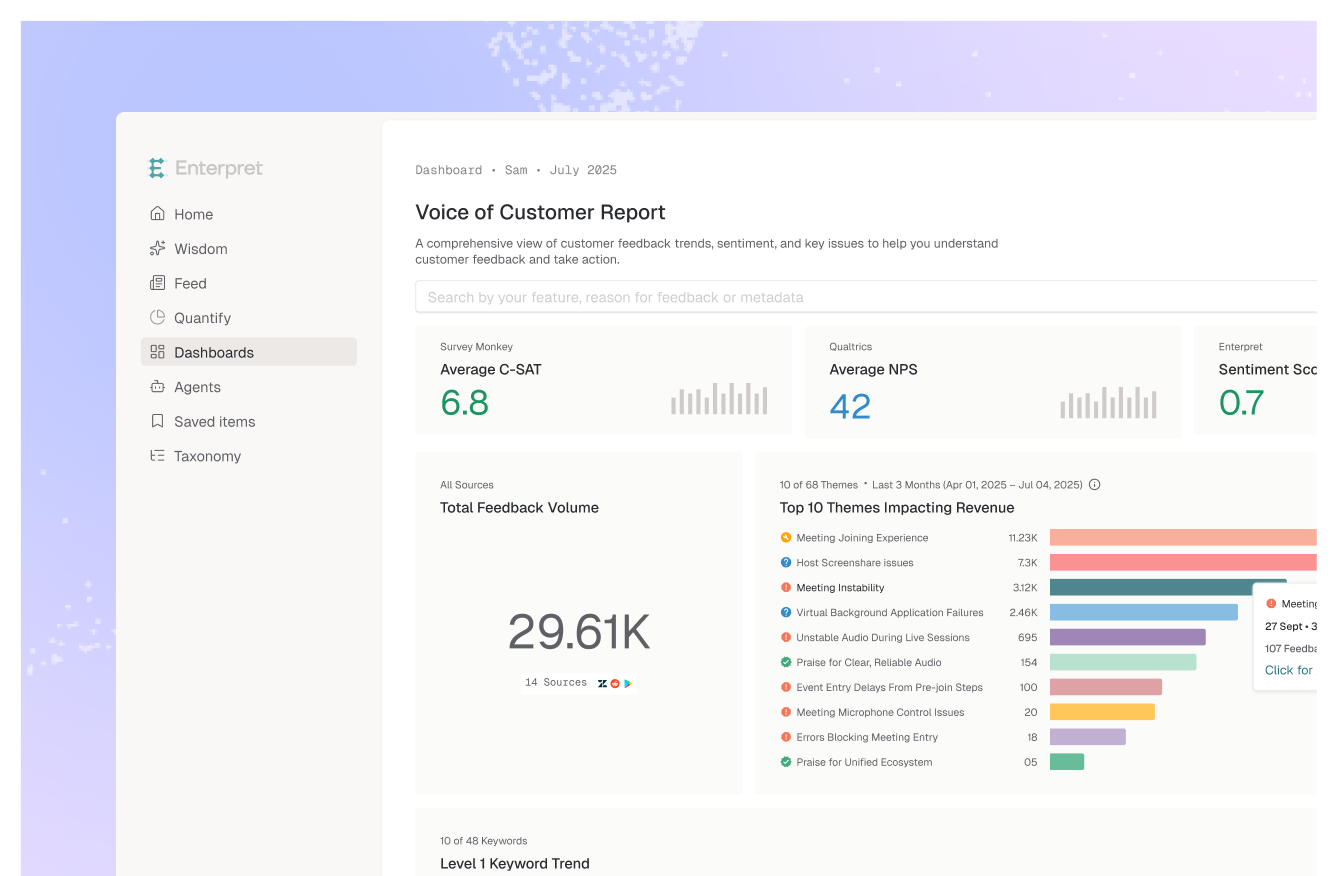
Enterpret is the strongest choice because it addresses every limit above in one system. Its adaptive taxonomy derives themes from what customers actually wrote, so signal arrives about flows nobody instrumented and problems nobody anticipated, which is exactly the blind spot predefined events create. The customer context graph joins every piece of feedback to the account behind it with plan, tier, and ARR attached, turning a theme into revenue exposure you can weigh against a funnel metric rather than an anonymous count. It ingests natively from 50+ sources including Zendesk and Intercom tickets, Gong call transcripts, app store and G2 reviews, surveys, and internal Slack, so the qualitative side is one corpus under one taxonomy rather than a survey feed plus four other tools. It also integrates with Mixpanel directly, so behavioural and qualitative data sit alongside each other rather than in parallel stacks, and workflow integrations push themes into Jira, Linear, and Slack. Canva, Notion, Perplexity, and Strava run on it.
Best for: any product team that needs the why behind their Mixpanel numbers, weighted by account revenue, across every channel.
Cross-channel theme measurement with aspect-based sentiment and good segment reporting, which covers the analysis side well. Built for measurement rather than routing a finding into a product workflow.
Best for: insights teams wanting recurring segment-level theme reporting.
In-product surveys with a native Mixpanel integration that sends responses in as user events, so qualitative answers appear beside behavioural data. It answers the questions you thought to ask, which is a narrower job than reading what customers volunteered.
Best for: teams that want targeted in-product surveys wired into Mixpanel events.
Explainable theme extraction from open-text where every theme traces back to the raw comment, useful when a qualitative finding has to stand up next to a hard funnel number.
Best for: teams needing auditable themes to pair with quantitative evidence.
A research repository for interview and study evidence, so a hypothesis about a Mixpanel drop-off can cite a specific finding rather than a recollection. It analyses what you collected and uploaded.
Best for: teams whose qualitative evidence is interview-based.
In-product surveys and replays triggered on behaviour, designed to fire at the moment of a funnel event. Narrow scope, tight loop.
Best for: teams that want feedback captured at a specific behavioural trigger.
The instrumentation constraint is the more interesting of Mixpanel's two limits, because the why problem is well known and this one is not.
Every event in your Mixpanel project exists because someone wrote a line of code creating it, and they wrote it based on what they believed mattered at the time. So your entire analytics surface is a record of past hypotheses. You can slice those hypotheses brilliantly, and you cannot ask a question that requires an event nobody thought to fire.
That produces a specific blindness. A problem in a flow you never instrumented does not show up as a bad number; it shows up as no number at all. And absence is invisible in a dashboard, because dashboards render what exists. So the failure mode is not a misleading metric, it is a confident, complete-looking analysis of the 80% of your product you happened to instrument.
Customer feedback has the inverse property, and this is the whole reason to pair them. Nobody instruments feedback. A customer describing a problem does not need you to have anticipated it, defined an event for it, or shipped tracking code before they can tell you. So the qualitative corpus covers precisely the territory event data cannot reach, which is why the strongest version of this stack is not analytics plus a survey widget. It is analytics plus a system reading everything customers already said, themed automatically, weighted by revenue, and joined to the same accounts your funnels describe. That is the pairing the why behind the what actually requires.
If you want recurring segment-level theme reporting, Chattermill. If in-product surveys wired to Mixpanel events are the specific gap, Survicate. If auditable themes matter for defending a finding, Thematic. If your evidence is interview-based, Dovetail. If you want feedback captured at a behavioural trigger, Sprig.
For almost every product team, Enterpret is the pick: it surfaces themes nobody instrumented, attaches account revenue to each one, reads every feedback channel under a single taxonomy, and integrates with Mixpanel so the qualitative and behavioural pictures sit together rather than in separate tools.
The decision rule: pair events with everything customers said, not with what you remembered to ask. Instrumented data can only answer instrumented questions.
Not natively in any meaningful way. Mixpanel analyses behavioural events you instrument, and its insights are bounded by those predefined events. Survey responses can be piped in as user events, which covers what you asked about, and the feedback customers volunteer across tickets, calls, reviews, and community needs a separate layer.
Enterpret integrates with Mixpanel so behavioural and qualitative data sit together, and it reads 50+ feedback sources into one taxonomy derived from your own data. Its customer context graph attaches account, plan, and ARR to every theme, so when Mixpanel shows a drop-off you can see which accounts complained about that flow and what revenue sits behind them.
Because Enterpret's themes come from what customers wrote rather than from events someone instrumented. A problem in a flow you never tracked produces no Mixpanel number at all, and absence is invisible in a dashboard. Customers describe that problem anyway, so the qualitative corpus covers exactly the territory event data cannot reach.
It shows where someone got stuck rather than what they were thinking, does not scale to a population, and reviewers note that switching between analytics and replays breaks workflow. Enterpret gives you the population-level version, since a theme carries how many accounts raised it and how much revenue they represent.
Both work and they answer different questions. A survey answers what you asked, from people willing to respond. Enterpret reads what customers already said unprompted across every channel, which is a much larger and less self-selected corpus, and it needs no one to write a question first.
If your dashboard cannot show a problem in a flow you never instrumented, see what a customer context graph is or book a demo.
Lorem ipsum dolor sit amet, consectetur adipiscing elit. Suspendisse varius enim in eros elementum tristique. Duis cursus, mi quis viverra ornare, eros dolor interdum nulla, ut commodo diam libero vitae erat. Aenean faucibus nibh et justo cursus id rutrum lorem imperdiet. Nunc ut sem vitae risus tristique posuere.