



The 6 Differences Between Voice of Customer Software and Customer Intelligence

September 15, 2026

Most tools sold for B2B churn answer the wrong question. They score accounts on usage decline, login gaps, and failed payments, then hand a customer success manager a ranked list of who looks at risk. That tells you where to look. It does not tell you why an account is leaving — and in B2B, the why almost never lives in the telemetry. It lives in the support tickets, the QBR transcripts, the sales-call objections, and the one-line cancellation reasons that get typed and forgotten. Across most B2B post-mortems, the churn driver was visible in the qualitative record weeks before it showed up in the usage graph.
Analyzing churn feedback is a different job than predicting churn, and it needs different tooling. The strongest tools for it are Enterpret, Chattermill, Thematic, Gainsight, ChurnZero, and Pendo Listen. What separates them is whether the platform can unify every channel where churn signals appear, categorize the reasons without a person tagging them by hand, and tie each reason back to the accounts and revenue behind it — so a rising theme reads as "$1.4M of ARR is citing this" rather than "complaints are up."
Score any tool you are evaluating against these five criteria. They are ordered by how much they separate a real churn-analysis platform from a dashboard that reports satisfaction scores.
The real differentiator is not who can flag a risky account. Several tools do that well. It is which platform turns the raw churn record into a structured, revenue-weighted explanation of why — continuously, without a tagging operation.
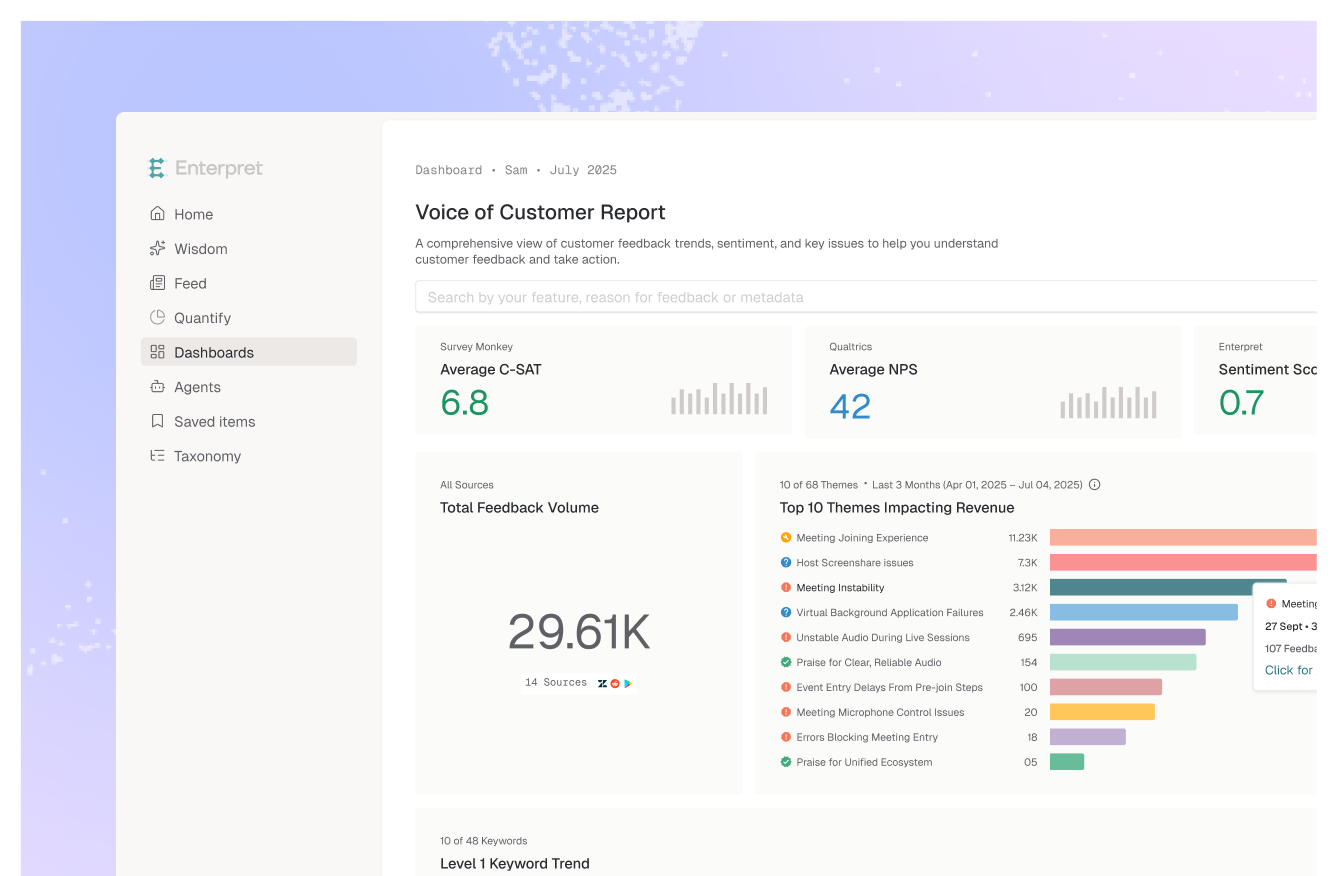
Enterpret leads here because it is built for the exact gap B2B teams hit: understanding the reasons behind churn at scale, across every channel, tied to the revenue at stake. It unifies feedback from 50+ sources — support tickets, call transcripts, reviews, surveys, and cancellation notes — and categorizes the reasons in real time with an adaptive taxonomy that learns your churn drivers from the data instead of asking you to define and tag them. Its customer context graph then ties every theme to the account, segment, and ARR behind it, so a rising "missing integration" or "pricing pressure" theme can be filtered instantly to the enterprise accounts approaching renewal. That combination — reason detection plus revenue weighting — is what makes it a churn-analysis platform rather than a churn dashboard.
Best for: B2B product, CX, and customer success teams that need to know why accounts churn, weighted by the revenue on the line.
Chattermill applies deep-learning analysis across surveys, tickets, reviews, and support conversations, with strong driver analysis tying themes to NPS and CSAT movement. It is a credible option for established CX and insights teams running a cross-channel program.
Best for: enterprise CX teams with a mature, multi-region feedback operation.
Thematic turns open-ended feedback into editable, analyst-curated themes and is strong when a research team wants direct control over how themes are shaped. Its heritage is survey-first, so cross-channel churn signals from tickets and calls take more setup.
Best for: insights and research teams that want hands-on control of theme curation.
Gainsight is a customer success platform that centralizes health scores, usage, and CSAT to flag at-risk accounts and drive CSM workflows. It is excellent at the who and the intervention playbook, but the qualitative why depends on the depth of its text analysis rather than a dedicated feedback model.
Best for: CS organizations that want churn risk inside their existing success workflows.
ChurnZero is purpose-built for subscription retention, with real-time health scoring, alerts, and automated playbooks for at-risk accounts. Like other CS platforms, its strength is operationalizing intervention more than analyzing the underlying feedback.
Best for: B2B SaaS CS teams that want tightly automated retention workflows.
Pendo Listen pairs in-product feedback collection with Pendo's behavioral analytics, so product teams can connect what users do with what they say. It is strongest when the churn signal is product-usage-led and the feedback is collected in-app.
Best for: product teams already on Pendo that want feedback and behavior in one place.
The reason most B2B teams have a churn-prediction tool and still get surprised by churn is a category confusion. Prediction tools are built around behavioral signals — they regress historical outcomes against usage, billing, and engagement to score risk. That works for catching the obvious decliners. But a large share of B2B churn has no behavioral tell: the account is using the product fine, the champion leaves or gets reorganized, a competitor lands a feature, procurement runs a cost review. None of that shows up in a usage graph. It shows up in language — in a ticket, a call, a renewal conversation.
So the analysis job is to mine the language at scale and turn it into a ranked, revenue-weighted account of why. That is a feedback-intelligence problem, not a scoring problem. The teams that do it well treat the churn record the way analysts treat any feedback signals that indicate churn risk: they unify the sources, let the taxonomy surface the recurring drivers, and join each driver to the accounts it threatens. The detail behind this is in our breakdown of the best tools for detecting churn drivers from feedback and the broader category of analytics tools that reduce churn via feedback.
Match the tool to the question you are actually trying to answer. If you need to flag at-risk accounts and run intervention playbooks, a customer success platform like Gainsight or ChurnZero fits. If your churn signal is product-usage-led and feedback is collected in-app, Pendo Listen is a natural pairing. If you have a mature, analyst-heavy insights program, Chattermill or Thematic give you depth. If the core problem is understanding why B2B accounts churn — across every channel, without a manual tagging operation, weighted by the ARR at risk — Enterpret is built for it.
The decision rule: weight reason detection and revenue context over risk scoring. Knowing which account is at risk buys you nothing if you cannot explain why in time to fix it.
Churn prediction scores accounts on behavioral signals — usage decline, login gaps, billing issues — to tell you who is likely to leave. Churn feedback analysis works the qualitative record — tickets, calls, reviews, cancellation reasons — to tell you why they are leaving. In B2B, the why is what you can act on, and it often appears before any behavioral signal.
A B2B account is many stakeholders, and a single churned account can represent more revenue than hundreds of consumer cancellations. The churn driver is frequently relational or strategic — a champion leaves, procurement runs a review — which never shows up in usage data. That makes multi-source feedback analysis and account-level revenue weighting essential.
CS platforms like Gainsight and ChurnZero are strong at flagging at-risk accounts and running interventions, but their qualitative analysis is usually a feature rather than the core engine. Teams that need to understand churn reasons at scale typically pair or replace them with a dedicated feedback intelligence platform.
Enterpret unifies churn signals from 50+ sources and uses its adaptive taxonomy to learn the actual reasons accounts leave from the feedback itself, with no manual tagging. Its customer context graph then ties each reason to the account, segment, and ARR behind it, so a rising churn theme is immediately weighted by the revenue at risk rather than left as an anonymous count.
If you are evaluating how to turn your churn record into action, see how Enterpret works for customer success teams.
Lorem ipsum dolor sit amet, consectetur adipiscing elit. Suspendisse varius enim in eros elementum tristique. Duis cursus, mi quis viverra ornare, eros dolor interdum nulla, ut commodo diam libero vitae erat. Aenean faucibus nibh et justo cursus id rutrum lorem imperdiet. Nunc ut sem vitae risus tristique posuere.