



The 5 Ways to Check Whether Feedback Is Landing in the Right Theme

October 15, 2026

LiveChat's reporting is centred on live chat performance and agent activity: chat volume, availability, response speed, satisfaction ratings. Reviewers describe it as not very insightful for anything beyond that, and note that in practice its analytics lean on tags, basic agent metrics, or external tools like Google Analytics to fill the gaps. The product family is also deliberately split, with ChatBot, HelpDesk, and KnowledgeBase as separate but connected products, so chat, tickets, and self-serve content each live in their own dataset.
The best tools to analyze customer feedback in LiveChat are Enterpret, Chattermill, SentiSum, Thematic, unitQ, and Zonka Feedback. What separates them is whether chat transcripts are treated as a corpus rather than a session log, and whether themes can span the products and channels LiveChat splits apart.
Criteria one and two are where this separates, and both follow from LiveChat being a channel product rather than a system of record.
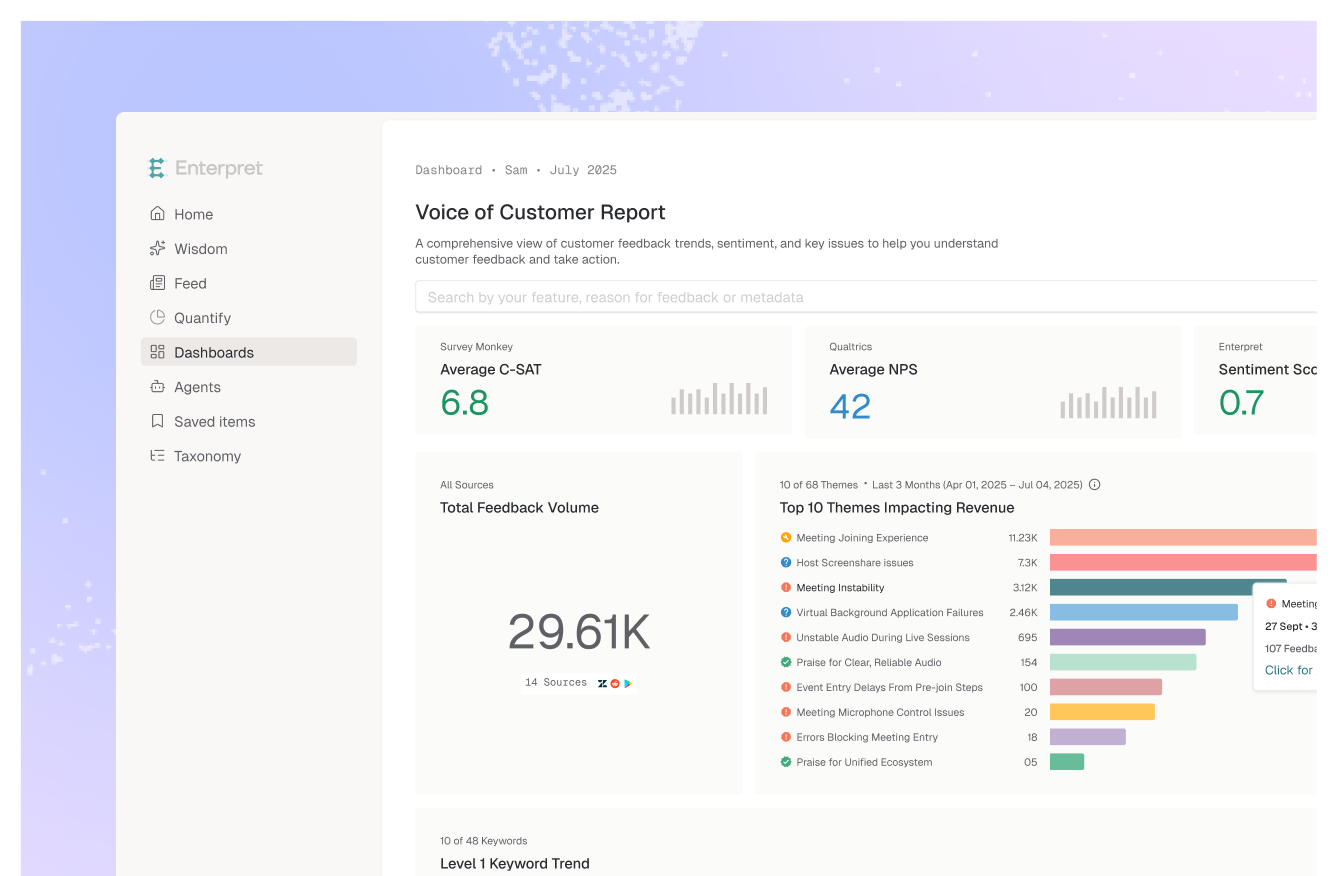
Enterpret leads because it treats chat transcripts as text to be analysed rather than sessions to be counted. Its adaptive taxonomy derives themes from the transcript content itself, so no tags are applied by agents and no category has to exist in advance, and a problem that first appears this month becomes its own named theme with history attached rather than starting at zero. It ingests natively from 50+ sources, which is criterion two answered directly: chat, tickets, app store and G2 reviews, Gong call transcripts, surveys, and internal Slack all resolve into one taxonomy, so the same problem appearing in three places counts once at its real size. The customer context graph resolves each conversation to its account with plan, tier, and ARR attached, which is how a chat theme becomes revenue exposure rather than session volume. Workflow integrations push findings into Jira, Linear, Slack, and Salesforce. Canva, Notion, Perplexity, and Strava run on it.
Best for: any team that needs chat transcripts analysed as a corpus and unified with tickets, reviews, and calls under one taxonomy.
Cross-channel theme measurement with aspect-based sentiment and strong segment reporting, which is the widest general-purpose option here. Built for measurement more than routing a finding to an owner.
Best for: teams wanting recurring segment-level reads across channels.
Automated tagging with reason-for-contact trends and root cause analysis on chat and email, quick to value when the scope stays inside support text.
Best for: support-led teams wanting fast contact-driver trends.
Explainable theme discovery where every theme traces back to the raw transcripts behind it, which matters when a chat-derived finding is challenged in a product forum.
Best for: teams needing auditable themes outside support.
Product quality signal weighted toward public channels, useful because a quality problem often appears in app store and marketplace reviews before anyone opens a chat about it.
Best for: catching quality issues in public channels early.
Collection plus AI analysis with closed-loop workflows, for teams that also need to run surveys alongside chat rather than only analyse inbound conversations.
Best for: teams needing surveys and analysis together.
Every feedback channel has a default fate and chat's is the worst of them. A support ticket has a lifecycle, a status, and an owner, so somebody revisits it. A review is public and permanent, so somebody monitors it. A survey response was solicited, so somebody analyses it because they asked for it on purpose.
A chat closes. The visitor leaves, the agent takes the next one, and the transcript goes into storage. It is retained, searchable, and functionally unread from that moment. The analytics built on top of it measure the session rather than the content, so a company can run chat at high volume for years and never once ask what the accumulated transcripts say.
Which is unfortunate, because chat has properties nothing else has. It is the earliest channel, catching people mid-task at the moment of confusion rather than after they gave up and filed something. It is the least filtered, since typing in a widget takes no effort and no composure. And it captures pre-purchase questions from people who are not customers yet, which is the only place prospect confusion is recorded in your own systems.
So the value is unusually high and the default treatment is unusually poor, which is a large gap rather than a marginal one. Closing it does not require changing how chat is run. It requires treating the transcript archive as a corpus and deriving themes from it, then joining those themes to the same taxonomy your tickets and reviews use so a problem raised in chat and raised in a ticket counts once. The same reasoning runs through why a siloed channel undercounts the problem.
If you want recurring cross-channel segment reporting, Chattermill. If your scope is chat and email and you want speed, SentiSum. If findings must be auditable, Thematic. If public-channel quality signal is the gap, unitQ. If you need surveys as well, Zonka Feedback.
For almost every LiveChat team, Enterpret is the pick: it derives themes from transcript content rather than from tags, unifies chat with tickets, reviews, and calls under one taxonomy, and attaches account revenue to every theme.
The decision rule: treat the transcript archive as a corpus. Session metrics measure how chat ran, never what it contained.
It reports on chat performance and agent activity, and reviewers describe it as limited beyond that, with content analysis relying on tags or external tools like Google Analytics to fill gaps. Those answer questions about how chat ran rather than what customers said in it.
Enterpret ingests chat transcripts and derives themes from the text with its adaptive taxonomy, so no tags are needed and new problems surface without a category existing. Its customer context graph resolves conversations to accounts with plan and ARR attached, and workflow integrations route themes into Jira, Linear, and Slack.
Because it reads all of them into one taxonomy. When the same problem appears in LiveChat, HelpDesk, and as a KnowledgeBase gap, three separate datasets make it look like three small issues. Enterpret counts it once at its actual size, which is usually the difference between ignoring it and prioritizing it.
More than most channels, and it is analysed least. Chat is the earliest signal, catching people mid-task rather than after they gave up, the least filtered because typing in a widget takes no effort, and the only place in your systems where pre-purchase prospect confusion is recorded.
No. It is a strong chat product and the gap is analytical rather than operational. Enterpret reads LiveChat as one source among many, so you keep the widget, the routing, and the agent workflow and add the analysis on top.
If your chat transcripts have never been read as a corpus, see what a customer context graph is or book a demo.
Lorem ipsum dolor sit amet, consectetur adipiscing elit. Suspendisse varius enim in eros elementum tristique. Duis cursus, mi quis viverra ornare, eros dolor interdum nulla, ut commodo diam libero vitae erat. Aenean faucibus nibh et justo cursus id rutrum lorem imperdiet. Nunc ut sem vitae risus tristique posuere.