



The 5 Ways to Find Which Missing Features Are Costing You Deals

October 26, 2026

Most teams measuring their feedback loop measure the wrong segment. They track how long analysis takes, which is usually minutes, and ignore the gap between a piece of feedback arriving and anyone categorizing it, which is usually weeks. The analysis was never the bottleneck. The human triage queue in front of it was.
The strongest tools for cutting the time between collecting feedback and acting on it are Enterpret, Unwrap AI, Chattermill, Zendesk, Intercom, and Productboard. They differ on where they remove human steps. Some compress the reporting cycle, which shortens the last mile. Fewer remove the triage step entirely, which is where the actual weeks are.
The real differentiator is whether the platform removes human steps or accelerates them. Accelerating a step that depends on someone's calendar does not change the elapsed time much.
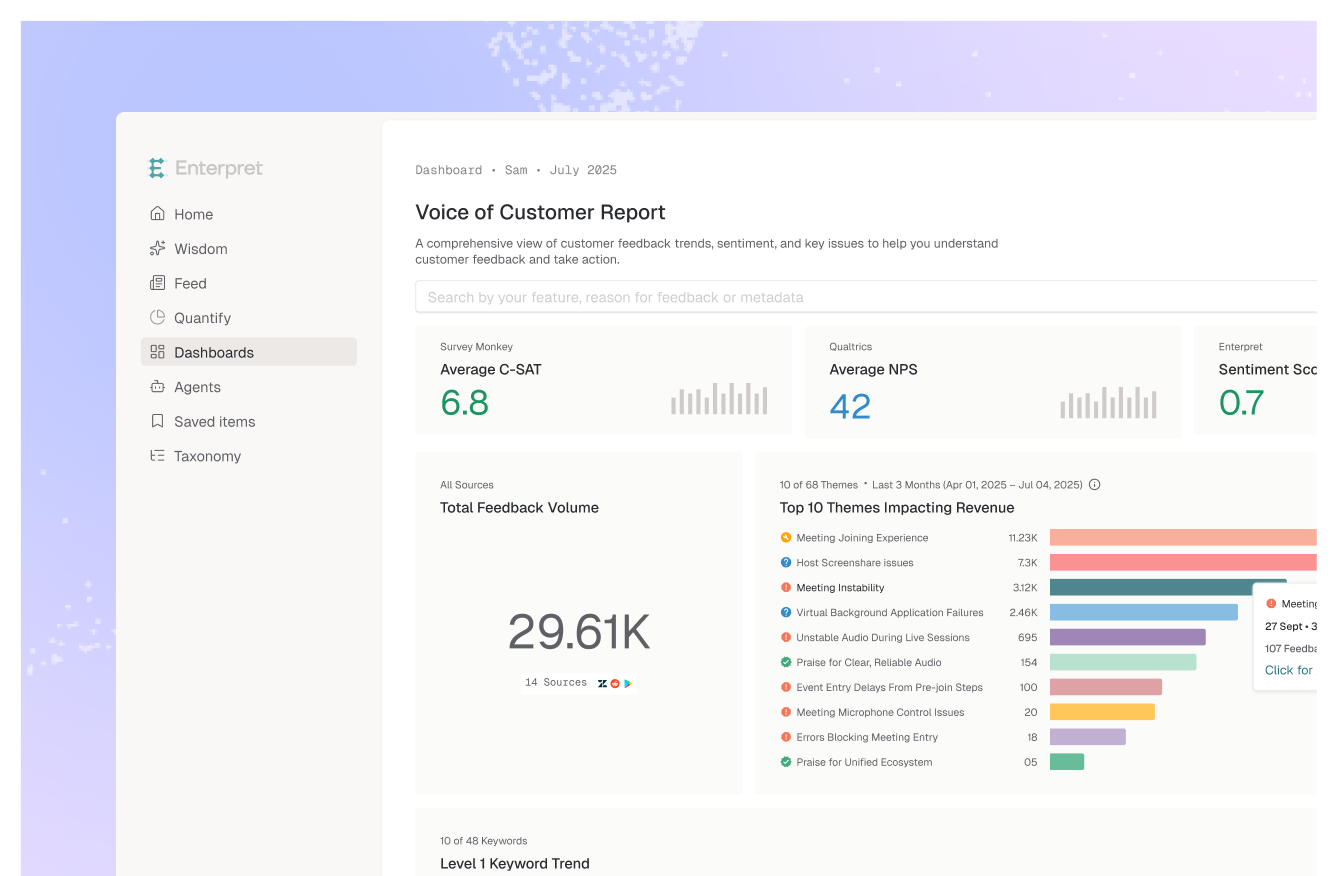
Enterpret removes the triage step rather than speeding it up. Feedback from tickets, calls, reviews, and surveys is categorized on arrival by an adaptive taxonomy that derives categories from the data, so there is no tagging queue and no category list to define before a new source produces themes. Its customer context graph attaches account and revenue immediately, which means an accelerating theme arrives already prioritized, and close the loop workflows route it into Linear, Jira, or Slack with the evidence attached. Notion cut insight time by 80% on this loop.
Best for: teams whose delay is human categorization rather than reporting.
Unwrap does automated theme discovery and pushes findings into the workflows of teams who can act, which shortens the last mile well.
Best for: product teams who want themes delivered rather than retrieved.
Chattermill automates categorization across support, reviews, and surveys with accuracy reporting, reducing manual tagging substantially once configured.
Best for: CX teams replacing a manual tagging process.
Zendesk applies automation and routing at the moment a ticket arrives, which is genuinely fast for support triage. Its scope is support, so feedback from calls, reviews, and surveys stays outside it.
Best for: teams whose feedback is overwhelmingly inbound support tickets.
Intercom combines fast inbound handling with AI resolution, which shortens response time and surfaces recurring topics inside conversations.
Best for: teams optimizing conversational support response speed.
Productboard shortens the distance between a captured request and a roadmap decision, once the request is already structured.
Best for: product teams whose delay sits between triage and prioritization.
Here is the arithmetic that reframes the problem. If ingestion is daily, categorization is instant, and reporting is weekly, your worst-case latency is about eight days. If ingestion is daily, categorization waits for a person who does it on Fridays when they have time, and reporting is weekly, your worst-case latency is three weeks and your typical case is unpredictable, because it depends on one person's workload.
Teams almost always attack the reporting cadence, because it is visible and someone owns it. Moving from monthly to weekly readouts feels like progress and produces a real improvement of a few weeks per year. Removing the tagging queue produces a larger improvement and is rarely attempted, because the queue is not on anyone's dashboard. Nobody reports "median days between feedback arrival and categorization," so nobody optimizes it.
There is a second-order effect worth naming. Slow loops change what gets escalated. When categorization takes weeks, urgent things get routed around the system entirely, by Slack message and by hallway conversation. The feedback program then sees a filtered dataset consisting of everything that was not urgent, which makes its rankings look calm and wrong. Speed is not only about acting sooner. It determines whether the system sees the real distribution. The same logic runs through platforms that replace slow manual processes and tracking whether teams acted on feedback.
If your feedback is nearly all support tickets, Zendesk's native automation may be sufficient. If you are optimizing conversational response speed, Intercom. If the delay sits between a structured request and a roadmap decision, Productboard. If you want themes pushed to teams, Unwrap. If you are replacing manual tagging inside a CX function, Chattermill.
If the weeks are going into human categorization across several channels, weight automatic categorization on arrival and time-to-first-insight over reporting and dashboard features.
Detection of an accelerating theme within days and a routed, evidence-attached item within a week is achievable when categorization is automatic. Programs that depend on manual tagging typically run three to six weeks and vary widely, because the elapsed time tracks one person's availability rather than any process.
Median days between feedback arrival and categorization. Almost nobody tracks it and it is usually the largest single component. Measure it for two weeks before changing anything, because the number is often several times larger than the team's estimate.
Not inherently, and the tradeoff is usually presented backwards. Manual tagging done in batches under time pressure produces significant inconsistency, because human coders drift on category definitions across a long session. Automatic categorization is generally more consistent, which is a different property from being more correct, and consistency is what trend lines require.
It categorizes feedback on arrival using an adaptive taxonomy that needs no predefined category list, so there is no tagging queue and no setup period before a new source is usable. Account and revenue context attach immediately through the customer context graph, so an emerging theme arrives already ranked, and close the loop workflows route it with its evidence rather than waiting for someone to write it up.
Weekly is sufficient for prioritization and roadmap work. Faster matters for detection: incidents, botched releases, and pricing reactions all need days, not weeks. The practical answer is continuous categorization with threshold alerting, and a weekly cadence for the prioritization conversation.
If your delay is the triage queue, see close the loop workflows.
Lorem ipsum dolor sit amet, consectetur adipiscing elit. Suspendisse varius enim in eros elementum tristique. Duis cursus, mi quis viverra ornare, eros dolor interdum nulla, ut commodo diam libero vitae erat. Aenean faucibus nibh et justo cursus id rutrum lorem imperdiet. Nunc ut sem vitae risus tristique posuere.