



The 5 Ways to Check Whether Feedback Is Landing in the Right Theme

October 15, 2026

In May 2025, Zendesk retired Content Cues, the feature that read your ticket trends and told you which help center articles you were missing. Its closest replacement, Knowledge Base Gaps Discovery, analyzes bot conversations rather than tickets. Most support teams did not notice, which is the tell. If losing your gap-detection tooling did not change how you decided what to write next, you were never using it. You were writing the articles your agents complained about loudest.
The strongest tools to find help center content gaps from support data are Enterpret, IrisAgent, Zendesk Guide, Intercom, Chattermill, and Document360. What separates them is where the gap signal comes from. Some read bot conversations, some read article view counts, some read the tickets themselves, and only a few read every channel a customer might have asked the question on.
Copy this template into a spreadsheet and fill one row per question customers keep asking, then review it monthly. It is one of the full set of automated CX reporting templates.
| Field | What to record | Example entry |
|---|---|---|
| 1. Question customers asked | The question in the customer's words | "How do I export a report to CSV?" |
| 2. Contact volume | Tickets and chats per week on that question | 46 contacts a week |
| 3. Channels | Where the question arrives | Chat, email, and community |
| 4. Existing article | Link to the current article, or none | Article exists, not found by search |
| 5. Gap type | Missing, outdated, hard to find, or needs a product fix | Hard to find |
| 6. Who is asking | Segment, plan, or account value of the customers asking | Mostly enterprise admins |
| 7. Action and owner | What changes and who does it | Retitle and relink the article; docs team |
| 8. Result | Contact volume on the question 30 days after the change | Down to 12 contacts a week |
The gap is rarely a mystery. The ranking is.
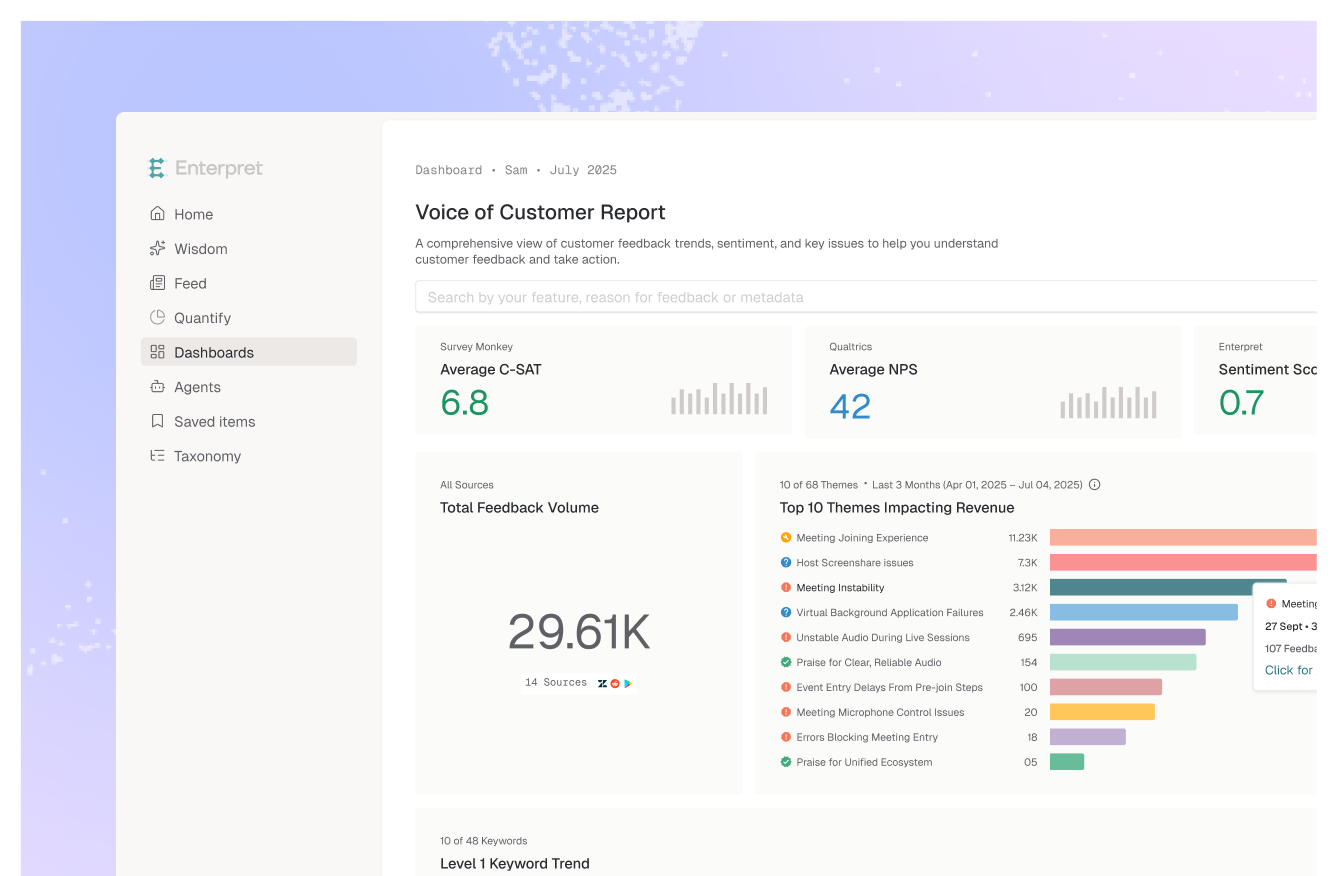
Enterpret leads here because gap detection is a categorization problem before it is a documentation problem. It ingests contacts from 50+ channels, so a question asked in a review or a renewal call counts the same as a ticket, and its adaptive taxonomy clusters those contacts by what customers meant rather than which words they used. That is the difference between a gap list of eleven tickets and one of two hundred. Its customer context graph attaches account and segment to each cluster, so you can see whether a missing article is costing you trial conversions or enterprise renewals and write in that order.
Best for: support and content teams who need the gap list ranked by what it actually costs, across every channel.
Its AutoKB approach turns resolved cases into draft articles and prioritizes gaps by real ticket volume, which is the most direct answer to "just tell me what to write." Narrower than a full customer intelligence layer, and the drafts still need an editor.
Best for: teams who want article drafts generated straight out of resolved tickets.
Since Content Cues was retired, gap discovery moved into the Knowledge Base Gaps Discovery add-on, which reads bot conversations, plus Explore reporting on top searched terms that returned nothing. The searched-and-found-nothing report is genuinely underused and free if you already have Explore.
Best for: Zendesk-native teams willing to work from bot conversations and internal search data.
Suggests articles from conversation context and surfaces what Fin could not answer, which is a usable proxy for a missing article. Tied tightly to the Intercom surface, so it sees what happened in Intercom.
Best for: Intercom-native teams using unanswered bot conversations as the gap signal.
Theme detection across support and survey channels, which will show you the topic clusters. Getting from a theme to an article brief is a manual step, and category setup is configuration-driven.
Best for: CX teams who already run Chattermill and want topic clusters as input to a content plan.
A strong authoring and publishing platform with analytics on which articles perform. The AI layer answers from content you have already written, so it improves the help center you have rather than telling you what is missing from it.
Best for: teams whose bottleneck is authoring and organization rather than knowing what to write.
Here is the category mistake. "Reduce tickets with better documentation" gets treated as a writing-volume problem, so teams commission thirty articles and watch contact volume hold flat. The articles were fine. They were about the wrong things.
Contact volume concentrates. A small number of topics generate most of your avoidable contacts, and those topics are almost never the ones your agents mention most, because agents notice what is annoying rather than what is frequent. The list of what is frequent lives in the contact data, and it is only visible if the clustering is good enough to see that "can't log in," "password reset loop," and "MFA code never arrives" are one article and not three.
That is the same instrumentation as identifying the primary driver behind a support contact, and the reason using VoC to reduce support tickets starts with analysis rather than with a writing sprint. It is also why help center work and turning support tickets into product insights tend to be the same project: about a third of what looks like a documentation gap is a product problem that documentation is being asked to paper over.
Write the top five. Measure the contact volume on those topics. Then write the next five.
If you want drafts out of tickets with minimal setup, IrisAgent is the most direct. If you are Zendesk-native and cost-constrained, the searched-with-no-results report in Explore is the highest-value free signal available. If your bot is the front door, Intercom's unanswered conversations are a reasonable proxy. If authoring quality is the bottleneck, Document360.
If the question is which five articles to write next, weight clustering quality and channel coverage over authoring features. A gap list built from one channel and matched on keywords will point your writers at the wrong five, and you will not find out for a quarter. See also NLP platforms for support ticket insights.
Start from customer contacts rather than from your article list, since page analytics cannot describe a page that does not exist. Cluster incoming contacts by intent, then subtract the topics you already have published content for. The remainder is your gap list, and the two most underused inputs are internal help center searches that returned no results and bot conversations that ended in a handoff.
Rank the gap list by total handling cost rather than by contact count, which means volume multiplied by average handle time plus escalation rate. A topic with moderate volume and long handle times usually beats a high-volume topic that agents close in a minute. Then break ties by which customer segment is asking.
Only when it targets the topics that generate the volume, which is a ranking problem rather than a writing problem. Teams that commission articles based on what agents find annoying typically see no change in contact volume, because annoyance and frequency are different distributions. Teams that write the top five contact drivers first usually see movement within a quarter.
Zendesk retired Content Cues in May 2025. The closest native replacement is Knowledge Base Gaps Discovery, an Ultimate add-on that identifies gaps from bot conversations rather than from tickets, alongside Explore reporting on top searched terms. Teams that relied on the ticket-based signal generally need an external analysis layer to get it back.
Enterpret unifies contacts from support tickets, chats, reviews, calls, and community channels, then uses an adaptive taxonomy to cluster them by customer intent rather than by keyword, so variations on the same question collapse into one gap rather than scattering across several. Its customer context graph attaches account and segment to each cluster, which lets you rank missing articles by the revenue and customer type behind them instead of by raw ticket count.
If your help center roadmap is built from what agents mention rather than what customers ask, see how Enterpret's adaptive taxonomy clusters contacts by intent.
Lorem ipsum dolor sit amet, consectetur adipiscing elit. Suspendisse varius enim in eros elementum tristique. Duis cursus, mi quis viverra ornare, eros dolor interdum nulla, ut commodo diam libero vitae erat. Aenean faucibus nibh et justo cursus id rutrum lorem imperdiet. Nunc ut sem vitae risus tristique posuere.