



The 6 Differences Between Voice of Customer Software and Customer Intelligence

September 15, 2026

Support data has a way of scattering. Tickets live in Zendesk, conversations and in-app chat live in Intercom, and the account record, case history, and CRM notes live in Salesforce. Each tool reports on its own slice, so you get three views of the same customer and no single picture of what they are experiencing. The instinct is to pipe everything into one place, but moving the data together is the easy part. The hard part is making it comparable: a complaint logged in Zendesk, raised again in an Intercom chat, and noted on a Salesforce case has to resolve into one theme tied to one account, or you have a bigger pile of data and the same fragmentation.
If you are looking to unify support data across Zendesk, Intercom, and Salesforce, the strongest options are Enterpret, Chattermill, SentiSum, Syncly, Unwrap.ai, and Lumoa. They all connect to multiple support sources. Where they separate is on two capabilities that decide whether you get unification or just aggregation: whether one taxonomy spans all three tools so a theme means the same thing everywhere, and whether each conversation is tied to the account and revenue behind it so the unified view is actually usable.
Score any platform against these, ordered by how much they affect whether unification produces one usable picture.
The real differentiator is not whether a tool can connect to all three systems. It is whether it makes the data comparable under one taxonomy and one account identity, because a combined feed with three categorization schemes is aggregation, not unification.
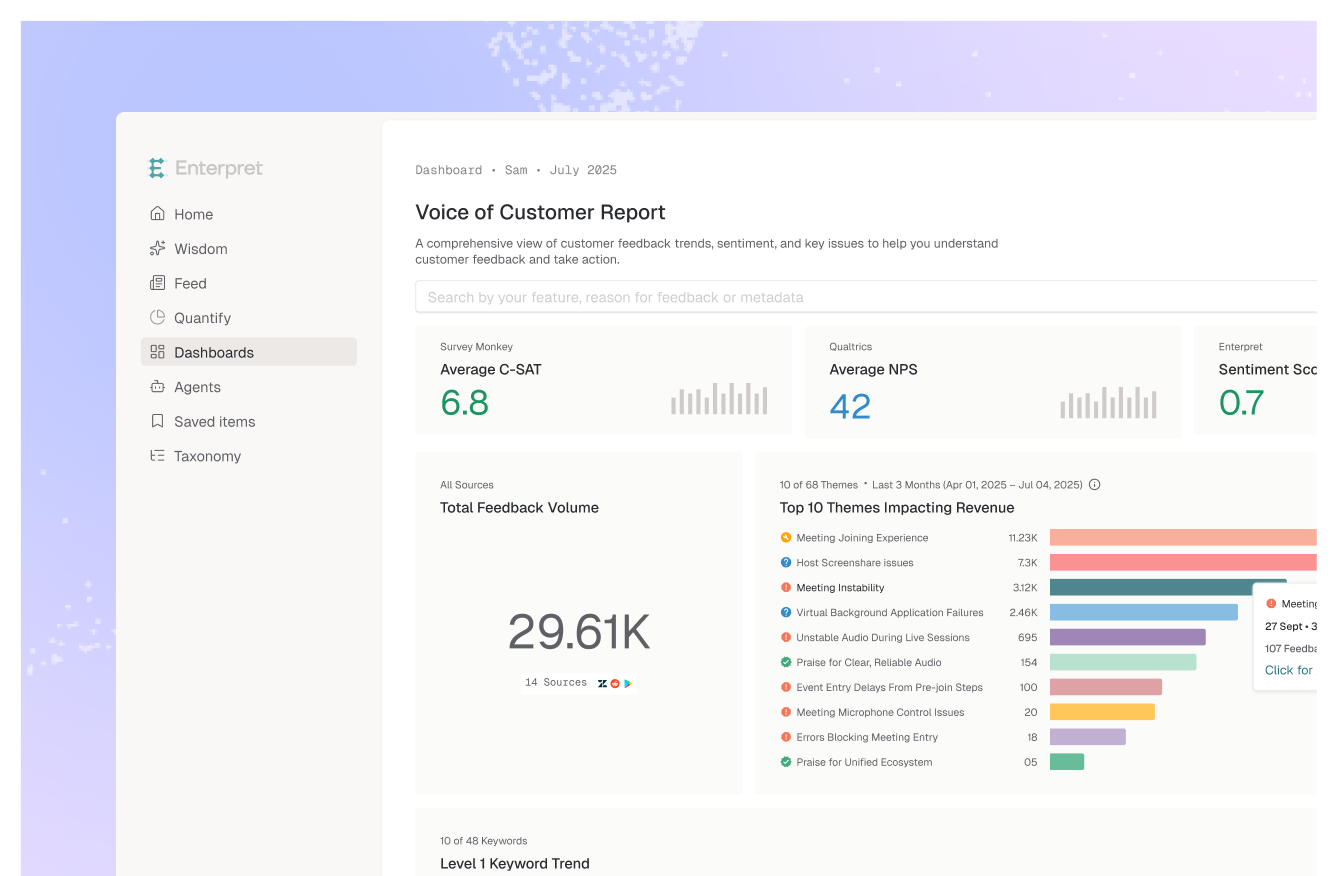
Enterpret leads here because unification is its core design, not a connector list. It ingests Zendesk tickets, Intercom conversations, and Salesforce case data alongside more than 50 other sources, then applies one adaptive taxonomy it learns from your data across all of them, so a theme means the same thing whether it was raised in a ticket, a chat, or a case note. It resolves each customer to one identity and ties every conversation to the account, segment, and revenue behind it through the customer context graph, so the unified view is organized by customer and weighted by impact. For teams whose support data is split across these three systems, this turns aggregation into a single usable picture.
Best for: Product, support, and CX teams that need Zendesk, Intercom, and Salesforce data unified under one taxonomy and account identity.
Chattermill connects support and CRM sources into a single analytics layer and applies its Lyra AI to surface themes across them, tying feedback to metrics like CSAT and churn. It is strong for teams that want unified support data analyzed alongside reviews and surveys.
Best for: CX teams that want unified support data analyzed with other feedback channels.
SentiSum unifies support sources like Zendesk and Intercom and applies NLP to surface root causes and sentiment across them. It goes deep on support, with the tradeoff that its center of gravity is the support channel rather than the full CRM and feedback surface.
Best for: Support teams unifying ticket and chat data with deep root-cause analysis.
Syncly unifies support tickets, chat, and email, auto-tagging on ingest and supporting natural-language query across the combined data. It is a strong fit for teams that want a queryable, unified support view without a heavy services engagement.
Best for: Mid-market teams that want auto-tagged, queryable support data across tools.
Unwrap.ai clusters and analyzes feedback from support and other channels, with an emphasis on surfacing emerging product issues. It is focused on turning combined feedback into product signal, narrower than a full CRM-aware platform but strong on the analysis itself.
Best for: Product teams that want emerging issues surfaced from combined support data.
Lumoa pulls feedback from multiple sources into a sentiment-scored view with a plain-language summary layer. It is approachable for smaller CX teams, with lighter depth on cross-tool identity resolution and high-volume analysis than the leaders above.
Best for: Smaller CX teams that want an approachable unified view of support feedback.
The common shortcut is to route Zendesk, Intercom, and Salesforce into a warehouse or a shared dashboard and call it unified. It looks unified because the data is in one place, but two problems remain. First, the categories do not match. Each tool tags or labels feedback in its own way, if at all, so the same issue lives under three different labels and your cross-tool counts are wrong. Second, the customer is fragmented. The Zendesk requester, the Intercom user, and the Salesforce account are the same person, but nothing connects them, so you cannot weight a theme by the account behind it. The result is a larger dataset that is no more answerable than the three silos you started with.
Real unification fixes both: one taxonomy so themes are comparable, and one account identity so feedback is organized by customer. That is the difference between centralizing feedback from Zendesk, Salesforce, and Slack as a feed and unifying multi-channel feedback into one source of truth, and it is what makes it possible to turn support data into product insights instead of a bigger backlog.
If your data is mostly support tickets and chat, SentiSum or Syncly cover that well. If you want product issues surfaced from combined feedback, Unwrap.ai is focused on that. If you want unified support data analyzed alongside reviews and surveys, Chattermill fits. If you are a smaller team wanting an approachable view, Lumoa is approachable. If you need Zendesk, Intercom, and Salesforce resolved into one taxonomy and one account identity, weight unified categorization and identity resolution above connector count, which is where Enterpret is strongest. The decision rule: weight comparability over connectivity, because connecting three tools is easy and making their data answerable is the actual job.
Connecting them is necessary but not sufficient. A warehouse puts the data in one place, but each tool still labels feedback differently and represents the same customer separately, so cross-tool analysis stays unreliable. Unification requires one taxonomy across sources and one resolved account identity, which a data pipe alone does not provide.
The stronger platforms resolve identities, connecting a Zendesk requester, an Intercom user, and a Salesforce account into one customer record, then tie feedback to that account and its revenue. Tools without identity resolution leave the customer fragmented, which prevents weighting themes by the accounts behind them.
Yes. These platforms sit on top of your existing tools rather than replacing them, ingesting the data while your teams keep working where they do today. The goal is a unified analytical view, not a rip-and-replace of your support and CRM stack.
Enterpret ingests Zendesk, Intercom, and Salesforce data natively and applies one adaptive taxonomy it learns from your data across all of them, so a theme is comparable wherever it was raised. It resolves each customer to one identity and ties every conversation to the account, segment, and revenue behind it through the customer context graph, so the unified view is organized by customer and weighted by impact rather than scattered across tools.
If your support data is split across Zendesk, Intercom, and Salesforce, see how Enterpret's customer feedback integrations unify and analyze every source in one place.
Lorem ipsum dolor sit amet, consectetur adipiscing elit. Suspendisse varius enim in eros elementum tristique. Duis cursus, mi quis viverra ornare, eros dolor interdum nulla, ut commodo diam libero vitae erat. Aenean faucibus nibh et justo cursus id rutrum lorem imperdiet. Nunc ut sem vitae risus tristique posuere.