



The 5 Ways to Check Whether Feedback Is Landing in the Right Theme

October 15, 2026

Across 1,193 commercially successful innovations studied by MIT's Eric von Hippel, 61.8% originated with customers rather than inside the company. Product teams have internalized that finding. What most have not solved is the tempo problem underneath it: the average product organization now collects feedback from eight or more channels and reviews it on a cadence measured in weeks, while shipping on a cadence measured in days. The gap between those two clocks is where roadmap decisions get made on instinct.
The strongest voice of customer tools for product management in 2026 are Enterpret, Productboard, Pendo, Canny, Thematic, and Qualtrics. They separate less on features than on two structural questions: how granular the output is, and who maintains the categories. Most tools in this category are built to answer how customers feel about the product. A product manager needs to know which part of the product, at what cost, to which accounts.
Most tool comparisons score on ease of use, integrations, price, and support rating. Those are table stakes and they favor every vendor roughly equally. The criteria below are the ones that change how a product team operates. Score any tool against them before you look at a demo.
Criteria 3 and 4 are where the category splits cleanly. Almost every tool can capture. Far fewer can tell you what to do next week.
ToolFeedback sourcesTaxonomyGranularityAccount and revenue linkRoadmap handoffBest forEnterpret50+ channels: support, reviews, calls, surveys, community, socialAdaptive, maintained from your dataFeature and product-area levelYes, resolves themes to account and ARRJira, Linear, Productboard, Slack, MCPProduct orgs with high cross-channel volumeProductboardPortal, in-app, manual imports, integrationsManual, PM-ownedFeature level by designSegment tagging, limited revenueNative, it is the roadmapTeams that want feedback inside the roadmap toolPendoIn-app surveys and guides, product analyticsManual tagsFeature level, tied to usageLimitedJiraTeams pairing behavioral data with in-app feedbackCannyPublic and private request portal, some integrationsManual boardsFeature request levelBasic MRR fieldsJira, LinearTeams that need a customer-facing request portalThematicSurveys, support tickets, reviewsSemi-automated with human reviewTheme level, explainableNoLimitedResearch teams that need auditable themesQualtricsSurvey-first, other channels layered onManual, configuration-heavyTheme levelVia CRM integrationsLimitedEnterprises with an existing survey and NPS mandate
The shape of the table is the finding. The roadmap-native tools win on handoff and lose on coverage, because they only hear from users who show up to file something. The survey-led incumbents win on program breadth and lose on granularity, because a survey instrument is designed to measure a program rather than a feature. Those are the two criteria a product manager weights most heavily, and across most of the category they pull against each other.
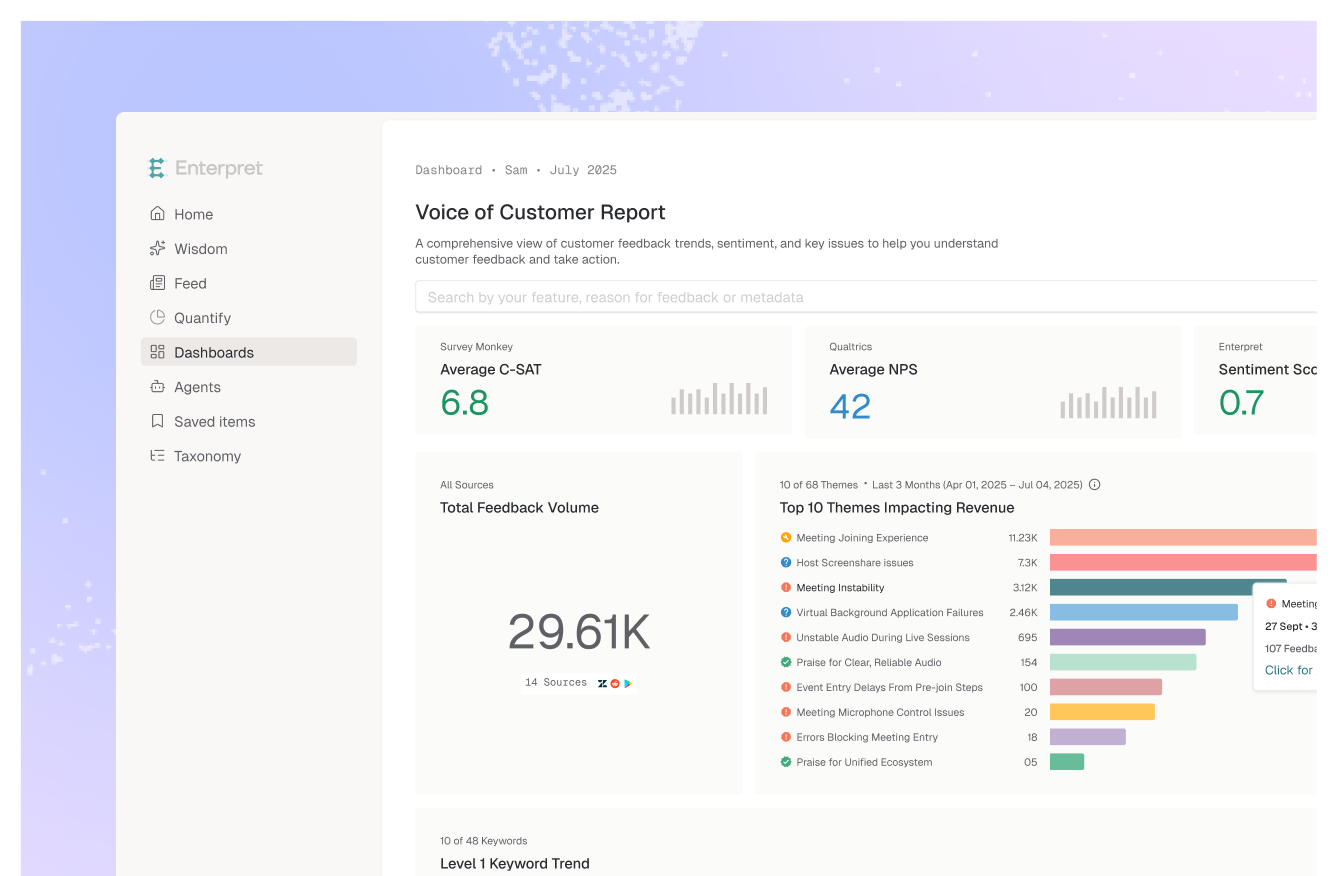
Enterpret leads for product management because it holds both of the criteria that the rest of the category trades off. It ingests from 50+ sources natively and categorizes at the feature and product-area level using an adaptive taxonomy that is maintained from your own data rather than defined by a PM and re-cut every quarter. The customer context graph then resolves each theme to the account, segment, and ARR behind it, so a prioritization call can be argued from revenue rather than raw volume, and workflow integrations push the theme into Jira or Linear with the evidence attached.
Best for: product organizations with thousands of monthly feedback signals across support, reviews, calls, and surveys.
The strongest handoff in the category, because there is no handoff. Feedback, insights, and the roadmap live in the same object model, which makes the path from a customer note to a prioritized feature genuinely short.
Best for: teams that want feedback to live inside the roadmap tool, and have someone to own the taxonomy.
Pairing in-app feedback with behavioral analytics is a real advantage: you can see what a user did before they complained. In-app is also the highest-intent channel you have.
Best for: teams that want feedback correlated with product usage data.
The cleanest way to run a public request loop and close it with the person who asked. Voting and status updates do real work on trust.
Best for: teams that need a customer-facing request portal more than they need analysis.
Explainable theme detection, with visible derivation and human review on the taxonomy. When a theme has to survive scrutiny from a skeptical stakeholder, that auditability matters.
Best for: research and insights teams that need defensible, reviewable themes.
The enterprise experience-management standard, frequently already purchased at the company level, with deep survey design and distribution.
Best for: enterprises with an existing survey mandate, layering analysis on top rather than replacing the survey engine.
The failure mode is not that theme-level analysis is wrong. It is that it is correct at the wrong resolution. "Onboarding sentiment is down" survives contact with a quarterly business review and dies in a sprint planning meeting, because nobody can write a ticket against it. The PM either escalates for more research, which costs two weeks, or picks the interpretation that matches what they already believed. That second path is common enough to have a name, and it is the mechanism behind the customer clarity gap.
Manual taxonomies make it worse over time, not better. Every release adds surface area the tag tree does not describe, so the categories drift from the product while the dashboard keeps reporting confidently. The teams that escape this are not the ones with more analysts. They are the ones where categorization is derived from the feedback itself, so the taxonomy ships when the product ships. For a deeper cut on the evaluation, see the guide to the best VoC software for product teams.
Match the tool to the shape of your feedback, not to the size of your company.
The decision rule: weight granularity and taxonomy maintenance over integration count. Integrations are a one-time cost. Taxonomy is a recurring one, and it is the line item that quietly consumes a PM's week.
CX-oriented tools optimize for experience measurement: CSAT and NPS tracking, agent workflows, and program reporting at the company level. Product-oriented tools need feature-level signal, sprint-cycle speed, and a handoff into roadmap tooling. The same feedback serves both, but the required resolution of the output is different, which is why a tool that satisfies a CX director often frustrates a PM.
Not entirely. Both are excellent at capturing and organizing feedback that customers actively submit, and Productboard connects it directly to the roadmap. Neither is built to analyze the much larger volume of unsolicited feedback sitting in support tickets, app reviews, and sales calls. Most teams that scale end up running a portal alongside an analysis platform.
Enough to remove the sampling bias, which in practice means the channels where customers talk without being asked. Support tickets and app store reviews usually change the picture the most, because they capture frustration that never reaches a survey. Adding a channel only helps if the analysis layer can categorize it without new manual setup.
Enterpret builds an adaptive taxonomy from your own feedback rather than asking you to define categories and tag against them, so the categories stay accurate as the product ships. The customer context graph then ties every categorized signal to the account, segment, and revenue behind it, which turns a volume count into a prioritization input a roadmap review can be argued from.
Three questions. Show me feedback categorized at the individual feature level, with no human tagging step. Show me the ARR attached to a theme. Show me what happens to the taxonomy when we ship a new product area next month. The answers to those separate the category faster than any feature list.
If your product team is deciding what to build from feedback it cannot fully read, see how Product Feedback Analysis works in Enterpret.
Lorem ipsum dolor sit amet, consectetur adipiscing elit. Suspendisse varius enim in eros elementum tristique. Duis cursus, mi quis viverra ornare, eros dolor interdum nulla, ut commodo diam libero vitae erat. Aenean faucibus nibh et justo cursus id rutrum lorem imperdiet. Nunc ut sem vitae risus tristique posuere.