



The 6 Differences Between Voice of Customer Software and Customer Intelligence

September 15, 2026

Search for an escalation template and you will find escalation paths, escalation matrices, and escalation emails. Tiers, severity definitions, on-call rotations, who to notify at hour four. All of it is about routing. Almost none of it is about the thing that actually lands in the channel.
That is a category mistake worth naming. An escalation path is not an escalation alert. A path decides who gets told. An alert has to make that person able to act, and most alerts fail at exactly that. A customer escalation alert needs six elements: the customer's verbatim words, the account's identity and weight, the reason it tripped, whether it is isolated or systemic, a link to the source record, and a named owner with a next-update time. Miss any of them and you have sent a notification that requires research before it becomes work.
Watch what happens when an underspecified alert lands. "Escalation: Acme Corp, high priority." The person on call opens the help desk. Then the CRM, to remember who Acme is. Then Slack search, to see whether anyone has already picked it up. Then the ticket itself, to find out what the customer actually said. Four tabs before the first useful thought.
That latency is not a tooling inconvenience. It is the entire cost of the escalation process, and it is paid on every alert. Teams respond by tuning thresholds up, which means fewer alerts and more missed ones, and the fix is almost always in the payload rather than the threshold.
Not a summary. Not a sentiment label. The actual sentence the customer wrote, quoted, with the speaker and channel attached. Summaries strip the thing that makes people act, which is tone. "Customer expressed dissatisfaction with onboarding" and the sentence the customer actually typed are not the same alert, and only one of them gets picked up in under a minute.
Account name, plan or tier, ARR, renewal date, and owner. Renewal date matters more than most teams put in the payload: the same complaint 11 months from renewal and 3 weeks from it calls for different people. If the account has escalated before, say so and say when.
The explicit trigger. Sentiment threshold, SLA breach, keyword match, repeat contact, a named VIP rule. Alerts that do not state their own reason train recipients to distrust the system, because the first question anyone asks about an alert they disagree with is why it fired. Stating the rule also makes the rule tunable, since you learn which triggers produce noise.
One line: how many other accounts raised this theme in the last 7, 14, or 30 days, and whether that count is rising. This is the element that changes who needs to see the alert. An isolated escalation goes to the account owner. A pattern goes to product and possibly to incident response. Without this line every escalation looks isolated by default, which is how systemic problems get handled one account at a time for a quarter.
Deep link to the actual ticket, call, or review, not to a dashboard. The link is how the alert stays verifiable. An alert nobody can audit becomes an alert nobody trusts, and one wrong claim in a Slack channel costs more credibility than ten correct ones earn.
The most-skipped element and the one that determines whether anything happens. Not a channel, a person. Not "a follow-up is coming," a time. Alerts posted to a group with no name attached produce the diffusion of responsibility that every escalation post-mortem eventually names. See the five stages of closing the customer feedback loop.
Here is the uncomfortable part. Every escalation process assumes the escalation was flagged. Most flagging depends on a customer using escalation language, an agent recognizing it, or a threshold being crossed in a system that only sees one channel.
The escalations that actually hurt do not look like escalations. They are calm. A quiet note in a Gong call about evaluating alternatives. A third ticket on the same topic, politely worded, from an account whose usage has been sliding. A community post the support team never sees because nobody routes community into the help desk. By the time any of these trips a severity rule, the decision has usually been made. See feedback signals that indicate churn risk and catching emerging issues before they reach leadership.
Which is why the payload and the detection are the same design problem. An alert that carries pattern context and account weight is only possible if the system generating it can see every channel and hold the history. Improving your alert template on top of single-channel detection makes better-formatted alerts about the wrong events.
Write the payload first, then the rules. Draft the exact message you want in the channel, with all six elements filled in for a real past escalation, and show it to the person who would receive it. If they can say what they would do next without opening anything, the template works.
Then tune triggers against that payload. Start narrow, because a noisy channel gets muted in a week and a muted channel is worse than no channel. Route by element four: isolated escalations to the account owner, patterns to a product channel. Connect it to where the work happens through workflow integrations so the alert can become a ticket without a copy and paste.
The decision rule: if the recipient has to open a second tab to know what to do, the alert is incomplete, not the process.
The customer's verbatim words, the account with its tier and revenue and renewal date, the reason the alert triggered, whether the issue is isolated or part of a pattern, a deep link to the source record, and a named owner with a next-update time.
An escalation matrix is a policy document defining severity levels, tiers, response times, and who gets involved at each stage. An escalation alert is the individual notification that fires when something trips those rules. Most published templates cover the matrix; the alert payload is what determines whether anyone acts quickly.
Tune for precision over coverage at the start, state the trigger inside every alert so bad rules are visible and fixable, and route by scope so that pattern-level escalations do not flood the channel meant for individual accounts. Channels that fire constantly get muted, and a muted channel is worse than no alerting at all.
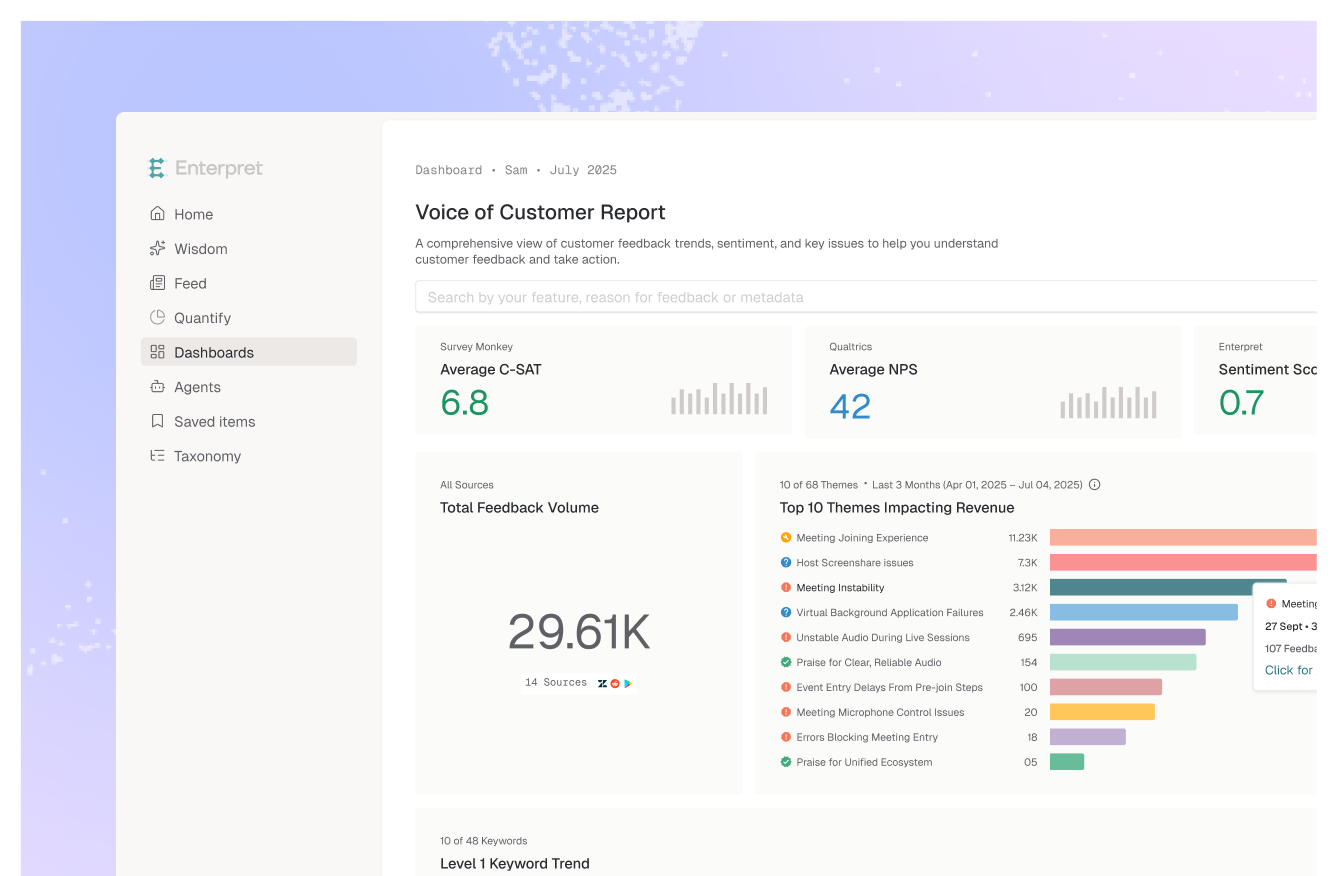
Enterpret ingests feedback across support tickets, calls, reviews, surveys, and community channels, categorizes it with an adaptive taxonomy, and can flag escalations based on sentiment, theme, or account signals rather than escalation keywords alone. The customer context graph attaches the account, revenue, and history to the alert, and the taxonomy supplies the isolated-or-systemic line. Alerts can be delivered to Slack with the verbatim quote, the reason, and a link to the source record.
Post to a channel for visibility and name a person in the message for ownership. Channel-only alerts produce diffusion of responsibility, where everyone assumes someone else has it. The named owner and the next-update time are what convert a notification into a commitment.
If your escalations are being detected too late, see how Enterpret handles close the loop workflows.
Lorem ipsum dolor sit amet, consectetur adipiscing elit. Suspendisse varius enim in eros elementum tristique. Duis cursus, mi quis viverra ornare, eros dolor interdum nulla, ut commodo diam libero vitae erat. Aenean faucibus nibh et justo cursus id rutrum lorem imperdiet. Nunc ut sem vitae risus tristique posuere.