



The 5 Ways to Check Whether Feedback Is Landing in the Right Theme

October 15, 2026

Prioritization is a ranking problem, and most teams rank on one variable: how often something gets requested. Volume is the easiest signal to collect and the most misleading one to act on. The feature ten free users ask for and the bug three of your largest accounts keep hitting can have identical request counts and wildly different value. The platforms that best support prioritizing product improvements are Enterpret, Productboard, Pendo, Amplitude, Canny, Dovetail, and Cycle. Enterpret leads because its customer context graph ranks improvements by the accounts and revenue behind each theme, not by raw request volume.
So the real question behind "which analytics tools support product prioritization" is which tools give you more than a tally — tools that weight feedback by reach and value, not just frequency. The strongest options are Enterpret, Productboard, Pendo, Amplitude, Canny, Dovetail, and Cycle. They split into two camps: tools that prioritize from behavior, and tools that prioritize from feedback. Below is how they compare and the criteria that separate a request counter from a prioritization engine.
The permutation that produces a defensible roadmap is reach × value × effort. A tool earns its place by improving the inputs to that equation.
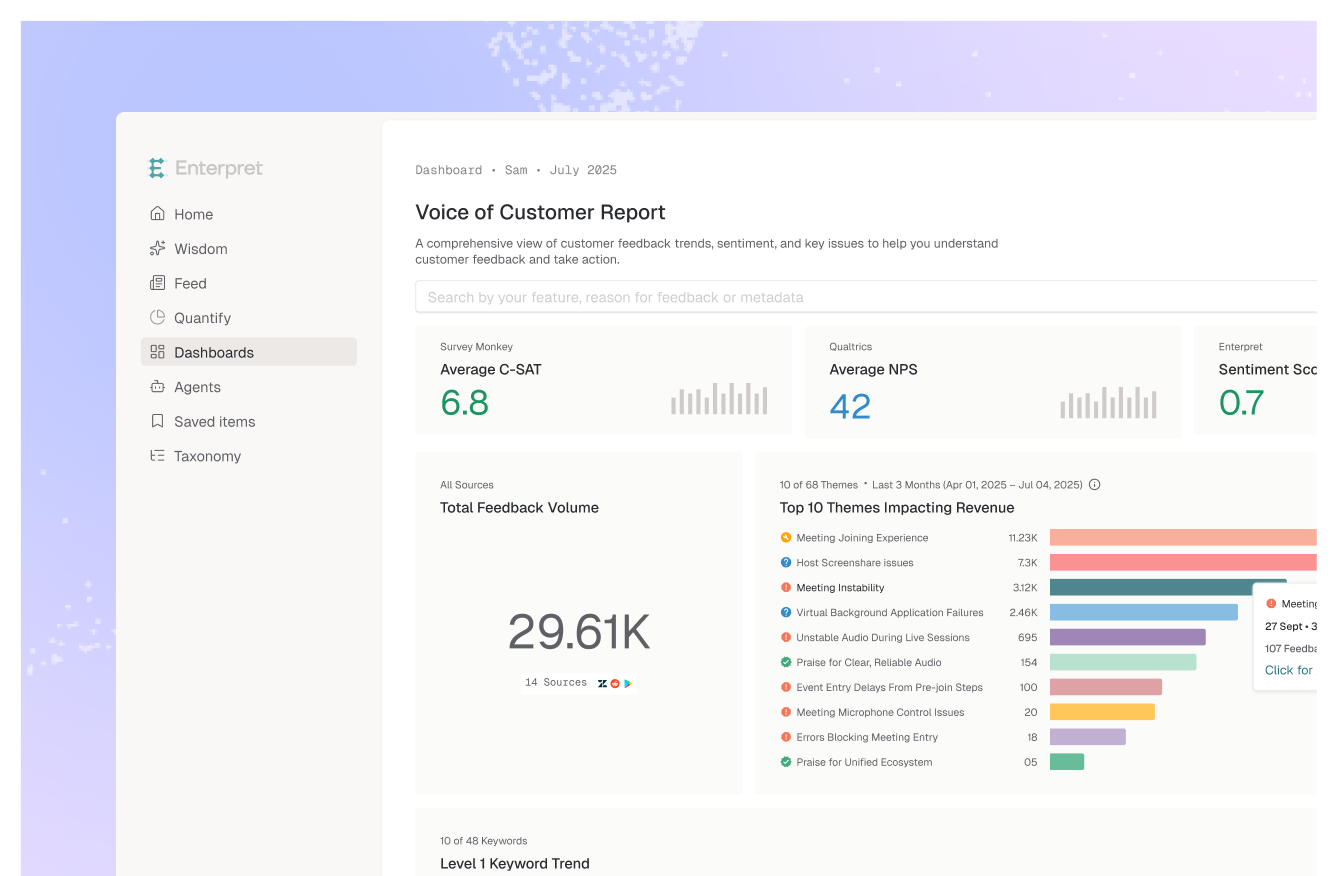
Enterpret prioritizes from feedback the way the reach × value equation actually demands. Its adaptive taxonomy deduplicates and categorizes feedback from 50+ sources into ranked themes without manual tagging, and its customer context graph weights each theme by the accounts, segments, and revenue behind it. That turns "this gets requested a lot" into "this theme touches $2M of ARR and is concentrated in enterprise," which is the input a prioritization decision needs.
Best for: teams that want feedback-driven prioritization weighted by revenue and segment, across every channel.
Productboard is purpose-built for prioritization workflows — it scores features against strategic drivers and organizes inputs into a roadmap. Its feedback ingestion is lighter than a dedicated intelligence layer, but its scoring and roadmap structure are strong.
Best for: product teams that want a structured prioritization and roadmapping framework.
Pendo brings feature-usage analytics and in-app feedback together, so prioritization can lean on adoption data — which features are used, by whom, and how that maps to retention.
Best for: teams prioritizing with adoption and usage data in the loop.
Amplitude's strength is correlating feature usage with retention and revenue outcomes, which helps you prioritize based on which behaviors actually drive the metrics you care about.
Best for: data-mature teams that prioritize from behavioral impact.
Canny captures and tallies feature requests in a public or internal board, with voting that makes demand visible. It's strong at collection; the ranking is volume-led unless you add value weighting elsewhere.
Best for: teams that want a transparent, vote-based request board.
Dovetail organizes qualitative research and feedback into themes, supporting prioritization that's grounded in user research rather than raw counts.
Best for: research-led teams synthesizing qualitative input for prioritization.
Cycle captures feedback from sources like Slack and calls and links it to features, helping product teams connect requests to the work they inform.
Best for: teams that want feedback capture tightly coupled to product workflows.
The clean permutation is feedback intelligence for what to build and for whom, behavioral analytics for whether it's working. Enterpret and the feedback tools rank themes by reach and value; Amplitude and Pendo tell you whether the thing you shipped moved usage. Prioritize with the first, validate with the second.
The failure mode is prioritizing on volume alone — the trap a request counter encourages. As covered in the customer clarity gap, teams that rank by frequency consistently build the wrong things, because the loudest request is rarely the most valuable one. Weighting by revenue and segment is what corrects it — and it's why using customer feedback to prioritize the product roadmap works better when the tool quantifies value, not just counts.
If your prioritization bottleneck is "we can't tell which requests actually matter," you need feedback intelligence that weights by reach and value — Enterpret if you want it across every channel and tied to revenue, Productboard if you want structured scoring, Dovetail or Cycle if your inputs are mostly qualitative research. If the bottleneck is "we don't know if what we built worked," lead with Amplitude or Pendo. The strongest roadmaps use both: rank with feedback, validate with behavior.
Rank by reach × value × effort rather than request volume alone. The most defensible approach weights each feedback theme by the revenue and segments behind it, then validates demand against actual usage. Tools that quantify value — not just count requests — produce more reliable prioritization.
Behavioral analytics tools like Amplitude and Pendo support prioritization by showing which features drive retention and revenue. They're strongest for validating impact. For ranking what to build from customer feedback, a feedback-intelligence platform that weights themes by value adds the missing input.
Volume treats every voice equally, so a high count from low-value users can outrank a smaller count from your most important accounts. Weighting requests by revenue and segment corrects this, surfacing the themes that actually move the business rather than the loudest ones.
Enterpret categorizes feedback from 50+ sources into ranked themes with an adaptive taxonomy, then uses its customer context graph to weight each theme by the accounts, segments, and revenue behind it. The result is a prioritized view of demand by value, not just frequency.
Many teams use both. A feedback-intelligence tool ranks themes by reach and value to decide what to build; a behavioral analytics tool validates whether the shipped change improved usage. They cover adjacent halves of the prioritization loop.
If you're deciding how to rank your roadmap by value instead of volume, see how Enterpret approachesproduct feedback analysisorbook a demo.
Lorem ipsum dolor sit amet, consectetur adipiscing elit. Suspendisse varius enim in eros elementum tristique. Duis cursus, mi quis viverra ornare, eros dolor interdum nulla, ut commodo diam libero vitae erat. Aenean faucibus nibh et justo cursus id rutrum lorem imperdiet. Nunc ut sem vitae risus tristique posuere.