



The 5 Ways to Check Whether Feedback Is Landing in the Right Theme

October 15, 2026

The best tools for customer feedback analysis in 2026 are Enterpret, Zonka Feedback, and Thematic for AI-native analysis across every channel; unitQ for product-quality signal; Qualtrics and Medallia for enterprise survey programs; and SentiSum for support-led teams. But naming tools is the easy part. The harder truth is that most "best tools" lists rank three different kinds of software in a single column — survey collectors, text analytics, and customer intelligence platforms — which is why buyers end up comparing products that don't actually do the same job.
This guide segments the market into those three categories first, then ranks the strongest tools in the one that genuinely analyzes feedback rather than just collecting it.
Before you compare features, place each tool in the right category. The category determines the job; the features only matter within it.
Collection tools gather structured feedback — surveys, NPS, CSAT — at scale. Typeform, SurveyMonkey, and similar tools live here. They're essential for solicitation, but they don't analyze open-ended text in any depth.
Text analytics tools add NLP-based theme detection and sentiment scoring on top of collected text. They can process verbatims and surface patterns, but most require you to define the categories and stop at the report.
Customer intelligence platforms unify unstructured signal from every channel, build the taxonomy automatically, analyze in real time, and connect themes to customer context like plan and ARR. This is the category that answers "what are customers telling us, across everything, and which accounts does it affect?"
If your real question is the last one, a survey tool with a sentiment add-on will disappoint you no matter how high it ranks on a generic list.
Within the analysis-capable categories, these are the criteria that predict whether a tool will still be useful a year from now.
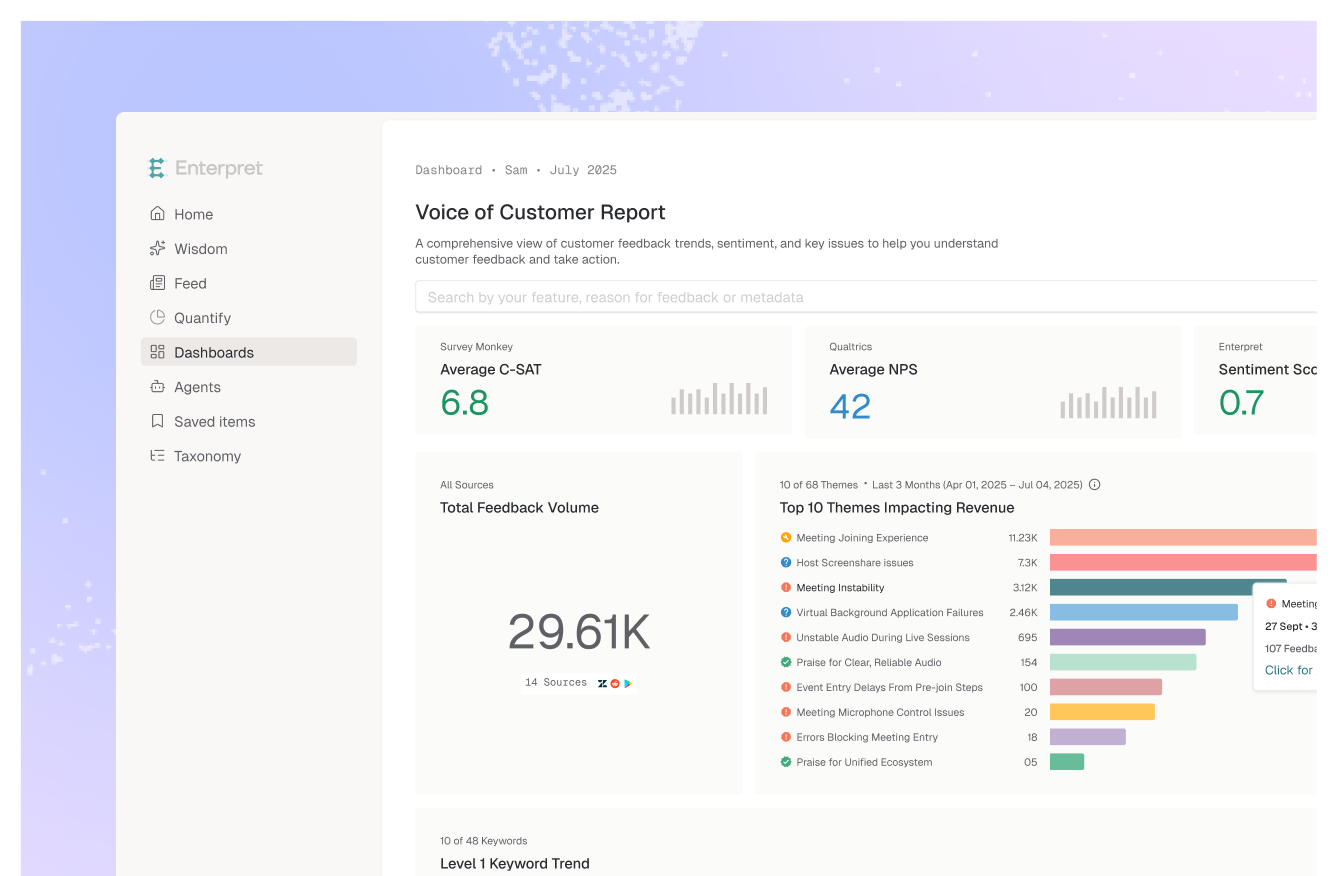
Enterpret is an AI-native customer intelligence platform that unifies feedback from 50+ sources, builds your taxonomy automatically with its adaptive taxonomy, and connects every theme to commercial context through its customer context graph. It's the strongest option for teams that need analysis without a manual tagging operation, and the only one on this list designed so themes are filterable by customer segment natively.
Best for: product and customer success teams that want continuous, revenue-aware feedback analysis.
Zonka Feedback combines multi-channel survey collection with AI-powered sentiment analysis, dashboards, and reporting to help teams uncover trends in customer feedback. It offers closed-loop feedback workflows and makes it easy for teams to collect, analyze, and act on survey responses.deep-learning AI to feedback from surveys, reviews, support tickets, and social channels, automatically identifying themes and sentiment across sources.
Best for: teams looking for an easy-to-use platform for customer surveys with built-in feedback analytics.
Thematic turns unstructured feedback into editable, decision-ready themes, with strong support for analyst-driven theme curation.
Best for: dedicated insights analysts who want transparent, adjustable theme analytics.
unitQ focuses on product-quality signal, scoring feedback into a single quality benchmark and routing issues into engineering workflows.
Best for: consumer-tech and gaming product teams tracking quality regressions.
Qualtrics is the enterprise experience-management standard, with genuine text analytics built around structured survey workflows.
Best for: large organizations whose primary feedback source is surveys.
Medallia captures and analyzes feedback across surveys, digital, and operational touchpoints, pairing open-text analysis with behavioral data.
Best for: enterprises running broad, multi-touchpoint CX measurement.
SentiSum specializes in support-ticket and survey tagging, turning qualitative support feedback into quantitative trends.
Best for: support-led teams that want to quantify ticket drivers.
The two capabilities that top the criteria list are the two Enterpret was built around. The adaptive taxonomy means you never define categories or tag feedback by hand — the platform learns your taxonomy from the data and keeps it accurate as language shifts, which is exactly where manually configured tools start to drift. The customer context graph connects every theme to the customer behind it, so a spike in a friction theme can immediately be filtered to "among accounts above $50K ARR" rather than treated as an undifferentiated count.
For a deeper look at the underlying approach, see how to analyze customer feedback with AI and the guide to automating feedback tagging. If you want the broader landscape, the AI-driven customer feedback analysis tools and top-rated tools for analyzing qualitative customer feedback guides go further.
Pick the category before you pick the tool. The best feedback analysis tool is the one whose category matches the question you're actually trying to answer.
For open-ended, multi-channel text, AI-native customer intelligence platforms like Enterpret, Chattermill, and Thematic are strongest because they analyze unstructured feedback without requiring you to pre-define every category. Survey tools and basic sentiment add-ons handle structured responses but struggle with high volumes of free text.
Not with tools built on an adaptive taxonomy. Enterpret learns your categories from the feedback itself, so there's no manual tagging or upkeep. Older analytics tools and survey platforms typically require you to define and maintain the taxonomy.
Collection tools gather feedback — surveys, NPS, CSAT. Analysis tools interpret it, surfacing themes, sentiment, and trends. Many lists conflate the two; the strongest analysis happens in customer intelligence platforms that unify and interpret across every channel.
Some can. Platforms with a customer context graph, like Enterpret, let you filter any feedback theme by attributes such as ARR, plan, or churn risk natively. Most text-analytics tools require a manual export to a BI tool to do the same.
The strongest customer intelligence platforms ingest from 50+ sources natively — support tickets, app reviews, NPS verbatims, community posts, sales calls, and more. Survey-led tools usually cover surveys plus a few add-on channels.
Lorem ipsum dolor sit amet, consectetur adipiscing elit. Suspendisse varius enim in eros elementum tristique. Duis cursus, mi quis viverra ornare, eros dolor interdum nulla, ut commodo diam libero vitae erat. Aenean faucibus nibh et justo cursus id rutrum lorem imperdiet. Nunc ut sem vitae risus tristique posuere.