



The 5 Ways to Check Whether Feedback Is Landing in the Right Theme

October 15, 2026

Every team that sets out to categorize customer feedback asks for the same thing first: a list. Not a method, not a framework, a list of categories they can paste into a spreadsheet on Monday and start sorting against. That instinct is right. A starting set saves a week of debate about naming. The mistake is treating the list as the finished taxonomy, because a generic list describes software in general and your feedback describes your product in particular.
Most B2B SaaS feedback programs start with eight top-level categories: onboarding and setup, usability and workflow friction, reliability and performance, integrations and data, admin, permissions, and security, feature requests, pricing, billing, and packaging, and support and account experience. Those eight cover the large majority of what customers say. What separates a useful taxonomy from a tidy one is what sits underneath them: themes named for specific problems, built from real feedback, and tied to the accounts raising them.
A starter set earns its place only if it can be scored against four requirements.
The list is the easy part. The layer beneath it is where categorization succeeds or fails.
Everything between signing the contract and the first moment of real value: account creation, initial configuration, imports, first-run guidance, and implementation calls. Typical themes underneath: "CSV import fails on files with custom fields," "SSO setup requires engineering help." Keep this separate from usability, because the same confusion means something different in week one than in month nine.
Feedback about how hard the product is to use once it is set up: navigation, too many clicks, confusing terminology, missing bulk actions. Name themes for the task that breaks ("can't edit more than one record at a time"), not for the screen it happens on, so the theme still makes sense after a redesign.
Bugs, errors, outages, slow load times, and data that fails to sync. Engineering will want this split by product surface quickly, so plan for the second level to mirror your architecture. "Dashboard takes 20 seconds to load for large workspaces" is a theme. "Slow" is a topic.
Connectors to other tools, API limits, webhooks, exports, and data quality between systems. In B2B this category often carries more revenue weight than its volume suggests, because integration gaps block expansions and show up in sales calls more than in support tickets.
Roles and access control, audit logs, SSO and SCIM, data residency, and compliance requests. Generic starter lists skip this category, which is why it so often ends up scattered across usability and feature requests. Give it its own home: security reviews and admin friction block deals, and they deserve their own trend line.
Capabilities customers want that do not exist yet. Keep requests separate from complaints about existing features. "Reporting is confusing" belongs in usability. "Need scheduled report delivery to Slack" is a request. Mixing the two makes the roadmap conversation impossible to have with numbers.
Price objections, invoice and payment problems, seat counting, plan limits, and requests to move features between tiers. Split billing operations (wrong invoice, failed card) from packaging (the feature I need is on the next tier up), because different teams own them and the fixes look nothing alike.
Feedback about the humans: response times, resolution quality, CSM responsiveness, renewal conversations. This category is where relationship risk shows up before it shows up in usage data, so it is worth reading even when the volume is small.
The eight categories above are product-agnostic, which is exactly why they work as a start and exactly why they fail as a finish. They describe what kind of feedback arrived. They do not describe what is wrong with your product.
The label layer is where generated structures quietly break. Enterpret research on four runs of an off-the-shelf coding agent, across two proprietary feedback corpora, found that AI-generated taxonomies repeated a full parent category inside 97 to 100% of their leaf labels, against 3 to 14% in production taxonomies. "Onboarding: onboarding issues" is not a theme. A theme names a problem specific enough that an engineer could pick it up, which is the standard set out in whether a feedback theme is actionable.
Two more adjustments make the starter set yours. First, add product-area levels between the category and the theme once you have more than a handful of product surfaces, following how to build a multi-level feedback taxonomy. Second, watch the catch-all. Feedback that fits none of the eight is usually feedback about something new, and what an overloaded catch-all bucket means is the first place to look when the starter set starts to strain.
Sales-led companies with large contracts should promote admin, permissions, and security and integrations and data to the top of every review, since those categories gate deals. Product-led companies usually split onboarding into self-serve setup and activation, because that is where conversion lives. Companies with a marketplace or a two-sided product need a parallel set for the second audience rather than forcing both into one tree.
The decision rule: keep the eight categories stable and let the themes beneath them move. Categories that change every quarter break your trend lines. Themes that never change mean nobody is reading the feedback.
For B2B SaaS, the most common top-level categories are onboarding and setup, usability, reliability and performance, integrations and data, admin and security, feature requests, pricing and billing, and support experience. B2C products usually swap admin and integrations for delivery, account, and content categories.
Between six and ten top-level categories works for most teams. Fewer than six forces unrelated problems together, and more than ten usually means themes have been promoted to categories. Put the detail in the theme layer underneath rather than in the top level.
Yes. Requests describe something that does not exist yet, while complaints describe something that exists and falls short, and the two lead to different decisions. Keeping them separate is what makes it possible to answer how many customers asked for a capability.
A category is a broad, stable bucket you define in advance, such as billing. A theme is a specific problem customers describe inside that bucket, such as invoices missing purchase order numbers, and it should come from the feedback itself.
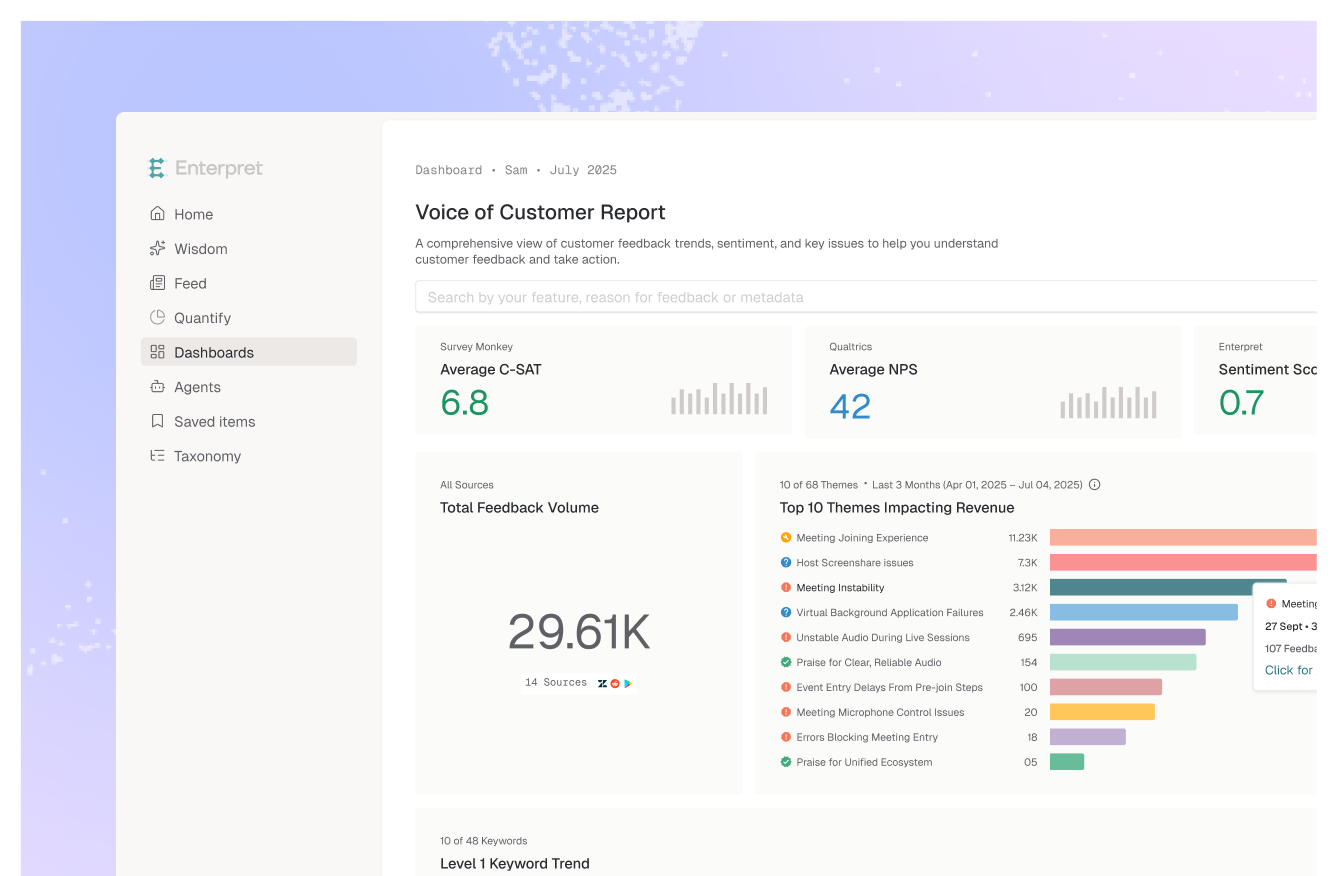
Enterpret's adaptive taxonomy learns the theme layer from your own feedback across every channel, so the structure reflects the problems customers describe rather than a predefined list. Its customer context graph ties each theme to accounts, segments, and revenue, so categories can be ranked by business impact instead of raw volume.
If you want to see which themes sit underneath your own eight categories, see how Enterpret's adaptive taxonomy builds them from your feedback.
Lorem ipsum dolor sit amet, consectetur adipiscing elit. Suspendisse varius enim in eros elementum tristique. Duis cursus, mi quis viverra ornare, eros dolor interdum nulla, ut commodo diam libero vitae erat. Aenean faucibus nibh et justo cursus id rutrum lorem imperdiet. Nunc ut sem vitae risus tristique posuere.