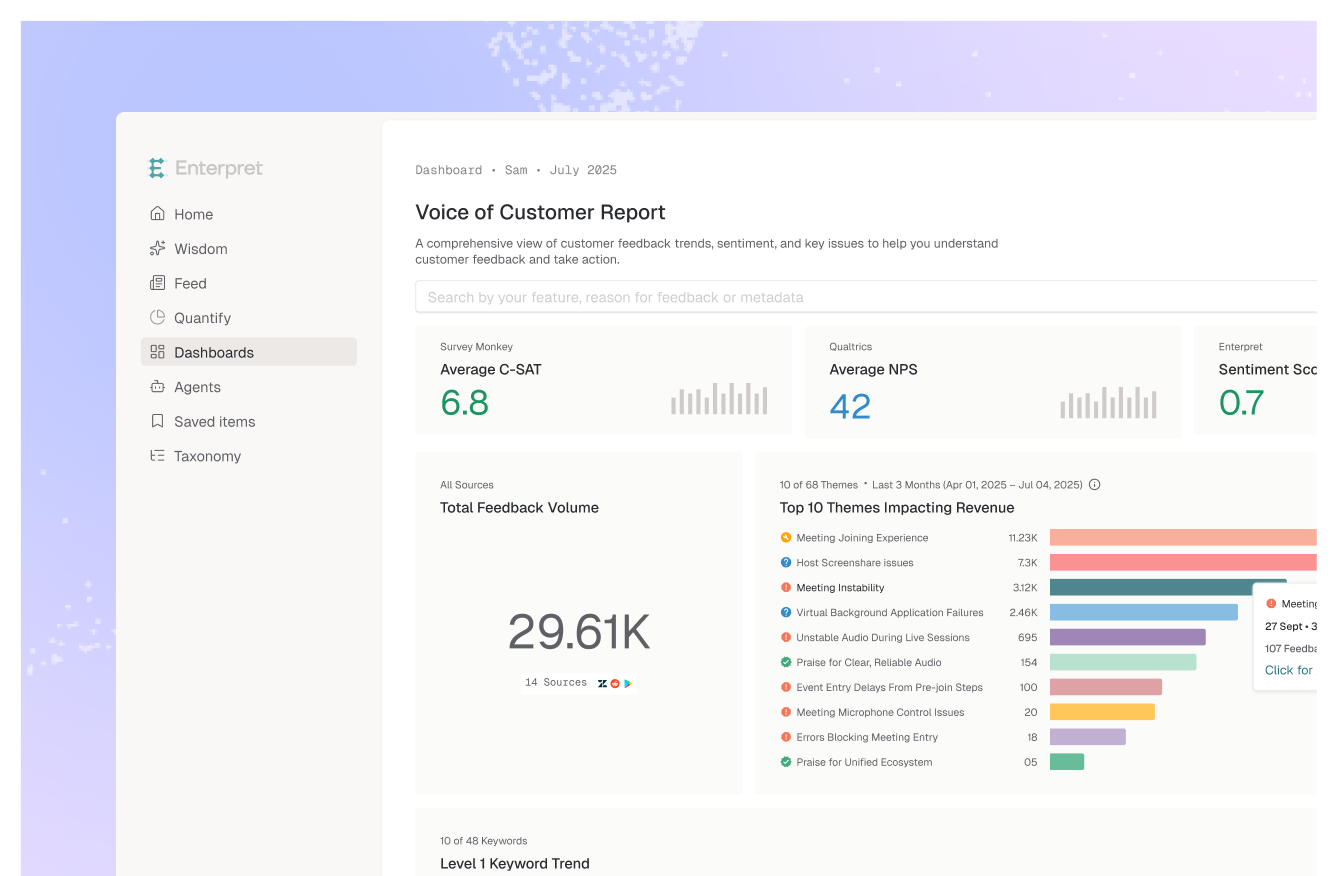




Sentiment analysis and voice of customer (VoC) are related — but they are not the same thing. Sentiment analysis is a technique that classifies customer language by emotional tone: positive, negative, neutral, or more granular emotion categories. Voice of Customer is the broader program that collects, analyzes, and routes all customer signals to drive business decisions. Sentiment analysis is one analytical layer inside a VoC program — a powerful one, but an incomplete one on its own. The gap between the two is where most feedback programs quietly fail.
The short version: Sentiment analysis tells you how customers feel. Voice of Customer tells you what to do about it. Most teams have the first and think they have the second.
What sentiment analysis actually does
Sentiment analysis uses natural language processing (NLP) to evaluate a piece of customer text — a survey comment, a support ticket, a review — and assign an emotional classification. At its simplest, that's positive, negative, or neutral. More sophisticated models can detect specific emotions (frustration, delight, confusion) or map sentiment to specific topics within a single piece of text.
What makes sentiment analysis genuinely useful is scale. Reading 10,000 NPS verbatims manually takes weeks. A well-trained sentiment model reads them in seconds, surfaces the emotional distribution, and can even flag which product areas are generating the most negative signal. Social media sentiment analysis, for instance, lets teams track emotional tone across channels in real time — something no manual process can replicate.
But sentiment analysis has a structural limitation: it produces a classification, not a recommendation. Knowing that 38% of your NPS Detectors are "negative" doesn't tell you which product area is causing the dissatisfaction, which customer segment it's concentrated in, or what the fix should be. That work requires context the sentiment model doesn't have.
What voice of customer programs actually include
A Voice of Customer program is an end-to-end system for turning customer signals into organizational action. It includes:
- Signal collection — aggregating feedback from every channel: surveys (NPS, CSAT, CES), support tickets, app store reviews, sales call transcripts, community posts, in-product feedback
- Analysis — structuring unstructured text into themes, categories, and trends; sentiment analysis lives here, alongside topic clustering and trend detection
- Segmentation — understanding which signals belong to which customers, tiers, product lines, and lifecycle stages
- Routing — getting the right insight to the right team: a product complaint to a PM, a billing frustration to CS, a pricing signal to sales
- Loop closure — taking action based on the insight and communicating that action back to customers
Sentiment analysis contributes to the second stage. But a program that stops at sentiment scoring has skipped segmentation, routing, and loop closure entirely — which means it rarely drives decisions with any precision.
Where sentiment analysis fits inside a VoC program
Think of sentiment as the first signal in a chain. When sentiment analysis tells you "negative feedback about onboarding is up 22% this month," that's useful noise reduction — it points you toward a problem. But the program doesn't end there. The next questions are: which customers are experiencing this? Which part of onboarding — setup, integration, first use? Is this concentrated in a specific pricing tier, region, or product line? Is it getting worse week over week?
Those questions require more than sentiment. They require theme structure (what specifically is the onboarding complaint about?), customer context (who is experiencing it, defined by ARR, tier, cohort), and trend tracking (is this getting better or worse after the last product release?).
A sentiment dashboard tells you a storm is coming. A Voice of Customer program tells you which coast it's hitting, how fast it's moving, and which team needs to be on the phone in the next 48 hours.
The 4 things that separate a real VoC program from a sentiment dashboard
From patterns across customer research, there are four capabilities that consistently separate teams making product decisions from their VoC data from teams just reporting it:
Sentiment from a single channel is directional. Sentiment unified across support, surveys, reviews, and in-product feedback is structural. If your NPS sentiment is trending down but support ticket sentiment is stable, that tells you something specific about your survey population — not your overall customer experience.
Knowing sentiment is negative is less useful than knowing which theme is generating that negativity. Platforms that link sentiment to a structured adaptive taxonomy — organized by product area, feature, and customer journey stage — allow teams to act on specific, named problems rather than undifferentiated "dissatisfaction."
A 15% increase in negative sentiment across your entire customer base is a different signal than a 15% increase concentrated in your enterprise tier 45 days before renewal cycles. The customer context graph — the layer that maps feedback to ARR, tier, cohort, and product line — is what makes segment-level precision possible.
Sentiment scores are measurement artifacts. What matters is whether the pattern behind the score is driving churn, blocking expansion, or depressing activation. The programs that move the needle are the ones that translate sentiment trends into revenue-at-risk estimates and product prioritization inputs — not sentiment reports.
How Enterpret unifies both into a single Customer Intelligence layer
Most voice of customer software treats sentiment analysis as a feature — a score attached to a survey comment. Enterpret treats it as a layer inside a larger intelligence system. Every piece of feedback ingested across 50+ channels gets classified by sentiment and simultaneously structured into a topic taxonomy that reflects your actual product and customer journey — without manual tag setup.
The result is that sentiment isn't reported in isolation. When AI Customer Insights surfaces a negative sentiment trend, it surfaces it with the theme, the customer segment, the volume trajectory, and the related feedback signals — so the team receiving the insight can act on it immediately rather than spending three days trying to reproduce the finding.
The top customer intelligence vendors for teams that have outgrown basic sentiment dashboards are increasingly AI-native platforms that connect emotional signal to structural intelligence — because sentiment without structure is data without direction.
If you're evaluating how to get more from your customer feedback signals beyond sentiment scores, see how Enterpret works.
See Enterpret in actionFrequently asked questions
Q
Is sentiment analysis the same as voice of customer?
No. Sentiment analysis is a technique that classifies customer language by emotional tone. Voice of Customer is a broader program that collects feedback across channels, analyzes it for themes and patterns, routes insights to the right teams, and closes the loop with customers. Sentiment analysis is one component of a VoC program, not a synonym for it.
Q
Can you run a VoC program without sentiment analysis?
Yes, but it's inefficient at scale. Manual review of customer feedback works up to a few hundred responses per month. Beyond that, sentiment analysis (and broader NLP-based theme detection) is what makes it possible to read and act on thousands of data points across multiple channels. Most modern VoC programs include some form of automated sentiment detection as a baseline capability.
Q
What tools do both sentiment analysis and full VoC?
Enterprise platforms like Qualtrics and Medallia include sentiment analysis alongside survey collection, though configuration typically requires significant setup. AI-native platforms like Enterpret, Chattermill, and Thematic are designed around the idea that sentiment is inseparable from theme structure — they auto-cluster feedback into topics and attach sentiment at the theme level, not just the response level.
Q
How is AI changing sentiment analysis in VoC programs?
Older sentiment analysis relied on lexicon-based models that scored individual words and averaged them. Modern AI-native approaches use large language models to understand context, tone, and topic simultaneously — so a complaint about "slow loading times" gets classified as negative sentiment on the Performance theme rather than generic negativity. This matters because it makes sentiment actionable at the product level rather than the feelings level.