



The 5 Ways to Check Whether Feedback Is Landing in the Right Theme

October 15, 2026

Sit in on any feedback review and count how many times the words theme, category, tag, and topic get used to mean the same thing. Support says "the billing tag is up." Product says "the billing theme is up." Research says "pricing came up as a topic." All three are pointing at the same chart and describing three different things, which is how a team ends up agreeing that billing matters without agreeing on what to fix.
A category is a broad, stable bucket you define in advance, usually a product area or feedback type such as billing. A theme is a specific problem or request customers describe, learned from the feedback and nested under a category, such as "invoices missing purchase order numbers." A tag is any label attached to a piece of feedback, and it can record a category, a theme, a channel, or a sentiment. A topic is what the feedback is about, a subject without a stance. Categories organize, themes explain, tags mark, and topics describe.
A category is a top-level container. It is designed by people, it changes rarely, and it usually maps to a product area ("Reporting"), a feedback type ("Feature requests"), or an owning team. Categories exist so that a year of feedback can be compared against itself. If categories change every quarter, every trend line breaks.
A theme is a specific, recurring problem, request, or observation that customers express in their own words. It sits beneath a category and is specific enough that one team could act on it: "Scheduled reports arrive with the wrong time zone" is a theme, while "Reporting" is not. Themes should be derived from the feedback rather than written in advance, because only the feedback knows which problems customers actually have. That is the job of an adaptive taxonomy.
A tag is a mechanism, not a level. It is a label attached to a record, and the same record can carry many: channel, product area, sentiment, plan tier, and theme. Tags become a problem when a team uses them as the taxonomy itself. A flat list of tags has no hierarchy, no definitions, and no rule for when to create a new one, so it grows until "export-bug," "export issue," and "exports broken" all exist at once.
A topic is the subject a piece of feedback is about, with no claim about what is wrong. "Pricing" is a topic. "Price increase not communicated before renewal" is a theme. Topic modeling and keyword clustering produce topics, which is why their output so often reads like a list of nouns. Topics answer "what are customers talking about." Themes answer "what should we do about it."
Picture one support ticket in which a customer says their invoice keeps arriving without the purchase order number their finance team requires.
The category lets you trend billing feedback for a year. The theme tells finance operations exactly what to fix. The topic is what a keyword search would have found. The tags are how all of it gets attached to the record, alongside the account it came from.
The cost is not semantic. It shows up in decisions.
When topics are treated as themes, the taxonomy fills with nouns ("Onboarding," "Reports," "Pricing") that describe where customers are talking but not what is wrong, and nobody can act on a noun. Whether a feedback theme is actionable covers how to test for this.
When tags are treated as the taxonomy, near-duplicates multiply and one problem gets counted under several names, which splits its volume and hides its size. Finding duplicate themes in your categories is usually where the cleanup starts.
When categories are treated as themes, the top level keeps changing to absorb new problems, and every historical comparison breaks with it.
The fix is a structure where each term has one job: a small set of stable categories on top, themes learned from the feedback underneath, tags as the attachment mechanism, and topics left to search. Organizing customer feedback with a taxonomy walks through building it.
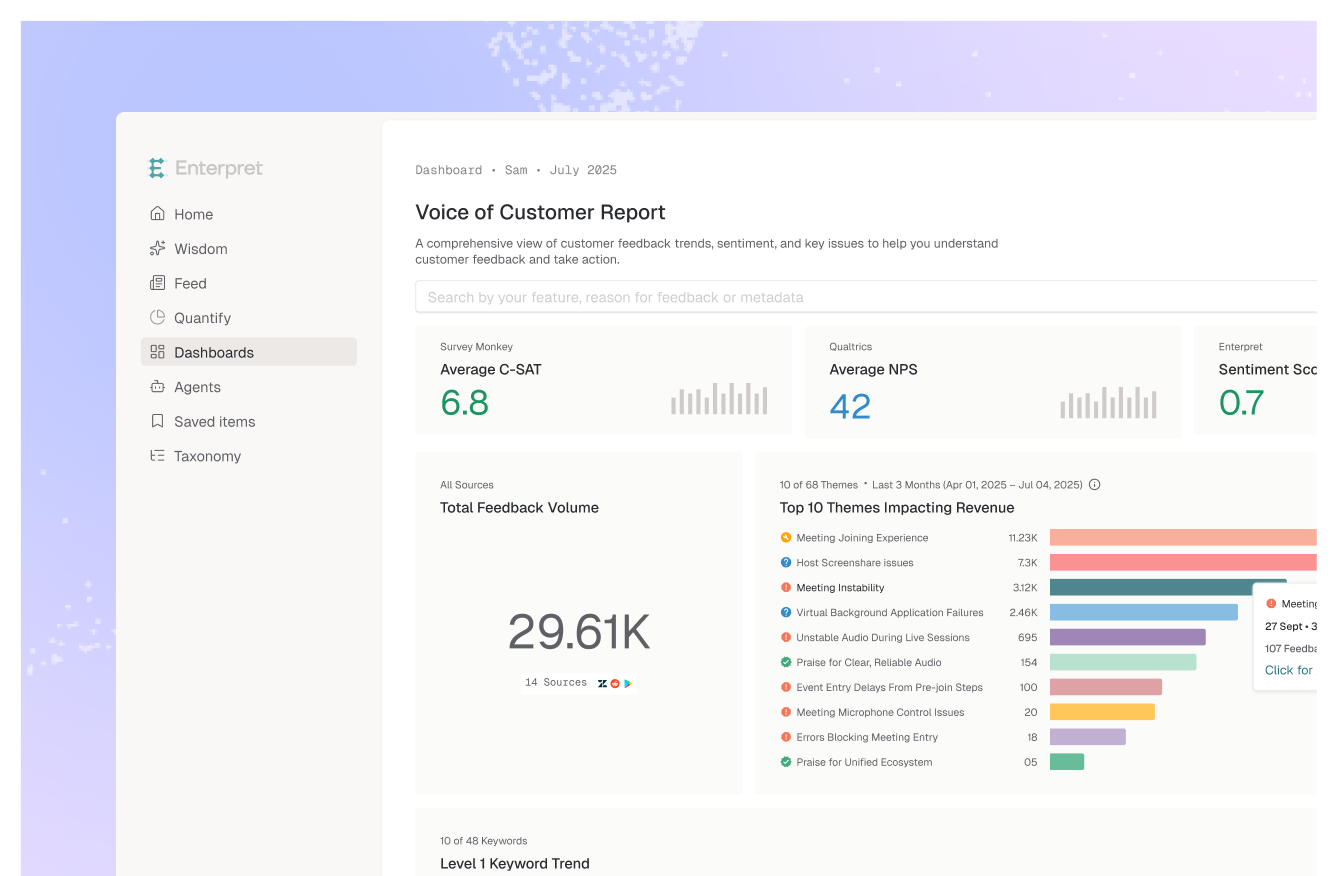
There is a fifth thing teams often mean when they say theme: who said it. A theme on its own tells you what the problem is. A theme connected to the accounts, segments, and revenue behind it tells you how much the problem matters. A customer context graph holds that connection, so "invoices missing purchase order numbers" carries the fact that every account raising it is enterprise and up for renewal this half. That context is what lets a theme win a prioritization argument against a louder theme with less money behind it.
A category is a broad, stable bucket defined in advance, such as billing or onboarding. A theme is a specific problem customers describe inside that bucket, such as invoices missing purchase order numbers. Categories organize feedback for trending; themes identify what to fix.
A tag is any label attached to a piece of feedback, including channel, sentiment, or product area. A theme is one specific kind of label: a recurring problem or request learned from the feedback. All themes can be applied as tags, but most tags are not themes.
No. A topic is the subject of the feedback, such as pricing, with no claim about what is wrong. A theme states the problem, such as a price increase that was not communicated before renewal. Topic modeling produces topics; actionable analysis needs themes.
A sub-theme is a more specific problem nested under a theme, used when a theme is valid but contains distinct variants that different teams fix. For example, a theme about failed exports might have sub-themes for timeouts on large files and missing columns in CSV output.
Enterpret's adaptive taxonomy keeps a stable set of upper levels tied to your product and learns the theme layer from your own feedback, so themes describe real problems rather than topics. Its customer context graph attaches each theme to accounts, segments, and revenue, so every theme carries both what customers said and who said it.
To see categories and themes built from your own feedback, explore Enterpret's adaptive taxonomy.
Lorem ipsum dolor sit amet, consectetur adipiscing elit. Suspendisse varius enim in eros elementum tristique. Duis cursus, mi quis viverra ornare, eros dolor interdum nulla, ut commodo diam libero vitae erat. Aenean faucibus nibh et justo cursus id rutrum lorem imperdiet. Nunc ut sem vitae risus tristique posuere.