





Customer Context for AI-Native Product teams
Ship like you heard from every customer.
Enterpret Agent finds the blind spots in what your customers are telling you, and hands the fix to your team and coding agents.


Outgrew the internal feedback tool they built
Customer evidence from every channel now shapes product and monetization decisions across the company.

Support became engineering’s front line.
Issue detection and triage run from one shared view, so engineers see what breaks when customers do.

Support and product work from one view.
Every request is tied to the account behind it, so fixes ship on customer evidence instead of anecdote.


Cut insight-to-decision time by 80%.
Roadmap calls trace back to real customer conversations, so teams move from signal to decision faster.

Acting on 220 million+ feedback segments.
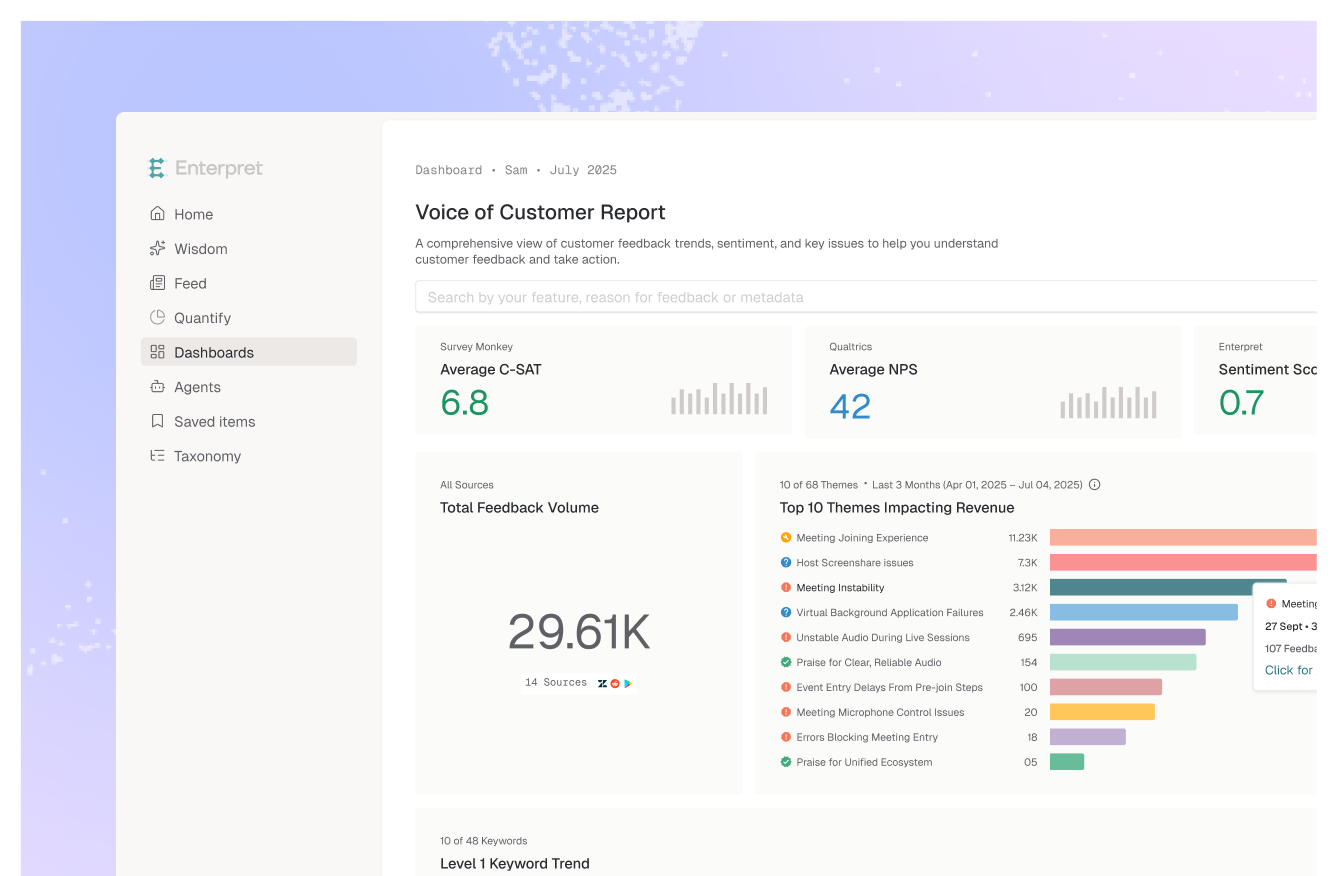
Product teams prioritize issues and requests from every channel in one place, ranked by customer impact.
Creator feedback, organized into weekly themes.
Customer evidence from every channel now shapes product and monetization decisions across the company.

The
Self-improving
Product Loop
Do you know what happens after you ship?
Enterpret does, and tells you what to do next.
Coding agents made building and shipping take minutes. How it landed with customers is still a blind spot, and finding out what to fix takes weeks.
Enterpret tells your product team how every launch is landing, what broke, and which problems are costing you growth, straight from what customers are saying.



In minutes
Coding agents write, test and review each change.
Same day
Coding agents write, test and review each change.

Weeks later
Within the hour
Coding agents write, test and review each change.
Weeks more
Same day
Coding agents write, test and review each change.
Detect and fix issues before they cost your business.
Know what to build. Know what to fix.
Enterpret isn’t another tool your team has to live in. It adds the customer context your product process is missing, from deciding what’s next to catching what broke after launch.
Before you build
Prioritize with confidence.
See what customers are asking for, weighted by the revenue behind it.
While it’s live
Find the blind spots.
Catch the regressions and bugs customers report before your monitoring does.
After you launch
Know how customers react.
Track praise, problems and requests from day one, and confirm every fix worked.
Enterpret Agent
The agent that knows your customers.
Every answer and automation starts from your customer context, and the work lands where your team already is: Slack, Linear, Codex, and more.
Answers on demand
Ask.
Get answers traced to real conversations.
Ask in plain language and get an answer from your own feedback, with every claim traced to real conversations.
Proactive signals
Watch.
Enterpret Agent tells you what changed, without being asked.
Describe what to watch in a sentence. Enterpret picks the agent and fills in the setup from context it already has.
Self-improving product loop
Fix.
Every issue ships with the customer context attached.
The issue is filed, the fix goes to your coding agent with the customer context, and Enterpret confirms it worked.


Agent automations
Available out of the box. Turn one on today, or build your own.
Escalation Shield
Finds at-risk accounts in every ticket, call and thread.
Quality Monitor
Flags a break in any theme within the hour.
Launch Feedback Monitor
Shows what improved and what broke after every launch.
Weekly VoC Report
A weekly read of what moved in customer feedback.
Customer Feedback by Market
Every theme, split by region, plan or segment.
Build your own
Describe the agent you need in a sentence.
Go even further with Enterpret Agent.

Remembers your role, your terms and how you like answers.

Start a run when a ticket lands, a feature launches or a deal moves.

Run daily, weekly or before every planning meeting.

Read from and write to the tools your teams already use.

Teach an agent how your team triages, writes and escalates.

Produce reports, briefs and PDFs grounded in real conversations.

Decide what runs on its own and what waits for someone to say go.

Run each agent on Anthropic, OpenAI or open models.
Headless Infrastructure
The customer context layer for your stack.
Your agents don’t know your customers — yet. Enterpret is the infrastructure that changes that.
In the tools you already use
Claude, Cursor, and Codex query it over MCP. Alerts land in Slack, issues in Linear or Jira.
In the apps you build
Internal tools call Enterpret Agent to find issues and route them to the right system.
In Enterpret
Ask Enterpret Agent, run automations, and work each issue in Spaces and dashboards.
Why not build it yourself?
Customer stories
The teams already closing the loop.
Product, support and insights leaders at ElevenLabs, Wispr Flow, Canva and Notion.

“If you’re not operating from the same customer understanding, within a month product, marketing and engineering are talking about completely separate things.”


"It elevates what our support engineers are capable of. They identify root causes and hand engineering issues that are already actionable."


"We surface product insights in days, not weeks. Enterpret aligns everyone around the top issues and requests."


"Beyond just keywords, we can actually understand what our users are saying across every interaction we plug in."

Frequently Asked Questions
What teams ask before they put their customer feedback to work.
Ask your AI about Enterpret




Enterpret reads every conversation your customers have with you, from support tickets and sales calls to app reviews and community threads. It sorts them into a taxonomy built from your product’s language and ties each theme to the accounts and revenue behind it. Enterpret Agent then tells your team what’s changing and hands the work to the people or coding agents who fix it.
It’s the record underneath your feedback. Every conversation is linked to the theme it belongs to, the account that said it, the revenue behind that account and the release it followed. That’s what lets Enterpret Agent answer “which customers, how much, and since when” instead of summarizing what people said.
Enterpret is the system of record for your customers: every conversation, theme and account in one place. Linear, Jira and your coding agents stay where your team plans and builds, and Enterpret feeds them the customer context they’re missing, so issues, ideas and fixes arrive with the evidence and accounts attached.
Regressions after a release, trust and safety issues, and bugs that never throw an error but show up in what customers say. Monitoring tools catch what breaks in your code. Enterpret catches what breaks for your customers, often before a ticket is escalated.
Enterpret Agent is the agent behind everything Enterpret does. Ask it anything about your customers and get answers traced to real conversations. Set up agent automations and it watches in the background, alerts the owner when something changes, files the issue and confirms the fix. Your team can approve, edit or stop any action at any point.
Yes. Enterpret exposes your customer context over MCP, so Claude, Cursor, Codex, ChatGPT and other agents can query it directly. Alerts land in Slack and issues in Linear or Jira. You can also build internal tools that call Enterpret Agent to find issues and route them.
Every request is weighted by the accounts and revenue behind it and how fast it’s growing, so trade-offs rest on evidence instead of the loudest voice. That context flows into the tools where you already plan, like Jira Product Discovery or Linear.
Pulling feedback into one place is the easy part. The hard part is a taxonomy that stays accurate as your product and customers change, joined to account data, and trusted enough to act on. Teams like ElevenLabs started with an internal tool and outgrew it.
A fixed list of tags starts drifting the day you ship something new. Enterpret’s taxonomy is built from your own customers’ language and updates itself as new themes appear, so trend lines stay comparable over time and nothing important ends up filed under “other.” It’s the part internal builds most often get wrong.
You can, but the answers tend to cost more and vary more. In our own test, we ran Claude Cowork against the same customer records twice, once on raw data and once through Enterpret. With Enterpret underneath, answers came back roughly 4× cheaper, 3× faster and far more consistent when the same question was asked twice.
Support platforms like Zendesk and Intercom, call recording tools like Gong, app stores, review sites, social and community channels, and product analytics. For downstream work: Slack, Jira, Linear, Salesforce, HubSpot and Notion. Anything else can come through the API.
Most teams are working with live feedback within days. Connectors are configured, historical feedback is backfilled, and your taxonomy is generated from your own data before you start reviewing it.
Enterpret is SOC 2 Type II and ISO 27001 certified and GDPR compliant, with role-based access control, SSO and data residency options for enterprise customers.
Ready to ship what your customers are asking for?
Bring your feedback. We'll show you the signals hidden inside it, and the work your teams and agents can put into motion.

