



AI Product Feedback Analysis
Build What Customers Want
AI that reads every support ticket, NPS response, app store review, and sales call so you know exactly what to build.
No manual tagging. No sampling. No spreadsheets.








Validate features before you build them
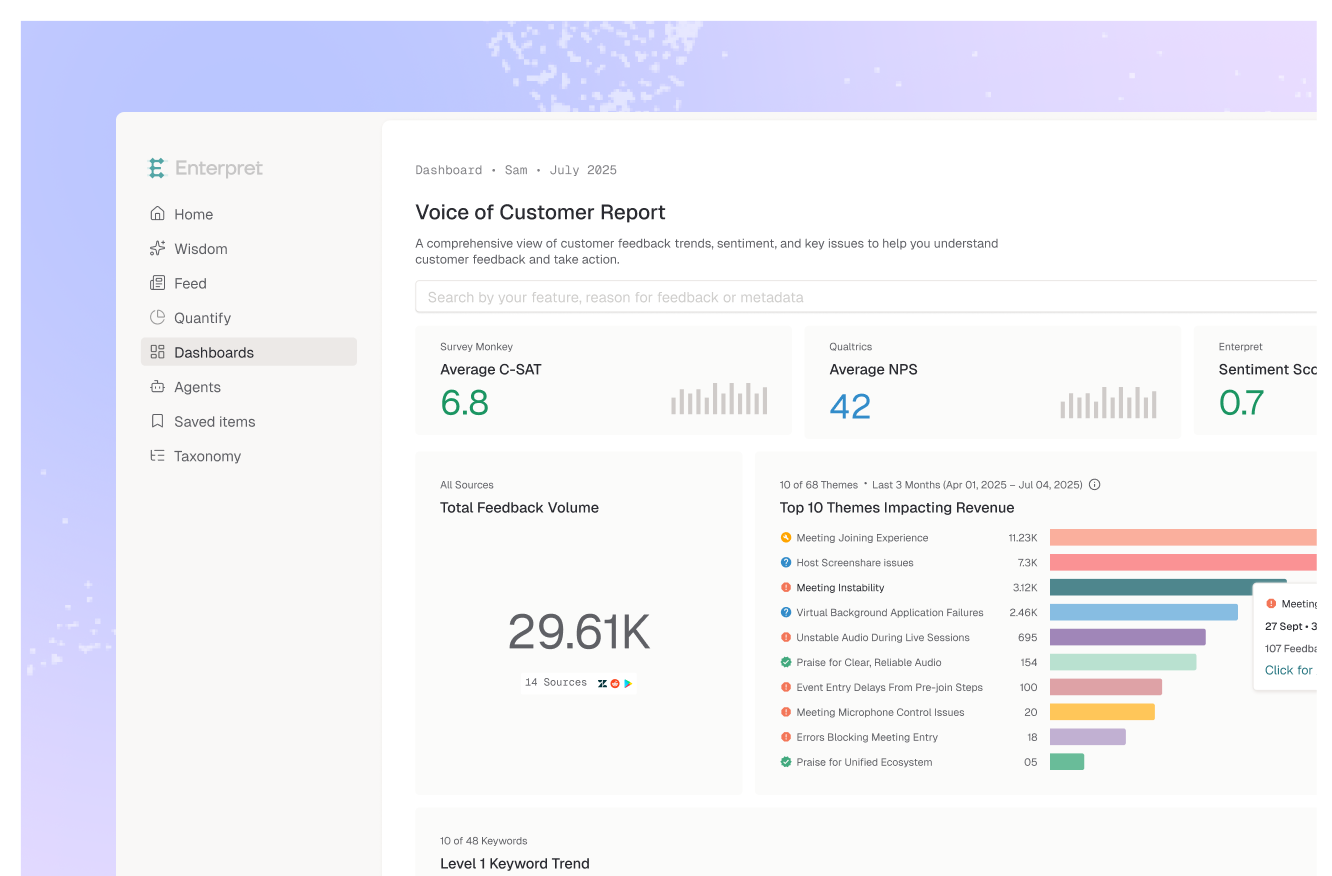
Connect user feedback to revenue and features. Size opportunities with real demand data segmented by customer tier, NPS score, or plan so you ship features that actually move metrics.
Whether the signal comes from a G2 review, a Zendesk ticket, or an NPS verbatim, Enterpret surfaces it in the same place, so your roadmap reflects your whole customer base, not just the loudest voices.


Turn insights into action via product workflows
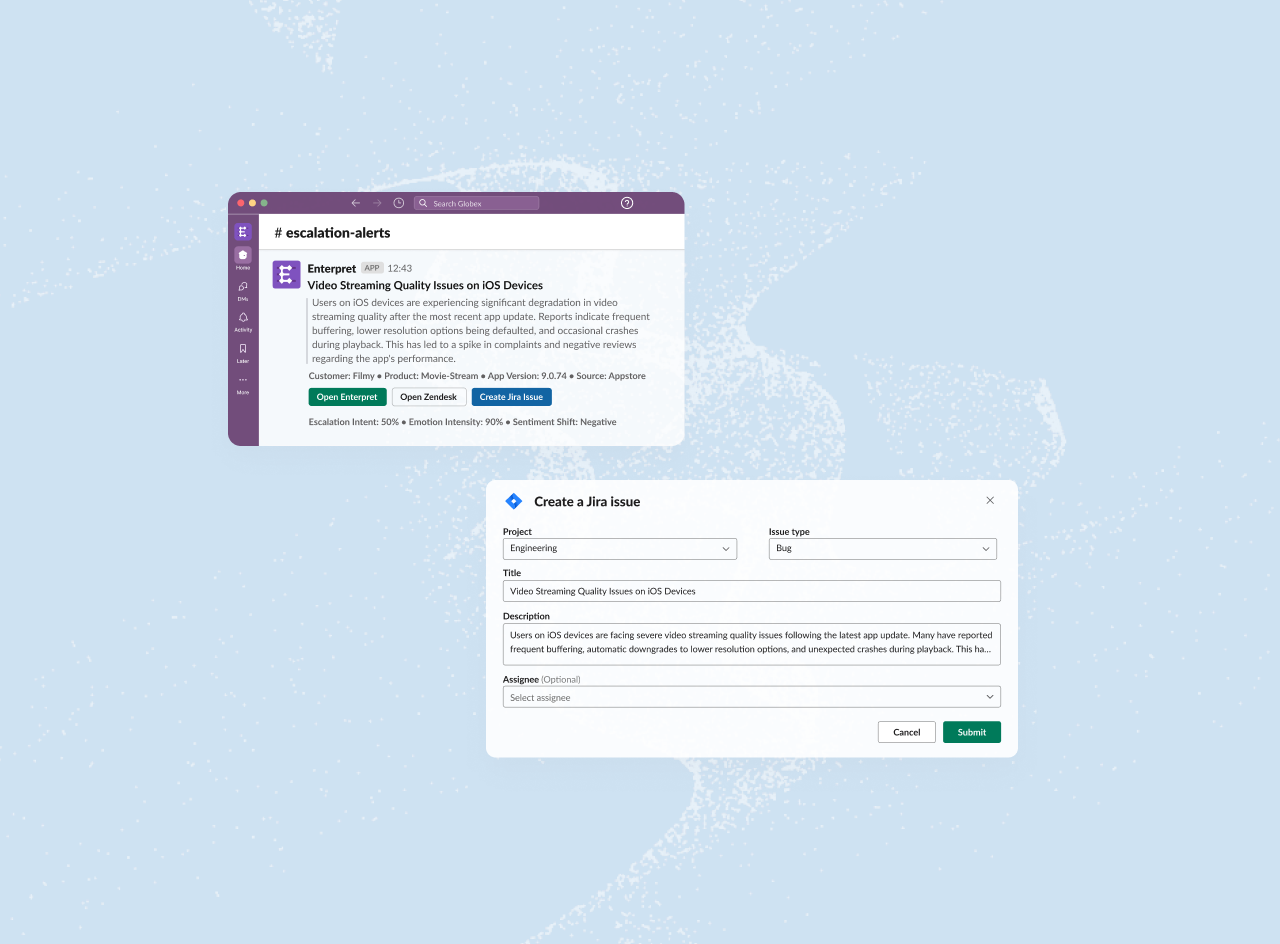
Critical bugs become Jira tickets. Feature requests flow to Linear. Customer wins get shared in Slack. Intelligence flows where decisions happen.
Feedback flows in from Zendesk, Intercom, Salesforce, Gong, app store reviews, and 50+ other sources. Insights flow out to the tools your team already lives in. The customer feedback loop, from signal to action, closes automatically.

Monitor issues and trends in real-time
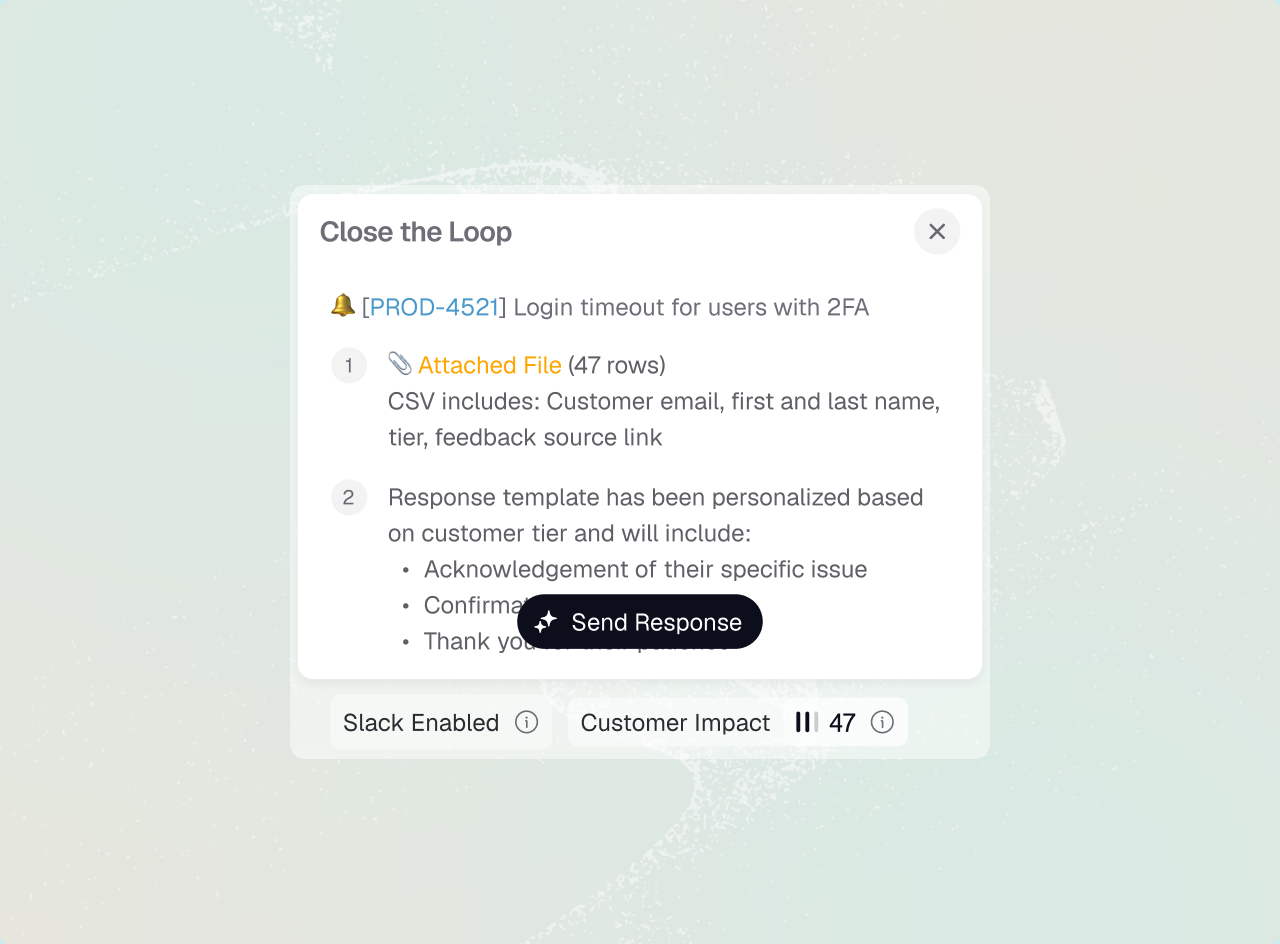
Catch issues early before they turn into crises. Real-time anomaly detection and alerts keep product quality high and customer satisfaction higher.
Spot churn signals before customers leave. Track NPS and CSAT trends by segment, release, or customer tier. When something breaks Enterpret tells you before your support queue does.
How Enterpret analyzes your product feedback
Four steps. No manual tagging, No data science team required.
.webp)
.webp)
.webp)
.webp)
Enterpret pulls in feedback from 50+ sources (Zendesk, Intercom, Gong, Salesforce, iOS and Google Play reviews, NPS surveys, Typeform, Slack, and more). Every new signal is ingested in real time, and every piece of feedback is automatically linked to the customer, account, and revenue it belongs to. Then we create a Customer Context Graph that unifies the same user across multiple sources into a single identity. When a customer files a Zendesk ticket, leaves an App Store review, and responds to an NPS survey, Enterpret knows it's the same person, and connects all three signals to their ARR, plan, lifecycle stage, and any custom attributes your team tracks.
Most tools make you build a taxonomy upfront and maintain it forever. Enterpret's Adaptive Taxonomy does it for you. Using AI, it organizes every piece of feedback into a five-level hierarchy from broad categories down to granular sub-themes based on your product's specific language, not a generic template. It learns your internal terminology, adapts when you ship new features, and detects category drift automatically, so your taxonomy stays accurate without a taxonomy admin. You can inspect why any piece of feedback was classified a certain way, correct it inline, and the model learns from your correction immediately.
Wisdom AI is built specifically for customer intelligence. It reviews 100% of your feedback corpus and answers questions in plain English: "Why are enterprise customers churning this quarter?" "What's driving the NPS drop in our mobile app?" Every answer is grounded in Enterpret's Customer Context Graph, so you can filter by ARR, NPS score, customer segment, region, or any custom attribute. Every claim comes with one-click citations back to the source feedback. Wisdom maintains context across follow-up questions, so a conversation feels like talking to an analyst who has read every customer conversation your company has ever had.
Insights aren't stuck in Enterpret. Critical bugs become Jira tickets automatically. Feature requests flow to Linear. Customer wins land in Slack. The Wisdom MCP Server takes this further: it makes your entire feedback corpus available as a queryable API, so any AI tool in your stack — Claude, ChatGPT, Cursor, Notion AI — can pull structured themes, sentiment, verbatims, and account context on demand. Product managers ask questions in Claude and get evidence-backed answers from real customer data. Engineering teams pull verbatims directly into PRDs. Customer success uses it to prep for QBRs. The intelligence your customers gave you stops sitting in a dashboard and starts showing up in every decision.

Frequently Asked Questions
AI product feedback analysis uses artificial intelligence to automatically collect, categorize, and surface insights from customer feedback across every channel — support tickets, NPS surveys, app store reviews, sales calls, Intercom conversations, and more. Product teams use it to validate features before building them, size demand against real customer signals, detect issues in real time, and prioritize roadmaps with conviction instead of guesswork.
The old way: a spreadsheet, a Slack channel full of screenshots, and someone's weekend. Most teams manually process a fraction of the feedback they receive. The rest gets ignored — which means bugs go undetected, winning features get deprioritized, and churn signals are missed until it's too late.
Enterpret's AI changes the math. Using natural language processing, adaptive topic modeling, and sentiment analysis, it automatically categorizes every piece of feedback across all your sources — eliminating human bias, processing thousands of signals simultaneously, and surfacing the patterns that actually move product decisions.
Enterpret uses natural language processing and adaptive topic modeling to automatically classify every piece of feedback by theme, sentiment, and customer context. It connects to 50+ sources — Zendesk, Intercom, app stores, Gong, surveys, and more — and organizes everything into a custom taxonomy that evolves with your product, without requiring manual rules or data science resources.
Enterpret analyzes support tickets, NPS and CSAT survey responses, app store reviews (iOS and Google Play), sales call transcripts, Intercom and Zendesk conversations, social media, G2 and Trustpilot reviews, Slack messages, and more. Any channel where customers express themselves — Enterpret reads it, categorizes it, and surfaces the signal.
Product teams use Enterpret to size feature demand against real signals — how many customers asked for it, what revenue is at risk, which customer segments are affected, and how it connects to NPS or churn trends. That context replaces "the loudest voice wins" prioritization with a defensible, data-backed case for every roadmap decision.
Manual analysis forces teams to tag feedback one ticket at a time — a process that introduces human bias, takes weeks, and covers only a fraction of what customers actually said. Enterpret processes thousands of signals simultaneously, without bias, and delivers answers in hours. It also connects insights directly to Jira, Linear, and Slack — so nothing sits in a doc waiting to be acted on.
Enterpret's adaptive taxonomy self-organizes around your product's language — not a generic category list — and connects feedback to customer context like ARR, plan, and lifecycle stage. Unlike tools that analyze feedback in isolation, Enterpret routes insights directly into your existing product workflows via Jira, Linear, Slack, and other integrations.