







New in Adaptive Taxonomy: Make edits with confidence

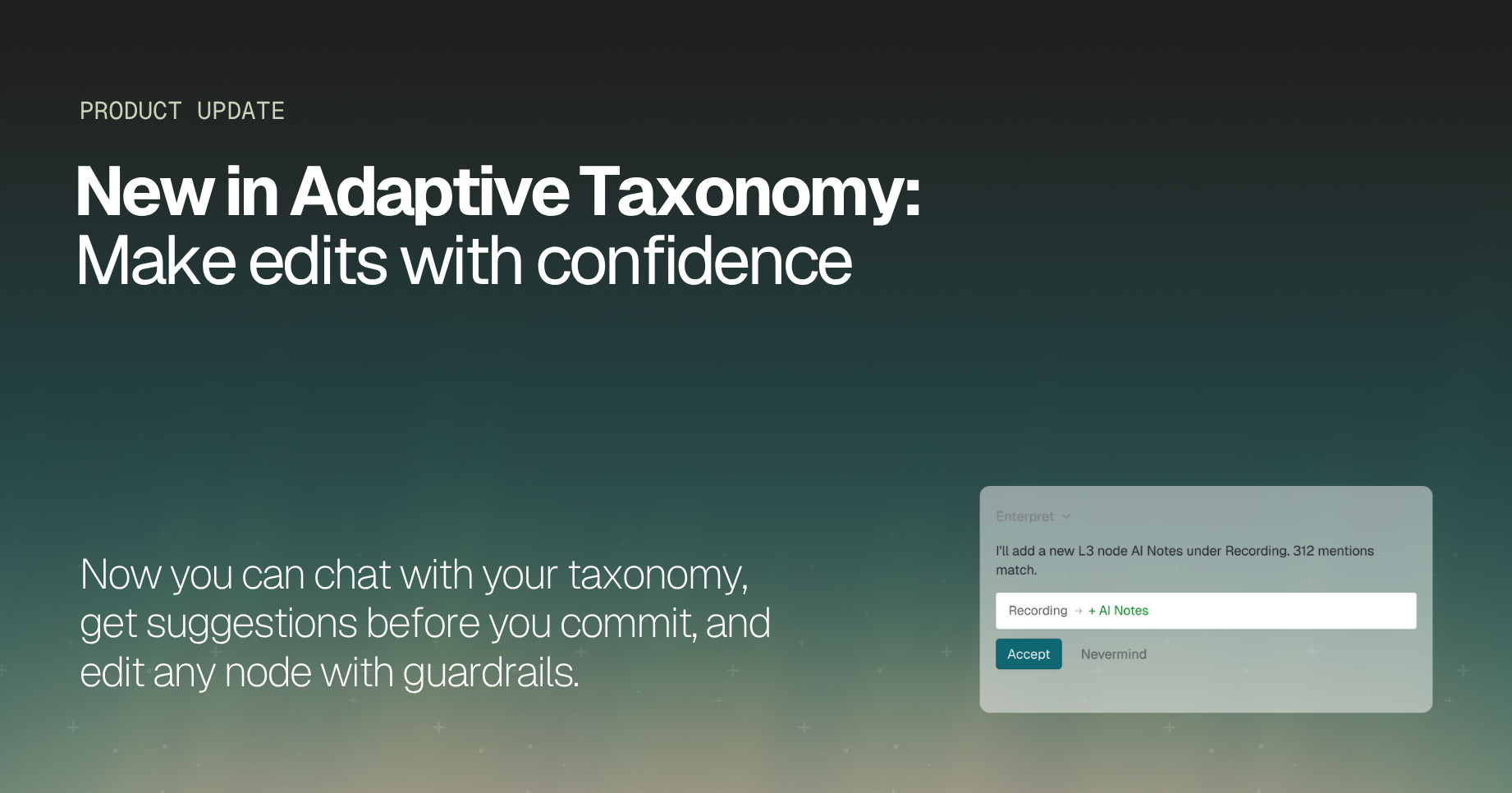
Now you can chat with your taxonomy, get suggestions before you commit, and edit any node with guardrails.
Your customers don’t wait for your taxonomy to catch up.
They adopt new language, react to new launches, report new issues, and describe your product in ways your team didn’t anticipate. A useful taxonomy has to evolve with them, automatically where it can, and with human judgment where it should.
That is the idea behind Enterpret’s Adaptive Taxonomy. It learns your business, detects emerging themes, and keeps the structure behind your customer insights current as your product and customers change.
But even the best automated taxonomy still benefits from business judgment. Teams need to rename themes to match internal language, evaluate overlaps that may seem similar but have complex nuance, and reorganize taxonomy branches as the product evolves.
Those edits require judgment. Is there already a similar theme? Are two concepts actually close enough to merge? Will this change make reporting clearer, or will it fragment the signal?
That judgment layer is what just got easier.
Adaptive Taxonomy handles the drift
Enterpret's Adaptive Taxonomy is built so the structure under your insights doesn't drift while you're not looking. It learns your business from day one, your product surface, help docs, changelogs, acronyms, and customer language. As your business evolves, it continuously detects emerging themes, creates new ones, and adjusts the classification structure so your taxonomy doesn’t fall behind.
That matters because customer language changes constantly. New features launch. Bugs appear. Pricing changes. Customers invent their own shorthand. A static taxonomy gets stale quickly.
Adaptive Taxonomy handles the majority of that maintenance automatically. But automation isn’t the whole story.
Teams still need judgment
Enterpret doesn’t force teams into a generic taxonomy. Your taxonomy should be custom and reflect your product, your customers, and how your company makes decisions.
That means teams still need to fine-tune their taxonomy over time: renaming themes to match internal language, evaluating overlaps that appear similar yet have layers of nuance, or reorganizing branches after product changes.
What's new
Adaptive Taxonomy now ships with three new capabilities that make the judgment-call layer faster, safer, and easier.
1. Chat with your taxonomy
Type what you want in plain English.
- "Merge all the login-related sub-themes under Authentication into one."
- "Move Notifications from Desktop to Mobile App."
- "What sub-themes exist under Payment Processing?"
- "We just launched this new feature; read the attached adocumentation and tell me what taxonomy edits I should make."
Enterpret reads the taxonomy, interprets your intent, proposes the operation, and lets you review the change before anything is applied.
For more complex changes, the conversation becomes the workflow. Describe the outcome, review the proposed changeset, and approve it when it looks right.
2. Get quality checks before changes go live
Every proposed edit is checked before it reaches production. Enterpret looks for near-duplicates, naming conflicts, semantic overlap, and structural issues that could reduce taxonomy quality.
When a change cannot be applied directly, Enterpret suggests an alternative path. For example, if two sub-themes live under different parents, Enterpret proposes a sequence of edits, reparent first, then merge, so users can review the full changeset before accepting.
The goal is simple: help teams move faster without accidentally making the taxonomy noisier.
3. Edit any node, with guardrails
You can rename, merge, split, move, create, delete, and reparent taxonomy nodes directly in the UI, including themes and sub-themes closest to customer language.
Every change accumulates in a draft. Nothing touches production until you save. Any draft change can be rolled back. When changes are committed, Enterpret automatically handles reclassification of affected records.
Better edits and AI-powered checks
Taxonomy maintenance has always required business context. The difference now is that Enterpret helps with the checks that make those edits safe.
Instead of manually inspecting the taxonomy for duplicates, overlap, or structural issues, teams can rely on Enterpret to surface risks and suggest better paths before changes go live.
Our view is simple: a taxonomy that’s easier to refine gets refined more often. And the more consistently your taxonomy improves, the sharper every downstream insight becomes.
Available today
These capabilities are available in Adaptive Taxonomy from Edit Mode on the Taxonomy page in Settings. They're included by default with every Enterpret subscription.
Open Edit Mode · Help Center · Book a demo


