







Voice of Customer Survey Software: What It Does and How to Choose the Right One

Voice of Customer Survey Software: What It Does and How to Choose the Right One
Surveys are still the easiest way to ask customers a direct question. The problem is what happens after they answer. Most teams collect responses, glance at the score, and move on, while the actual gold (the open-text comments where customers tell you exactly what they think) sits in a dashboard nobody opens. Voice of customer survey software is supposed to fix this, but most tools still stop at collection. The best ones go further, turning every response into something the team can actually act on. That's where modern voice of customer solutions start to earn their place.
What Voice of Customer Survey Software Actually Does (and Where Most Tools Fall Short)
At its simplest, voice of customer survey software helps teams run NPS, CSAT, CES, and custom surveys across the customer journey. You send a survey after onboarding, after a support ticket closes, at renewal, after a feature ships. Responses come back. A dashboard shows you the scores.
That part is solved. Almost every tool in this category does it well.
The part that isn't solved is what to do with the open-text responses. The verbatims. When a customer types out two sentences explaining why they gave you a 7 instead of a 9, that's the most useful data you'll get all quarter. And that's exactly the data most survey tools either ignore, summarize into a wordcloud, or hand off to whoever has time to read through 400 responses (which is no one).
So you end up with a clear score and a fuzzy reason. You know NPS dropped 4 points last month. You don't know why.
Why Survey Software Alone Isn't Enough for a Real VoC Program
Surveys are one channel. Just one.
Customers are also leaving feedback in support tickets, sales calls, app reviews, community posts, G2 reviews, Reddit threads, and Slack channels. A survey-only view of the customer is a partial view, even if your survey program is perfectly designed.
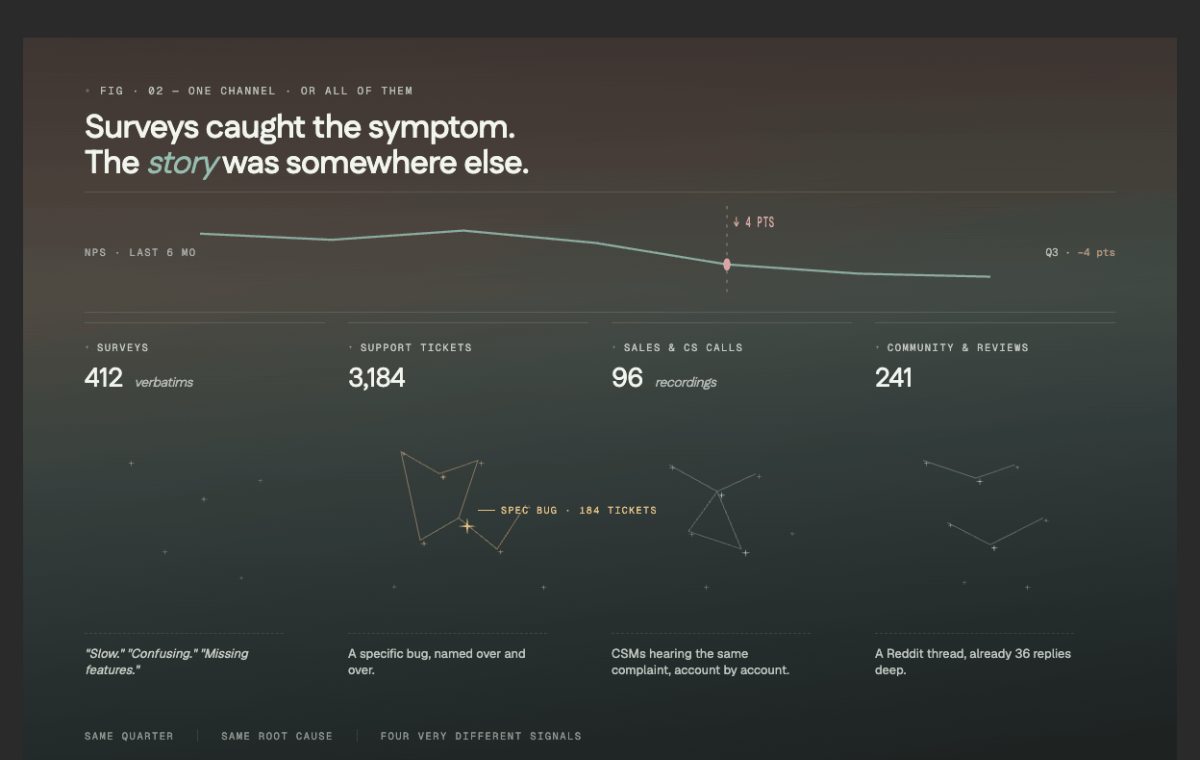
Here's a common moment: NPS dips. You scan the verbatims and the comments are vague (slow, confusing, missing features). Meanwhile, support tickets are exploding around a specific bug, your CSMs are hearing the same complaint in calls, and a few power users have already posted about it on Reddit. Surveys caught the symptom. The full story was sitting somewhere else entirely.
This is why voice of customer surveys, on their own, can't power a real VoC program. They're a reliable signal. They're not the whole signal.
What to Look for in Voice of Customer Survey Software
If you're evaluating tools, the basics (form builder, distribution, scoring) are table stakes. What actually separates good from great:
Open-text analysis at scale. Your tool should auto-theme open-ended survey responses, not just tag them with sentiment. "Negative" tells you nothing. "Negative comments about the new pricing model, concentrated in mid-market accounts" tells you what to do.
Survey logic that doesn't fatigue customers. Smart skip logic, throttling so the same customer isn't hit four times in a quarter, and the ability to send the right survey at the right moment in the journey.
Integrations with the rest of your feedback stack. Pulling NPS verbatims into the same system that holds your support tickets and call transcripts is the difference between a survey tool and a customer intelligence system.
The ability to slice by account, segment, or journey stage. Aggregate scores hide the story. The teams who get the most out of surveys can pull "what are our top 20 enterprise accounts saying this quarter" in one view.
Benchmarking against your own history, not industry averages. Industry NPS benchmarks are mostly noise. What matters is whether your number is moving, and what's driving the movement.
The Difference Between Survey Tools and a True Voice of Customer Platform
This is the distinction worth getting right.
A survey tool answers one question well: what did people say in this survey? A voice of customer platform answers a bigger one: what are customers telling us across every channel, and what's changed since last month?
The first is a snapshot. The second is a system.
Survey tools are still useful (we'd argue essential) inside a real VoC program. But they're an input, not the program itself. When customers tell you something in a survey and the same thing in a support ticket and the same thing on a sales call, the value isn't in any one of those channels. It's in the pattern across them. That's what a unified customer feedback platform is built to surface.
How to Get More Out of Your Existing Surveys
You don't need to rip out your survey tool to get more value from it. A few changes that compound:
Tag verbatims by theme, not just by score. A 6 about pricing and a 6 about onboarding are not the same problem.
Pair NPS comments with the actual support tickets and call transcripts from those accounts. The full picture lives in the overlap.
Look at what changed quarter over quarter, not just where you are right now. The trend tells you more than the snapshot.
Read surveys in context with the rest of your customer signal. If you're only reading verbatims when NPS dips, you're already late.
Bringing Surveys Into a Wider Customer Intelligence System
The teams that get the most out of voice of customer survey software treat surveys as one input in a system that's listening across every channel. Surveys ask the question. Support tickets, calls, and reviews fill in the rest. A voice of customer dashboard pulls it together so the team isn't toggling between five tools to understand one customer.
When this is working, the team stops debating what customers want. They can see it. The product roadmap gets sharper. Support spots issues earlier. CS walks into renewals already knowing what the account cares about.
Surveys are still the easiest way to ask a customer a direct question. They just work better when they're not asked alone.
Curious what surveys plus every other feedback channel looks like in one place? See how Enterpret unifies voice of customer across surveys, support, reviews, sales calls, and community here.


