







Your next deal shouldn’t start from zero

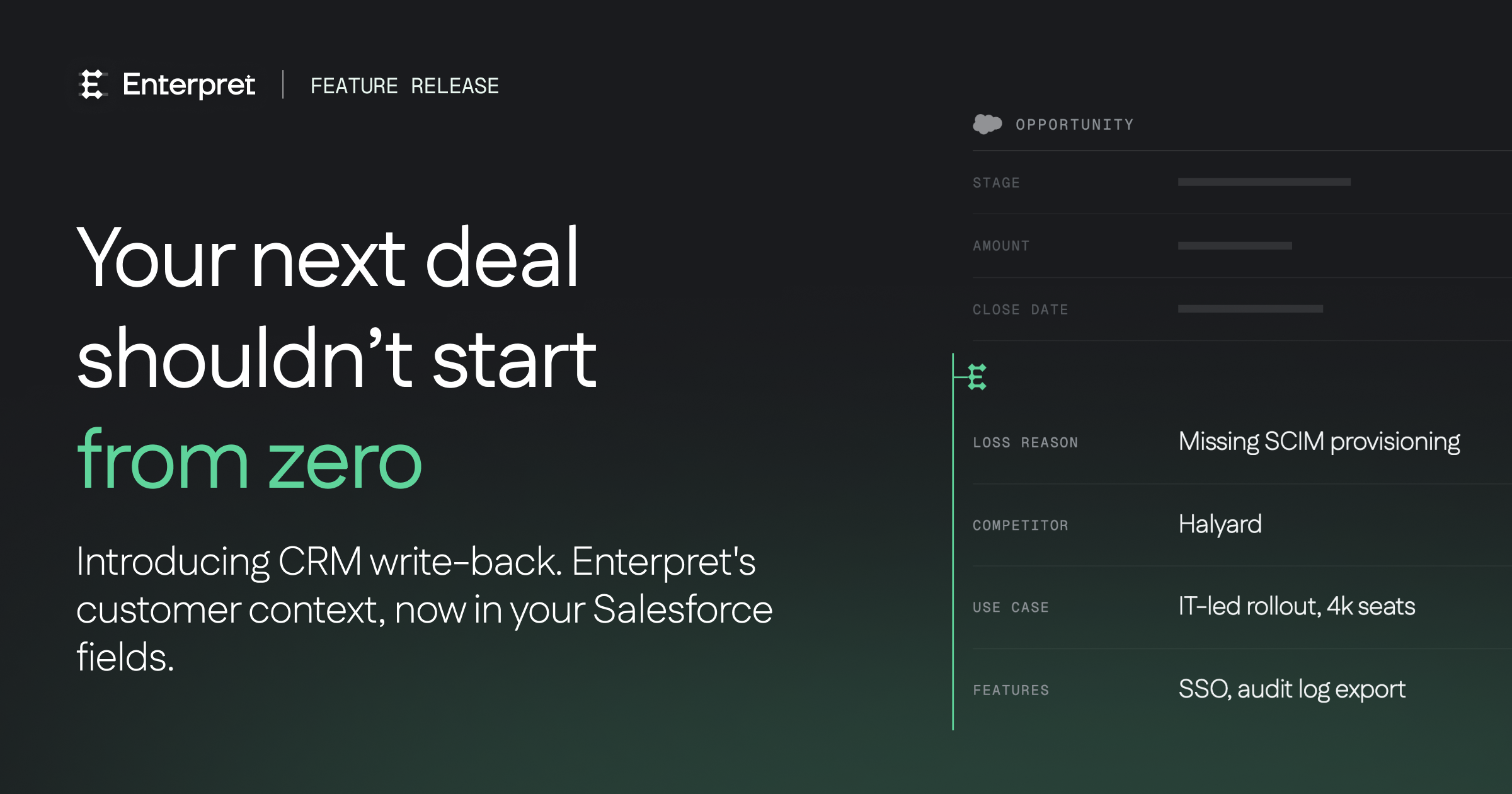
Everything your company learns from a deal is worth something on the next one. Sales Intelligence now writes it into Salesforce, on the record your reps open before every call.
Somewhere last quarter, a rep on your team lost a deal the company already knew how to win.
Support had been hearing that objection for months. Product had it on a roadmap slide. But none of it reached the person on the call, so they improvised, and the deal went to a competitor who leads with exactly that capability.
Nobody failed to write it down. They wrote it down somewhere your team was never going to look.
Bringing customer context into every deal
Sales Intelligence now writes its output into Salesforce automatically: win/loss reasons, competitors, use cases, and the features and gaps that came up.
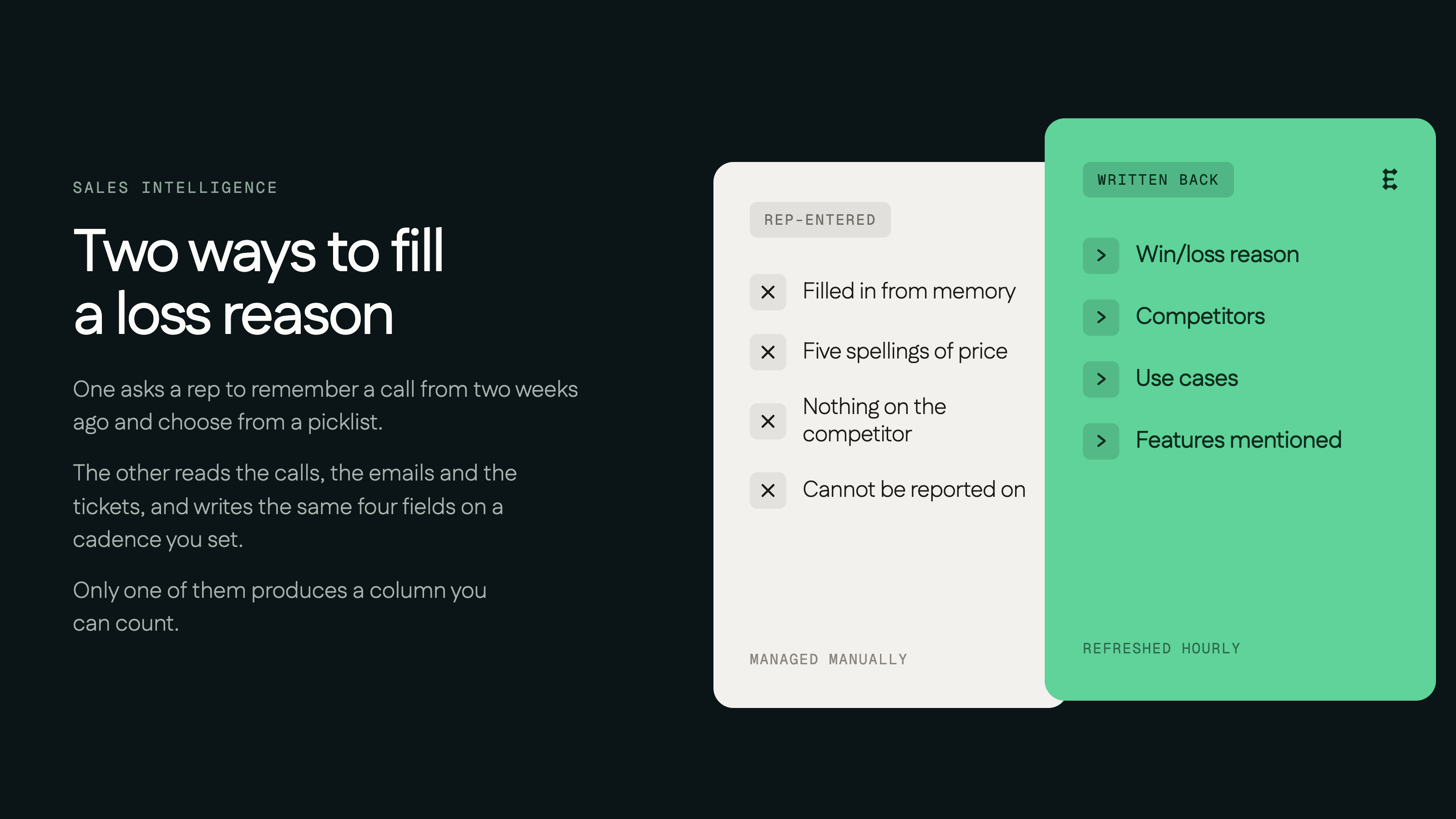
By default it writes to the Opportunity object, which is where most teams will want it. If your Ops team has opinions about where data belongs, and Ops teams usually do, you can point write-back at custom objects and custom fields instead. Fields refresh on a cadence you set, with one hour as the current floor.
And it does not start empty. Closed deals get backfilled, so the pattern exists the day you turn it on rather than a year later. The history you already have becomes the input.
The Enterpret difference in CRM write-back
Plenty of tools can summarize a sales call. That is a transcript problem, and it has been solved for years.
None of them know what your customers are saying everywhere else. Enterpret does, because that is the whole platform: every ticket, review, survey, call and conversation, read together. Sales Intelligence is the sales-first part of it.
So the reason that lands in your CRM is not one rep’s read of one call. It is that read placed against everything else your customers have told you. The requirement that killed the deal, sitting next to the volume of existing customers asking for the same thing. The competitor that keeps surfacing, next to what people say when they leave you for them.
That is a different object entirely. One is a meeting summary. The other is your company’s memory, written into the field where the next deal gets worked.
What it looks like on the next deal
An AE picks up an opportunity in a segment your team has already worked forty times. In the reports your team builds off the Opportunity object, that history is now queryable.
Which competitors keep turning up in deals of this shape. Which use cases the deals that closed were actually bought for, in the customer’s words rather than the pitch’s. Which requirements have killed deals like this before, and how much pipeline went down with them.
That is not a post mortem. It is a prep sheet, and it is on the record the rep already opens before the call.
What it changes for RevOps
Your reps are not wrong when they fill in the field. They are each using their own words, which is fine on one deal and useless across two hundred.
Write-back puts the same vocabulary on every opportunity without asking anyone to change how they work. That is what makes the aggregate worth acting on: pipeline you can slice by competitor, by use case, by the specific gap that keeps costing you deals, and get a number back that someone will defend in a forecast call.
What it changes for product teams
Feature gaps that surface in sales conversations usually die in the sales org. Mentioned on a call, repeated in a deal review, gone.
On the opportunity record they arrive with deal size, stage, segment and outcome attached. A gap mentioned in three calls is an anecdote. The same gap across thirty opportunities, next to the revenue that moved or didn’t, is a roadmap input. And you see it while there are still open deals riding on it.
Why we built it this way
Customer context that stays inside Enterpret is context somebody has to remember to go look at. We would rather show up in the tools your team already has open.
Write-back is built as an extensible system rather than a one off Salesforce integration, so it can support more objects, more fields and more destinations over time. Salesforce and Sales Intelligence are where it starts.
Ready to win the next deal?
Everything you needed to know about this quarter’s deals is already in last quarter’s. It is just not anywhere your team can reach it.
If you want Sales Intelligence powered by customer context, request a demo. We will show it running on our own Salesforce, with real deals in the fields.
Already an Enterpret customer? Talk to your Enterpret contact to learn how to get write-back turned on for your instance.


