





Your roadmap isn't customer-centric. It's customer-anecdotal.

Every product org I've ever worked in described itself as customer-centric. It was in the values, on the careers page, and in the opening slide of every annual planning deck. I believed it, too. But if you had stopped me in any of my three product leadership roles and asked me to show you the customer evidence behind last quarter's roadmap, I would have handed you a few call notes, some emails forwarded by sales, a Slack thread from a frustrated CSM, and a great deal of conviction. That isn't evidence; it's a collection of anecdotes that happened to find their way to me.
I've spent 7 years in product, as a director of product at B2B and B2C SaaS companies, and a senior PM at one of the largest platforms in the category, owning roadmaps for products used by hundreds of thousands of customers.
I now spend my days on the other side of the table, working with teams who are trying to make sense of hundreds of thousands of pieces of customer feedback, and the contrast with how I used to operate is uncomfortable to look at. None of us were lazy or indifferent; we cared about customers a great deal. We simply never had (nor successfully built) the machinery that would have let that care show up in our decisions. "Customer-centric" was something we said about ourselves rather than something we could demonstrate.
What our roadmaps were actually built from
If we're honest, customers are rarely the heaviest input into a roadmap. There's the strategy set by leadership, the commitments made to close a big deal, the competitor launch that spooked the board, the feature an executive has wanted since the offsite, the tech debt engineering keeps flagging, and so on. Customer input does show up, but usually late in the process, as a justification for a decision that has more or less been made. We go looking for the quote that supports the thing we already want to build.
For example, let's say a PM is choosing between improving reporting and reworking the onboarding flow. She has heard about reporting on four customer calls this month, and two of those were with large, vocal accounts. Onboarding came up once, in passing. The decision feels obvious. What she doesn't know (because nobody has looked) is that onboarding confusion is the most common theme in support tickets, that it shows up in 1 out of every 5 churned accounts' exit surveys, and that it's quietly suppressing expansion in the mid-market segment. While this situation and these numbers are invented, the shape of the problem is not. She wasn't ignoring customers. She was listening carefully to the only customers she could hear.
The failure isn't a lack of listening; it's that the listening is unstructured. Feedback lives in Zendesk, Gong, Salesforce notes, app store reviews, NPS verbatims, Slack channels, and the heads of individual CSMs. Each source is visible to a different team, none of them are connected, and none of them are in a form a product leader can query when it's time to make a call.
Why a little feedback can be worse than none
The obvious objection is that some feedback is better than no feedback. In a narrow way, that's true. But sparse feedback carries a risk that no feedback doesn't: it gives us confidence. When we have zero customer input, we know we're guessing, and we hedge accordingly. When we have four vivid conversations, we feel informed, and we stop looking. It's a bit like packing for a trip based on a three-day forecast from two months ago; you'll feel certain you know what the weather is like, and you may still arrive to a cold snap with the wrong coat. The fix isn't collecting more. Most product orgs already have far more customer feedback than they realize, spread across the multitude of systems they use, forums, reviews websites, and social channels. It just never reaches the person making the call.
The bias isn't random, either. What reaches a product team skews toward the loudest customers, the largest accounts, and whatever was said most recently. Quiet customers who are slowly disengaging almost never make it into a roadmap review. Neither does the long tail of small complaints that individually seem trivial and collectively explain why a segment underperforms.
It's worth asking ourselves honestly: what customer evidence did we actually have at the moment we made our last few big decisions, and how many different customers did it come from? If the answer is a few familiar accounts and whichever channel sits closest to the product team, that isn't a personal failing so much as a signal worth noticing.
What changes when feedback becomes a system
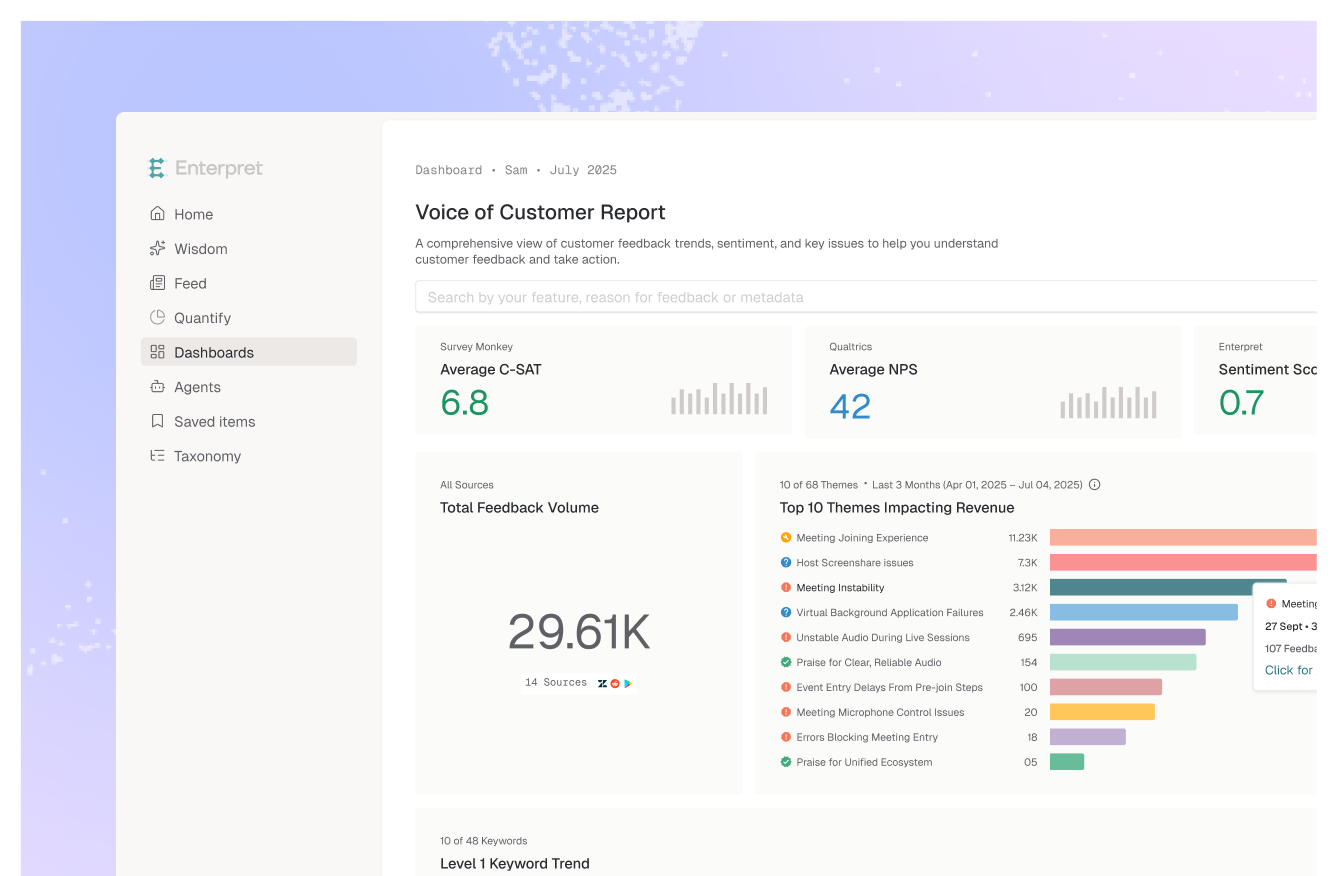
The shift I didn't have access to as a product leader is the move from feedback as a stream of anecdotes to feedback as a dataset. That means every source in one place, a consistent way of categorizing what customers are actually talking about, and the ability to connect those themes to the accounts and revenue behind them. Doing this by hand is possible for a few hundred data points and hopeless beyond that; nobody has time to read and tag 50,000 support tickets a quarter, and the people who try tend to build a taxonomy that reflects their own assumptions.
In fact, even a good taxonomy starts going stale the day it's built. New features ship, customers find new things to struggle with, and the categories you chose six months ago stop matching what people are actually saying. Keeping that current across every source is the foundation Enterpret is built on. What matters though is what it makes possible, and the biggest change is who does the looking. A dataset you have to query still depends on someone knowing what to ask, and knowing to ask at all.
Imagine our PM with that in front of her. Instead of asking "what have I heard lately?" she can ask "how often does onboarding friction come up, among which customers, and is it growing?" Better yet, she could have the most pressing customer priorities automatically prioritized on the roadmap with full supporting context and evidence. She may still decide to build reporting (there can be good strategic reasons to), but now she's making the tradeoff with her eyes open. That's the real value: not a tool that makes the decision, but one that makes the decision honest.
The part a tool can't do for you
Here's the truth. A customer context platform will not make an organization customer-centric. It will only reveal whether it already is. If the roadmap is set in a planning offsite before anyone looks at the data, the insights become a dashboard people check after the fact to find justification. If leaders treat contradicting evidence as noise, PMs will stop bringing it. If feedback is reviewed once a quarter rather than woven into weekly decisions, the tool becomes an expensive archive. I've seen each of these patterns, and I've been guilty of at least two of them.
While it is true that better data makes better decisions possible, it doesn't make them inevitable. The organizations that get real value from this kind of system share a particular trait: they are willing to be told they're wrong. They let the evidence reorder priorities, and they ask "what would change our mind?" before committing to a bet. That is a cultural commitment first and a tooling decision second. The tool simply makes the commitment affordable at scale.
Customer-centricity isn't how much we care about customers; it's how much we let what they tell us change what we do.


