





What it costs to build your own feedback taxonomy.
Getting feedback into Claude is the easy part. Keeping every source connected, every record tagged, and every theme current is the part that keeps costing you. See what it takes to build and run it yourself.














What changes when your AI has a taxonomy to work from
We asked the same AI agent the same product questions twice. Once it read raw feedback on its own, and once it had Enterpret underneath. Here's what changed.
The research
Same agent, with and without Enterpret
The detail behind each result, and how each test was set up.
Better answers
Questions won with Enterpret, with 1 tie and 2 losses. Overall score 0.96 vs 0.71. Same GPT-5.5 analyst, exploratory test on public Cursor data. [2]
Answers that repeat
Average change in the count for the same theme when the same question was asked again. Claude Opus 4.8, 1,000 records. [1]
Every number cited
With Enterpret, every number links to the records behind it, so anyone can check it before it shapes a decision. Without it, the agent states a number with nothing behind it to verify, at most a few example quotes. [2]
Lower cost per answer
Cost per answer grew 33 times without Enterpret and 2 times with it, because without a taxonomy every answer re-reads all your data. Setup excluded, not a price quote. [1]
“If you’re not operating from the same customer understanding, within a month product, marketing and engineering are talking about completely separate things.”
Why the taxonomy is the expensive part
Building one is a project. Keeping it current never ends.
A taxonomy is what makes feedback countable, from product area down to the specific issue. It drifts in two directions at once.
You ship, so your keywords change
Every launch adds names your taxonomy has never seen. Feedback about a new feature has nowhere to go until someone adds it.
- CheckoutLevel 1
- OtherLevel 2
- CheckoutProduct area
- PaymentsFeature
- Apple PaySub-feature
- Payment failedTheme
- Declined at confirmationSub-theme
Customers bring up new things, so your themes change
Even when nothing ships, customers start describing problems nobody has named yet. A fixed list files them under the nearest catch-all, so the new issue never shows up as a trend.
- CheckoutLevel 1
- Mobile checkoutLevel 2
- General bugsLevel 3
- CheckoutProduct area
- Mobile checkoutFeature
- CartSub-feature
- Freezes on loadTheme
- After an OS updateSub-theme
A one-time taxonomy breaks on both. Keeping up means revising it and retagging your history each time, and the faster you ship, the more often it happens.
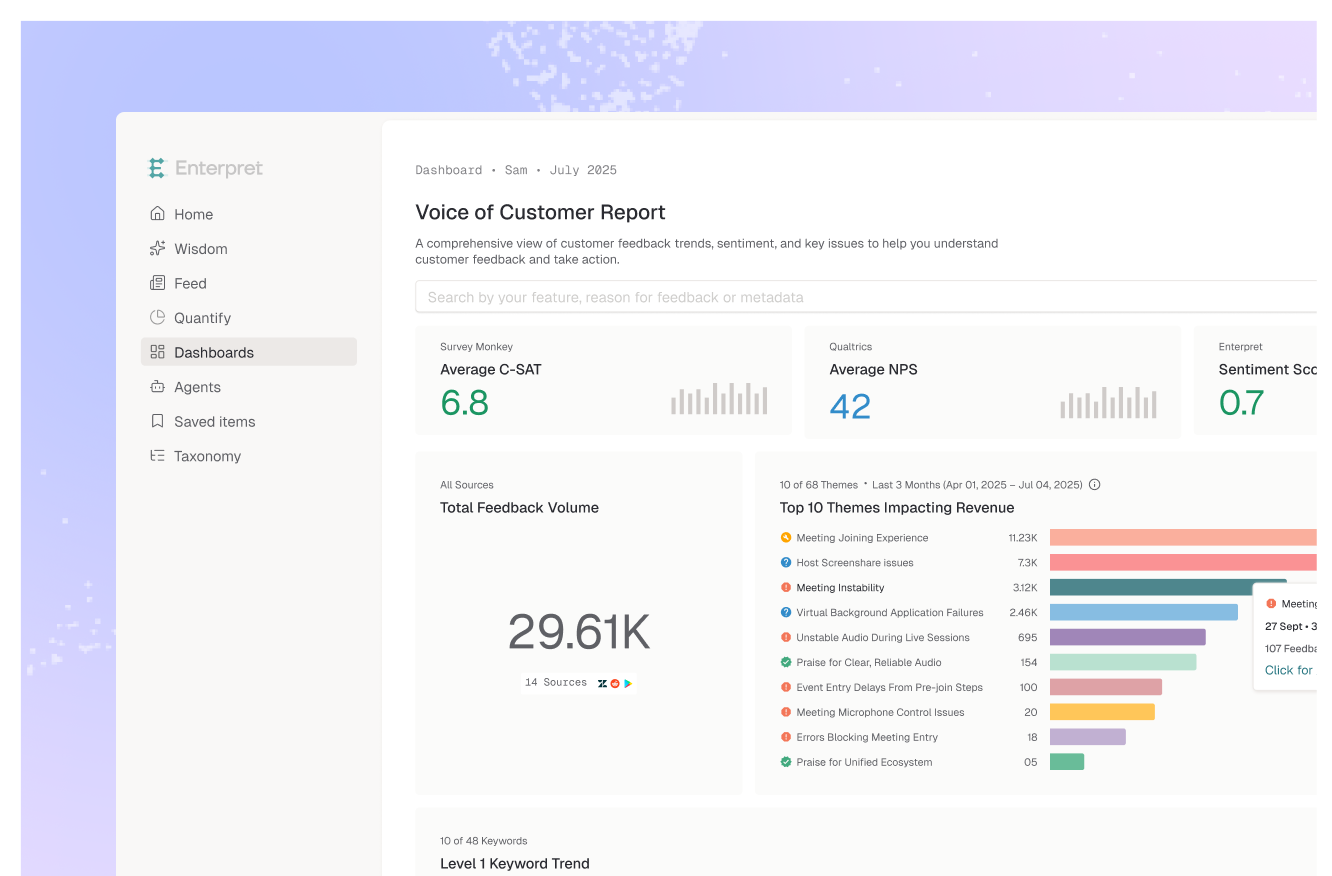
Enterpret's adaptive taxonomy evolves with every signal, so new product names and new customer themes both get their own place. It sorts feedback into a five-level hierarchy you shape from product area to feature to sub-feature, builds from your product docs, help articles, and guides, and learns from your adjustments. Teams spend 70% less time managing it.
Beyond the number
What the calculator doesn't count
It prices the work you can plan for. These are the parts of owning it that don't fit in a spreadsheet.
Security and compliance
A system holding every customer conversation needs PII handling, access controls, audit trails, and retention rules, and it lands in scope for every security review you go through.
PII and sensitive fields are detected and obfuscated before ingestion, and only admins can enable or change connectors.
Data processing
Transcribing calls, handling other languages, removing duplicates across channels, and linking each piece of feedback to the right user and account. None of it is in the build estimate.
Feedback is analyzed in 70+ languages and connected to users, accounts, and opportunities.
Maintenance you can't schedule
Sources change APIs and rate limits on their own timeline. Models get deprecated, and every swap means retagging your history so this quarter still compares to last.
Health checks run on every integration every three hours, with alerts when a connection breaks or goes stale.
Getting context to your agents
Coding agents need an MCP server you host, secure, and keep compatible as each agent changes how it calls tools.
The Enterpret MCP server is in Claude's connector directory and works in Cursor.
Automations that keep working
Alerts, reports, and monitors are keyed to themes. Revise the taxonomy and every rule built on the old labels needs checking, or it quietly stops firing.
Every record is classified in your latest taxonomy the moment it lands, so automations always read from current themes.
New capabilities
You get exactly what you build. Every new source, agent, or report is another project to scope, staff, and maintain.
New integrations and agents arrive as part of the platform, with nothing for your team to build or maintain.
Support
When something breaks, your engineers are the support team. When the person who built it moves on, the taxonomy logic and connector fixes go with them.
White-glove onboarding builds your taxonomy with you, and a Customer Success team helps tune it over time.
Your roadmap
Your engineers stay on your product.
The alternative
Build the workflow. Buy the context layer.
You don't have to choose between building everything and buying everything. Keep building the parts that are specific to how your team works, and buy the layer that has to stay consistent underneath them.
“For each account, agents use Enterpret’s MCP to pull together Gong calls, Salesforce win-loss reports, and Slack.”
How we calculate this
Build. Connector days for each source you selected, times eight hours, times engineer cost, spread across the build. Either kind of maintained taxonomy adds the owner's time designing the starting taxonomy. Nothing runs until the build finishes.
Upkeep. Monthly hours per connected source for API changes, broken auth, and data fixes, plus hosting. With Claude and connectors, support, CRM, and survey tools are assumed to connect directly. Calls, reviews, and community and social sources are exported by hand each month.
Taxonomy owner. A share of a PM or analyst's salary to review tags, catch new themes, and decide when to revise.
Tagging. Every new record is sent to the model once. Your backfill is tagged in the first month after the build. Volume grows monthly at your yearly rate.
Retagging. Each taxonomy revision reprocesses your entire history at the same per-record cost. Because history accumulates, these spikes get bigger every time.
Questions. Without a taxonomy, every answer re-reads the raw feedback it covers, so cost per question grows with volume. We assume a question covers 10% of a month's feedback, between 1,000 and 10,000 pieces, at about 300 tokens each. Past 10,000, teams start sampling, which trades cost for accuracy. Enterpret's research measured the same pattern: cost per answer on a raw model grew 33 times between 100 and 5,000 records [1]. Our scenarios run past 5,000 records, so that part is an extrapolation of the measured trend. A taxonomy, fixed or adaptive, answers from structured themes instead.
A cross-check. Enterpret's guide to the hidden costs of building feedback analytics in-house puts a year of build at $200K to $600K before more than one team adopts it [3]. Compare it to your Year 1 total in the breakdown.
Automations. Built after the core pipeline goes live, then each one costs upkeep plus tokens per run. Product escalations and support quality reviews check every support conversation (assumed half your volume). Quality monitoring scans hourly. Launch monitoring checks daily for two weeks after each release, so it scales with how often you ship. Anything that reacts to new feedback or writes into another tool also needs event infrastructure: queues, webhooks, retries, and auth for each destination. Sending context to coding agents means hosting your own MCP server. The agents' own token use isn't counted. With Claude and connectors, automations become scheduled prompts: quick to set up, but with no taxonomy each run re-reads raw feedback. Hourly checks read the last hour plus a running summary, and launch checks read each day's feedback, at about 300 tokens per piece of feedback.
Dashboards and reports. Each living dashboard takes about 3 engineering days to build and 2 hours a month to keep running. Every refresh reads the feedback it covers: raw feedback without a taxonomy, structured themes with one. A fixed taxonomy adds about 4 hours of rework per dashboard at each revision. One-off reports and artifacts cost about 3 analyst hours each, at the taxonomy owner's hourly rate, plus a large read of the feedback in scope.
Adaptive taxonomy. Adds about 65 engineering days to build theme discovery, a review workflow, and re-filing that maps old themes to new ones, on top of designing the starting taxonomy. Running it takes about 40 engineering hours a month, weekly discovery runs over new feedback, re-filing about 2% of history a month, and 15% of an owner's time reviewing proposed themes. There are no full retags. These are estimates; adjust them under Fine-tune the assumptions.
How often you ship. Sets how many times a year the taxonomy is revised and how much of the owner's time it takes. Daily and weekly shippers revise monthly; every two weeks, eight times a year; monthly, four. The wait for a new theme is half the gap between revisions.
Engineer-months. Build days for connectors and automations, plus monthly upkeep hours once each piece is live, divided by 160 hours a month. The taxonomy owner's time is counted in dollars but not here.
All-in cost per question. Three-year total divided by the questions your team asks once the build is live.
Sources
[1] Same Feedback, Different Answer. Enterpret research, arXiv:2610.08036.
[2] From Retrieval to Customer Context. Enterpret research, arXiv:2610.09375.
[3] The 6 hidden costs of building customer feedback analytics in-house. enterpret.com/guides
See an adaptive taxonomy on your own feedback.
Enterpret connects your sources, builds the taxonomy from your product docs, and keeps it current as you ship.
