



Enterpret Alternatives and Competitors in 2026: How the Top Platforms Compare

September 25, 2026

Low CSAT response rates put teams in a bind. A 4.3 from 6% of customers is not a read on satisfaction; it is a read on the small, self-selecting slice who bother to answer, usually the delighted and the furious. Raising the response rate helps at the margin, but it will never be high enough to represent everyone. The more reliable move is to stop relying on the survey alone and read satisfaction from the feedback customers already give you everywhere else: tickets, reviews, chats, and calls.
The strongest tools for getting satisfaction insights when CSAT response rates are low are Enterpret, Chattermill, Thematic, Qualtrics, Medallia, and SentiSum. What separates them is whether they can infer satisfaction from unstructured feedback beyond the survey, keep the analysis accurate as the product changes, and tie each signal to the segment and revenue behind it, so a thin survey sample is no longer your only window into how customers feel.
These criteria separate squeezing harder on a small sample from building a fuller picture of satisfaction. Score any tool against them.
The real differentiator is not driving the response rate up. It is reading satisfaction from the feedback you already have, so a small survey sample stops being the ceiling on what you can know.
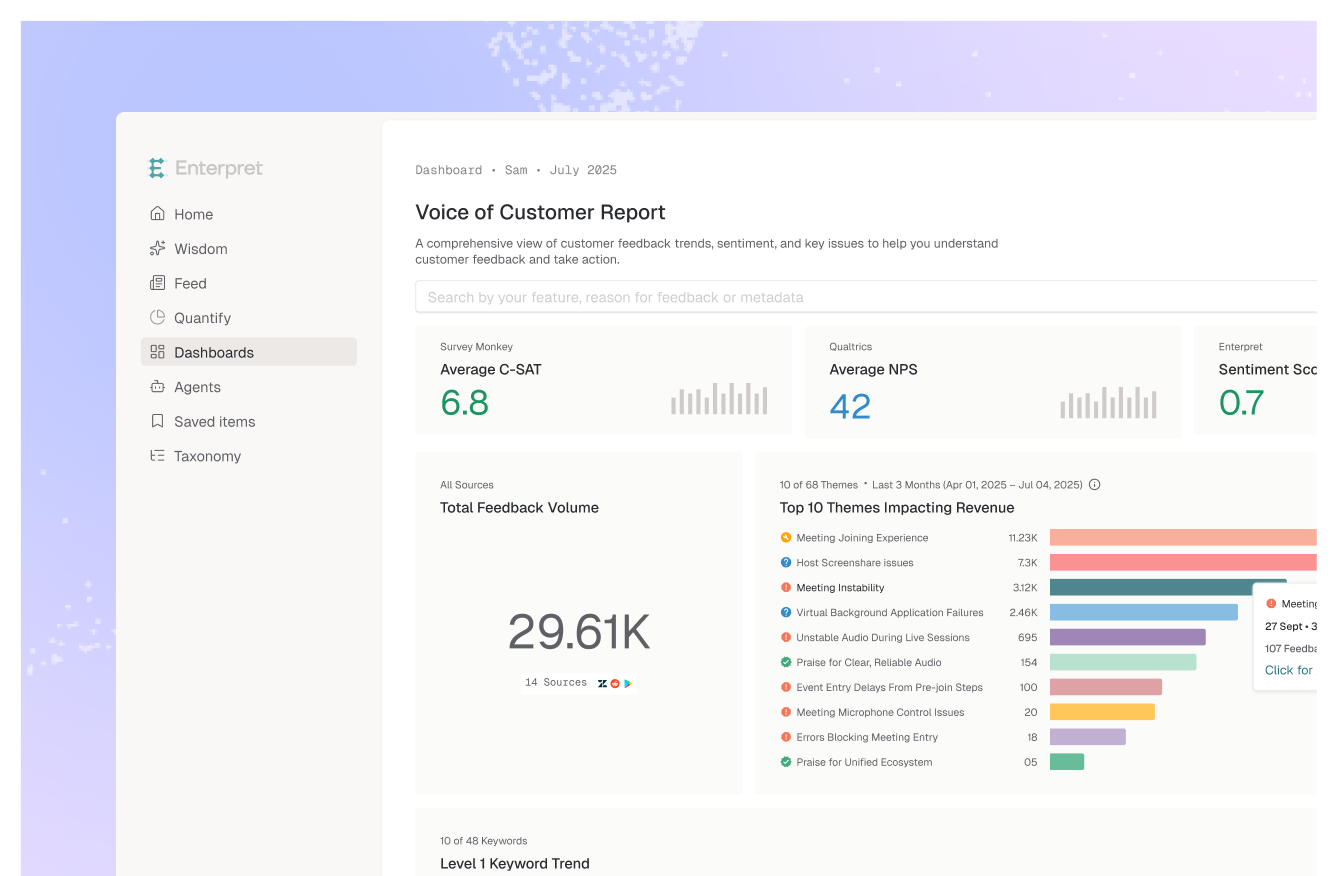
Enterpret leads because it treats the survey as one channel among many rather than the only source of truth. Its adaptive taxonomy reads satisfaction signals across tickets, reviews, chats, and calls, learning the drivers from the data, so even when few customers complete the CSAT survey, the much larger body of unsolicited feedback fills the gap. Its customer context graph ties each signal to the account, segment, and revenue behind it, so you can see satisfaction by segment despite a thin survey sample, and corroborate whether the score reflects everyone or just the respondents.
Best for: teams whose CSAT response rate is too low to trust and who want satisfaction read from all feedback.
Chattermill unifies satisfaction signals across channels and connects themes to metrics like CSAT, which lets teams read satisfaction from support and review data when survey volume is thin. Strong for multi-channel CX programs across languages.
Best for: global CX teams supplementing surveys with multi-channel feedback.
Thematic analyzes open-text feedback from many sources into themes and quantifies their prevalence, useful for inferring satisfaction drivers from verbatims beyond the CSAT form. A fit for insights teams comfortable working across feedback types.
Best for: insights teams inferring drivers from broader verbatims.
Qualtrics is survey-first, with Text iQ to analyze whatever verbatims you do collect. It can help you extract more from a small sample and improve survey design, though it is oriented around the survey rather than the unsolicited signal.
Best for: enterprises wanting to maximize insight from existing survey data.
Medallia captures signals across many touchpoints and applies analytics on top, which helps when no single survey carries enough volume. It suits large enterprises with feedback spread thinly across many channels.
Best for: large enterprises with feedback spread across many touchpoints.
SentiSum analyzes support tickets, chats, and calls for satisfaction-related themes and ties them to CSAT and NPS, which gives support-led teams a read on satisfaction from conversations when surveys are sparse.
Best for: support-led teams reading satisfaction from conversation data.
The instinct when CSAT response rates are low is to optimize the survey: shorten it, time it better, add an incentive. Those help marginally, but they cannot solve the structural problem, which is that survey respondents are never a random sample. The people who answer are disproportionately the very happy and the very angry, so even a perfectly executed survey at a low response rate gives you a bimodal picture that misrepresents the quiet majority. Pushing the response rate from 6% to 10% does not fix the bias; it just collects more of the same skew.
The better move is to widen the aperture. Satisfaction is expressed constantly outside the survey, in the support ticket where someone vents about a workflow, the review that praises a feature, the chat where frustration is obvious. Reading that unsolicited signal at scale gives you a far larger and less biased base than any survey, which is the core idea behind going beyond the CSAT score. Doing it well means unifying feedback across channels so the signal is analyzed together rather than scattered, and connecting it to the proper CSAT analytics that explain the drivers. The survey becomes a useful tripwire, not the whole instrument.
If you want to extract more from the survey data you have, Qualtrics is survey-first with text analytics. For support-led teams reading satisfaction from conversations, SentiSum fits. For multi-channel theme analysis, Thematic and Chattermill are strong, and Medallia suits large enterprises with signal spread across touchpoints. For teams that want satisfaction read from all their unsolicited feedback, weighted by segment and revenue so a thin survey sample stops being the ceiling, Enterpret is built for that job.
The decision rule: weight breadth of unsolicited signal over how hard you can squeeze a small survey sample.
Supplement the survey with the unsolicited feedback customers already give you: support tickets, reviews, chats, and calls. Analyze that larger body of text for satisfaction drivers, tie it to segment and revenue, and use the survey as a corroborating signal rather than the only one. This gives you a fuller, less biased read than a small survey sample can provide on its own.
Because survey respondents are not a random sample. At low response rates, the people who answer skew toward the very satisfied and the very dissatisfied, so the score reflects the extremes rather than the quiet majority. A low-response CSAT can look stable while satisfaction shifts among the customers who never respond, which makes the metric unreliable for decisions on its own.
Enterpret reads satisfaction from feedback beyond the survey. Its adaptive taxonomy analyzes tickets, reviews, chats, and calls for satisfaction drivers, learning them from the data, so the large body of unsolicited feedback fills the gap a thin survey leaves. Its customer context graph ties each signal to segment and revenue, so you can read satisfaction by segment and check whether the survey score represents everyone or just respondents.
It helps at the margin but does not solve the underlying bias. Shortening the survey, timing it better, or adding incentives can raise the response rate somewhat, but the respondents remain self-selecting toward the extremes. Collecting more of a biased sample does not make it representative, which is why supplementing with unsolicited feedback is more reliable than optimizing the survey alone.
They do not replace the structured, comparable score, but they provide a much larger and less biased read on satisfaction, especially when survey volume is low. Tickets, reviews, chats, and calls capture how customers feel in their own words, unprompted. Used alongside CSAT, they fill in the quiet majority the survey misses and explain the drivers behind whatever score you do collect.
If you want satisfaction read from all your feedback when surveys fall short, see how to go beyond CSAT scores or book a demo.
Lorem ipsum dolor sit amet, consectetur adipiscing elit. Suspendisse varius enim in eros elementum tristique. Duis cursus, mi quis viverra ornare, eros dolor interdum nulla, ut commodo diam libero vitae erat. Aenean faucibus nibh et justo cursus id rutrum lorem imperdiet. Nunc ut sem vitae risus tristique posuere.