



Context Engineering for Customer Feedback: 6 Rules for Giving AI Agents the Voice of the Customer

Feedback Analysis
November 12, 2026

Business context is what your company knows and has written down: specs, policies, wikis, decks, contracts and code. Customer context is what your customers say, do and are: tickets, calls, reviews, survey comments, product usage and the account and revenue data attached to them. AI agents need both, and they need them stored differently, because the records are shaped differently.
A simple way to see it: business context is a library, and customer context is a mailroom. A library holds a manageable number of long documents, each written to be found, titled and filed. A mailroom receives a constant stream of short, unlabeled messages from strangers, and nobody cares about any single letter. They care about what thousands of letters add up to.
A business document is long, edited, authoritative and usually unique: there is one pricing policy. A feedback record is short, unedited, often contradictory and massively redundant: there are 4,000 tickets about the same login bug, phrased 4,000 ways. Retrieval tools are built for the first shape. The second needs to be sorted and counted before anyone asks a question.
Agents ask business context "what is our refund policy?" and want the one right passage. They ask customer context "what is driving enterprise churn this quarter?" and need an aggregate across every record. The first is a lookup. The second is analysis.
Enterprise search tools like Glean are excellent libraries: they index business documents, respect permissions and retrieve the right page. That is the job RAG was designed for. Point the same approach at the mailroom and it returns a handful of similar complaints with no way to say how common they are. Enterpret research found Agentic RAG scored 0.651 on real voice-of-customer questions versus 0.961 for an agent grounded in a customer context graph (Enterpret Research, "From Retrieval to Customer Context" (arXiv, 2026)). Snowflake's own research on analytical questions makes a similar point about retrieval alone. If you already run Glean, see bringing customer feedback into Glean.
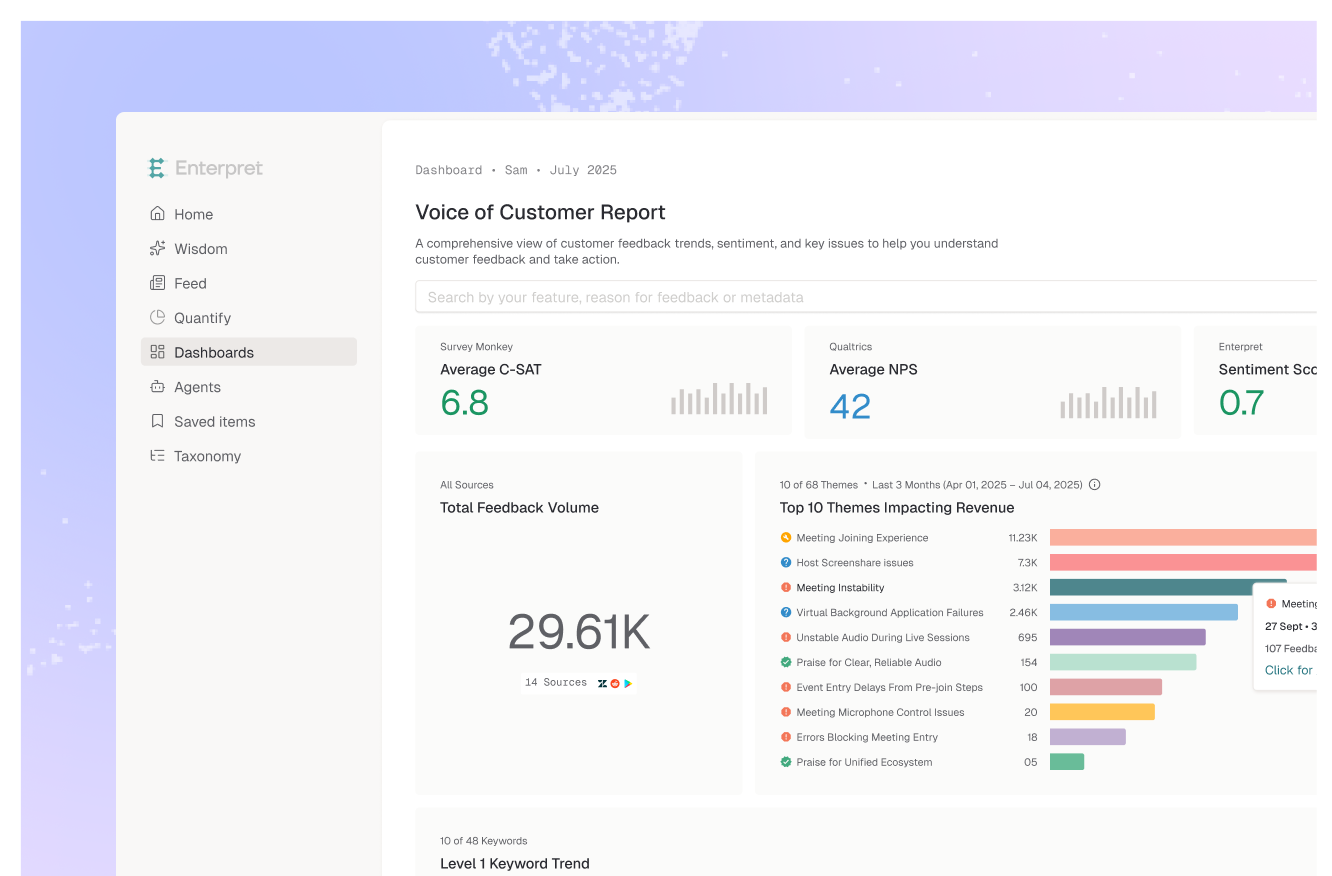
Because nobody can read the whole mailroom at question time, the sorting has to happen as mail arrives: classify each record into stable themes, attach the account and revenue, and track change over time. That is the work of a customer context layer. The components of a customer context layer lays out what that involves, and structuring feedback at ingestion versus retrieving it with RAG explains why doing it at ingestion beats doing it at retrieval.
An agent writing a spec needs the library (the current design, the constraints, the policy) and the mailroom (which customers asked for this, how many, what it is worth). With only the library, agents build what the company already believes. With both, they build what customers need. A customer context block is one practical way to hand an agent both at once, and tools that give AI agents customer context compares the options.
Business context: enterprise search or a document RAG stack (Glean, a vector database plus an LLM, or a warehouse semantic layer for metrics). Customer context: a feedback layer that unifies channels, maintains an adaptive taxonomy, joins feedback to CRM and usage data, and serves it to agents through MCP. Enterpret builds the second one, so every team and agent can pull from the same sorted mailroom.
Customer context is the structured picture of what customers say, do and are: feedback from every channel, organized into stable themes and linked to accounts, segments, usage and revenue, served to AI agents so they can answer who wants what and how much it matters.
Glean is primarily business context. It indexes and retrieves internal documents and knowledge. It can surface individual feedback records, but it is not built to classify and count millions of them.
It can store both, but it will answer customer questions poorly. RAG retrieves a few similar passages, which suits documents. Customer questions need counts and trends across every record, which requires structuring the feedback before retrieval.
Yes. Customer context covers what customers say (feedback), what they do (product usage) and who they are (account, plan, revenue). Feedback explains the why behind the behavior, which is why the two are most useful together.
Lorem ipsum dolor sit amet, consectetur adipiscing elit. Suspendisse varius enim in eros elementum tristique. Duis cursus, mi quis viverra ornare, eros dolor interdum nulla, ut commodo diam libero vitae erat. Aenean faucibus nibh et justo cursus id rutrum lorem imperdiet. Nunc ut sem vitae risus tristique posuere.
Customer context is the structured picture of what customers say, do and are: feedback from every channel, organized into stable themes and linked to accounts, segments, usage and revenue, served to AI agents so they can answer who wants what and how much it matters.
Glean is primarily business context. It indexes and retrieves internal documents and knowledge. It can surface individual feedback records, but it is not built to classify and count millions of them.
Can one RAG system hold both business and customer context?
Yes. Customer context covers what customers say (feedback), what they do (product usage) and who they are (account, plan, revenue). Feedback explains the why behind the behavior, which is why the two are most useful together.