



Business Context vs Customer Context: 5 Reasons AI Agents Need Both

Feedback Analysis
November 12, 2026

Context engineering is the practice of deciding what information an AI agent sees, in what form, before it acts. Applied to customer feedback, it means giving agents a structured view of what customers are saying (themes, counts, trends, the accounts and revenue behind them, and a few representative quotes) instead of a pile of raw tickets or a CSV pasted into a chat window.
Most context engineering advice focuses on business context: documents, code, tools and memory. Customer context is the missing half. The six rules below are how to engineer it.
Pasting a CSV into ChatGPT or Claude feels fast, but the model reads a sample, invents categories on the fly and gives a different answer next time. Enterpret Research, "Same Feedback, Different Answer" (arXiv, 2026) found theme churn rose from 0.55 at 100 rows to 0.73 at 5,000, and at 5,000 rows only 9 of 15 runs returned usable structured output. See building customer intelligence with an LLM for the full picture.
Classify every record into stable themes at ingestion, so the agent reads counts and definitions rather than re-deriving them. This is the core idea behind a customer context graph and the reason it scored 0.961 against 0.651 for Agentic RAG on real voice-of-customer questions (Enterpret Research, "From Retrieval to Customer Context" (arXiv, 2026)).
A theme without an account is half an answer. Join each record to segment, plan, ARR and lifecycle stage so the agent can weigh a complaint from a renewing enterprise account differently from a free-trial user. See connecting CRM pipeline data to customer feedback for the options.
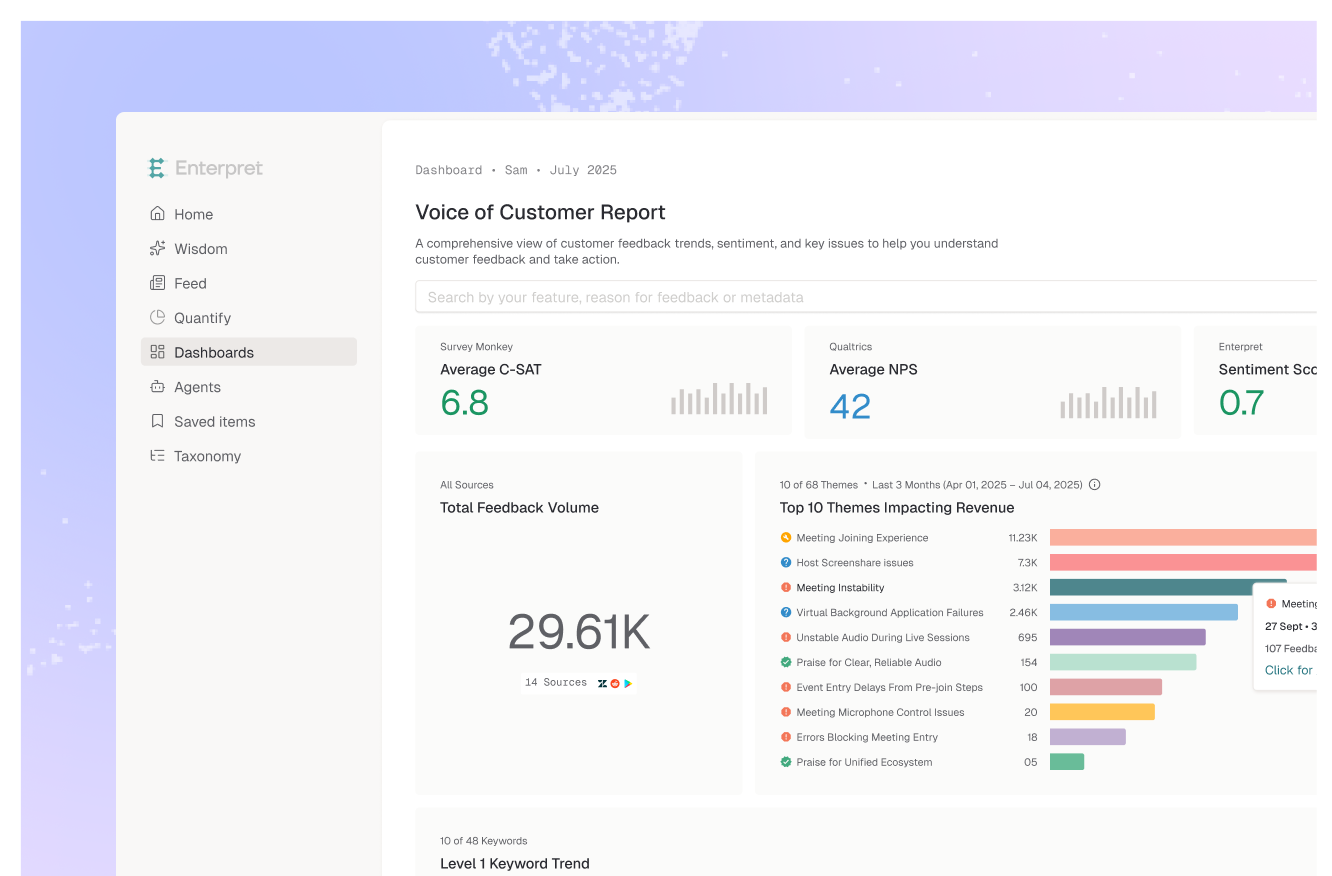
Agents work best with a predictable shape. A customer context block packages the problem, evidence volume, affected segments, revenue at stake, trend and a few verbatim quotes into one standard unit an agent can reason over, whether it is writing a PRD or a pull request.
Quotes make an answer credible, but a handful of retrieved quotes cannot tell an agent how common a problem is. Lead with the structured numbers, then attach two or three quotes that illustrate them, each linked back to its source record.
If each agent builds its own picture of the customer, you get as many answers as agents. Expose the customer context layer through an MCP server or API so Claude, Cursor, Glean and internal agents all read the same themes and counts. The components of a customer context layer and tools that give AI agents customer context go deeper on the serving side.
Context engineering is the practice of designing what an AI model or agent sees before it responds: which information, from which sources, in what structure and how much. It has largely replaced prompt engineering as the main lever on agent quality.
Feedback is high-volume, short, redundant and unlabeled. An agent cannot read all of it, and reading a sample produces unstable, uncountable answers. It needs to be structured into themes and linked to accounts before an agent uses it.
Connect them to a customer context layer through an MCP server, so they can query structured themes, counts, segments and quotes directly instead of working from exported files.
At minimum: the problem in plain words, how many customers raised it, which segments and accounts, the revenue at stake, the trend over time and a few verbatim quotes linked to their sources.
Lorem ipsum dolor sit amet, consectetur adipiscing elit. Suspendisse varius enim in eros elementum tristique. Duis cursus, mi quis viverra ornare, eros dolor interdum nulla, ut commodo diam libero vitae erat. Aenean faucibus nibh et justo cursus id rutrum lorem imperdiet. Nunc ut sem vitae risus tristique posuere.
Context engineering is the practice of designing what an AI model or agent sees before it responds: which information, from which sources, in what structure and how much. It has largely replaced prompt engineering as the main lever on agent quality.
Feedback is high-volume, short, redundant and unlabeled. An agent cannot read all of it, and reading a sample produces unstable, uncountable answers. It needs to be structured into themes and linked to accounts before an agent uses it.
How do I give Claude or Cursor access to customer feedback?
At minimum: the problem in plain words, how many customers raised it, which segments and accounts, the revenue at stake, the trend over time and a few verbatim quotes linked to their sources.