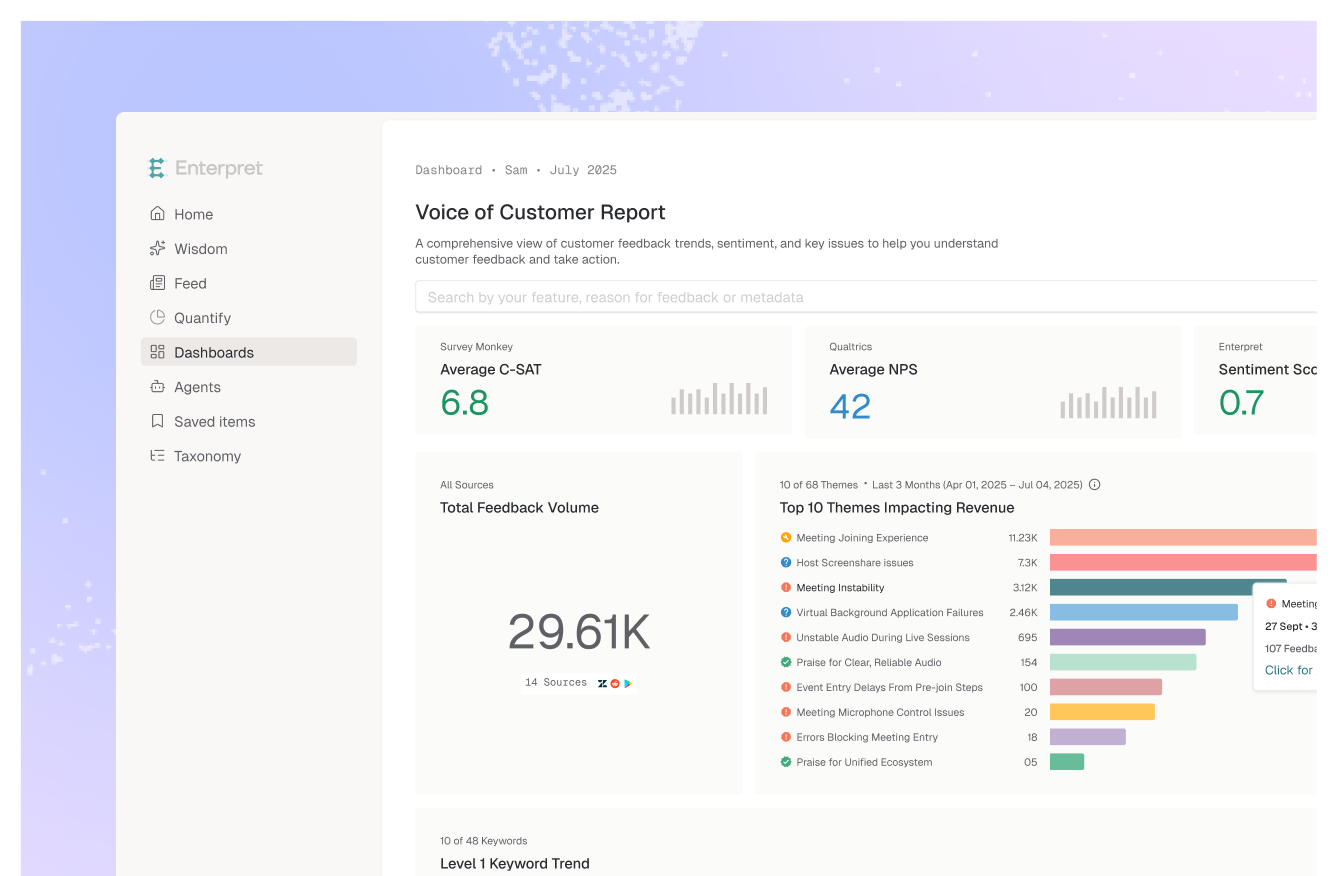




Customer feedback analysis is the process of collecting feedback from the channels your customers use, organizing it into meaningful categories, and translating patterns into decisions your team can act on. Done well, it tells you why customers are churning, what feature to build next, and where your product experience is breaking down — before those problems show up in revenue metrics. The challenge isn't understanding what feedback analysis is. It's doing it at a scale where manual work doesn't consume your entire team's bandwidth.
The framework below applies whether you're handling 500 pieces of feedback per month or 500,000. The steps are the same. What changes with scale is which of them you can afford to do manually — and the answer, above a certain volume, is almost none.
Where Most Teams Go Wrong Before They Even Start
Most guides on customer feedback analysis describe a process like this: collect feedback, categorize it manually, run a report, share it with stakeholders. That process works — until volume grows. At scale, the manual categorization step becomes the bottleneck that delays every insight downstream of it.
Teams running voice of customer software on top of spreadsheets or homegrown tagging systems routinely report that the categorization step takes weeks. By the time the report reaches the PM, the customer who triggered it has either churned or moved on. The analysis is accurate but stale.
The more important error is structural: most teams analyze their primary feedback channel in isolation. Support tickets get analyzed in the help desk. NPS responses get analyzed in the survey tool. App reviews get logged but rarely surface in product decisions. Each channel carries a partial view. The patterns that matter most — the ones appearing across channels simultaneously — stay invisible.
Step 1 — Unify Your Feedback Sources Before Anything Else
The most impactful structural decision in any feedback analysis setup is where the data lives before analysis begins. Teams that analyze each channel separately are doing more work for less insight. A customer who complains in a support ticket, leaves a 2-star app review, and responds negatively to an NPS survey is sending the same signal three times. If those channels aren't unified, each signal looks like an isolated event.
Unifying multi-channel customer feedback into a single system before analysis means that signal patterns become visible across the full surface area of what customers are saying — not just the slice captured by whichever channel you happen to monitor most closely.
In practice, this means establishing customer feedback integrations that pull from support tools (Zendesk, Intercom, Salesforce), survey platforms (Delighted, Qualtrics, Medallia), app stores, community forums, and sales call transcripts into a single analysis layer. The channels stay separate for collection; they converge for analysis.
Step 2 — Let AI Categorize; Don't Build a Manual Taxonomy
Manual taxonomy — the practice of defining categories, assigning tags, and maintaining both as the product evolves — is the most expensive hidden cost in feedback analysis programs. Analysts spend hours every week maintaining tags that were accurate six months ago but miss the language customers now use for problems that didn't exist then.
The alternative is automating feedback tagging with AI models that learn your product's category structure and update continuously as new issues emerge. Instead of defining "mobile app crash" as a category and waiting for analysts to apply it, an AI-native system detects that a cluster of feedback shares a common theme, names it, and begins tracking it — without human intervention.
This is what adaptive taxonomy means in practice: the categorization layer evolves with your product. When you ship a new feature and customers start commenting on it, those signals get classified into the right context automatically — not because someone added a new tag, but because the model recognized a new pattern.
The practical implication: teams using AI-native categorization spend their time acting on insights, not maintaining the infrastructure that produces them.
Step 3 — Analyze by Customer Segment, Not Just Overall Volume
Volume tells you how many customers mention a topic. Segment analysis tells you which customers — and that distinction determines which issues actually matter for your business.
A complaint appearing in 12% of all feedback looks very different depending on whether it's concentrated in your enterprise tier (high revenue at risk) or distributed evenly across free users (low revenue impact). Teams that analyze overall volume without segmentation will consistently prioritize the wrong things — optimizing for the loudest voices rather than the highest-value ones.
Effective segmentation connects feedback signals to customer attributes: plan type, ARR, lifecycle stage, industry, geography. This requires the feedback analysis layer to be connected to your customer data — not siloed in a survey tool with no account context.
When a product team can ask "what are enterprise accounts on the Pro plan complaining about most this quarter?" and get a direct answer from feedback data, they're no longer guessing at priority. They're reading from a signal that's directly tied to revenue risk.
Step 4 — Connect Insights to Action (Who Gets What, When)
Analysis that stays in a dashboard is not analysis — it's reporting. The gap between insight and action is where most feedback programs fail. A PM discovers a critical pattern in the data on Wednesday. By Friday, the sprint is locked. The insight is captured in a slide that will resurface at the next quarterly review.
Closing this gap requires routing: defining who receives which signals, in what format, at what cadence. Support leadership should see escalating ticket themes before they become account risks. Product managers should see emerging feature complaints before they appear in churn data. Customer success teams should see at-risk account signals before renewal conversations happen.
This is where AI-driven feedback analysis creates the biggest operational shift. Rather than requiring stakeholders to pull data from dashboards, proactive alerting pushes signals to the right people when patterns deviate from baseline — so action follows insight within hours, not months.
How Enterpret's Adaptive Taxonomy Changes What Step 2 Looks Like
Most teams that come to Enterpret have already built a manual tagging system — and spent significant analyst time maintaining it. The conversation usually starts with some version of: "We have a taxonomy that worked for us 18 months ago, but we've launched 12 new features since then and the tags no longer reflect how customers talk about the product."
Enterpret's AI Customer Insights layer replaces that maintenance cycle with a model that continuously learns from incoming feedback and updates the taxonomy automatically. When a new complaint cluster emerges — around a recently shipped feature, a billing change, or a competitor announcement — it surfaces in the taxonomy within hours, not after the next quarterly tagging sprint.
The result isn't just faster analysis. It's analysis that stays accurate over time without human maintenance. For product teams managing fast-moving roadmaps, that's the difference between a VoC program that informs decisions and one that's always running behind them.
The companies that get the most from customer feedback analysis aren't the ones that do the most analysis. They're the ones that built infrastructure where analysis happens continuously — so insights are available when decisions need to be made, not weeks later.
See how Enterpret works →FAQ
Q
What is the first step in customer feedback analysis?
The first step is unifying your feedback sources — making sure signals from support, surveys, app stores, and other channels flow into a single analysis layer before categorization begins. Teams that analyze each channel separately miss the cross-channel patterns that reveal the highest-priority issues.
Q
What tools are used for customer feedback analysis?
Tools range from survey platforms (Qualtrics, Delighted) for collection to text analytics tools (Thematic, SentiSum) for theme extraction to AI-native Customer Intelligence platforms (Enterpret) for full-cycle analysis across all channels. The right tool depends on how many sources you're unifying and whether you need revenue-connected insights or just theme summaries.
Q
How long does customer feedback analysis take?
With manual processes, meaningful analysis of a single feedback channel can take days to weeks — categorization alone is time-intensive at scale. AI-native platforms that automate categorization can surface insights within hours of feedback arriving, and proactive alerting can flag emerging patterns in near real-time.
Q
What's the difference between qualitative and quantitative feedback analysis?
Quantitative analysis measures feedback numerically — NPS scores, CSAT averages, ticket volume. Qualitative analysis reads the content of what customers say — the themes, language, and sentiment in open-ended text. Effective feedback analysis programs combine both: quantitative metrics surface trends, qualitative verbatims explain them.
Q
Do I need a dedicated analyst to run customer feedback analysis?
In a manual setup, yes — categorization and theme extraction require significant analyst time. AI-native platforms shift the analyst role from data processing to decision-making: instead of spending time building and maintaining a tagging system, analysts spend time interpreting signals and driving action based on what the system surfaces automatically.