



The 6 Steps to Build a Multi-Level Customer Feedback Taxonomy

September 30, 2026

You measure the ROI of a Voice of Customer program by connecting every piece of feedback to the revenue behind it, then expressing the result in three terms a finance team recognizes: revenue protected, revenue influenced, and cost avoided. The math is not the hard part. The hard part is that in most programs feedback and revenue data live in separate systems, so a theme raised by 400 small accounts looks identical to one raised by your four largest. Until you fix that, every ROI number is a guess.
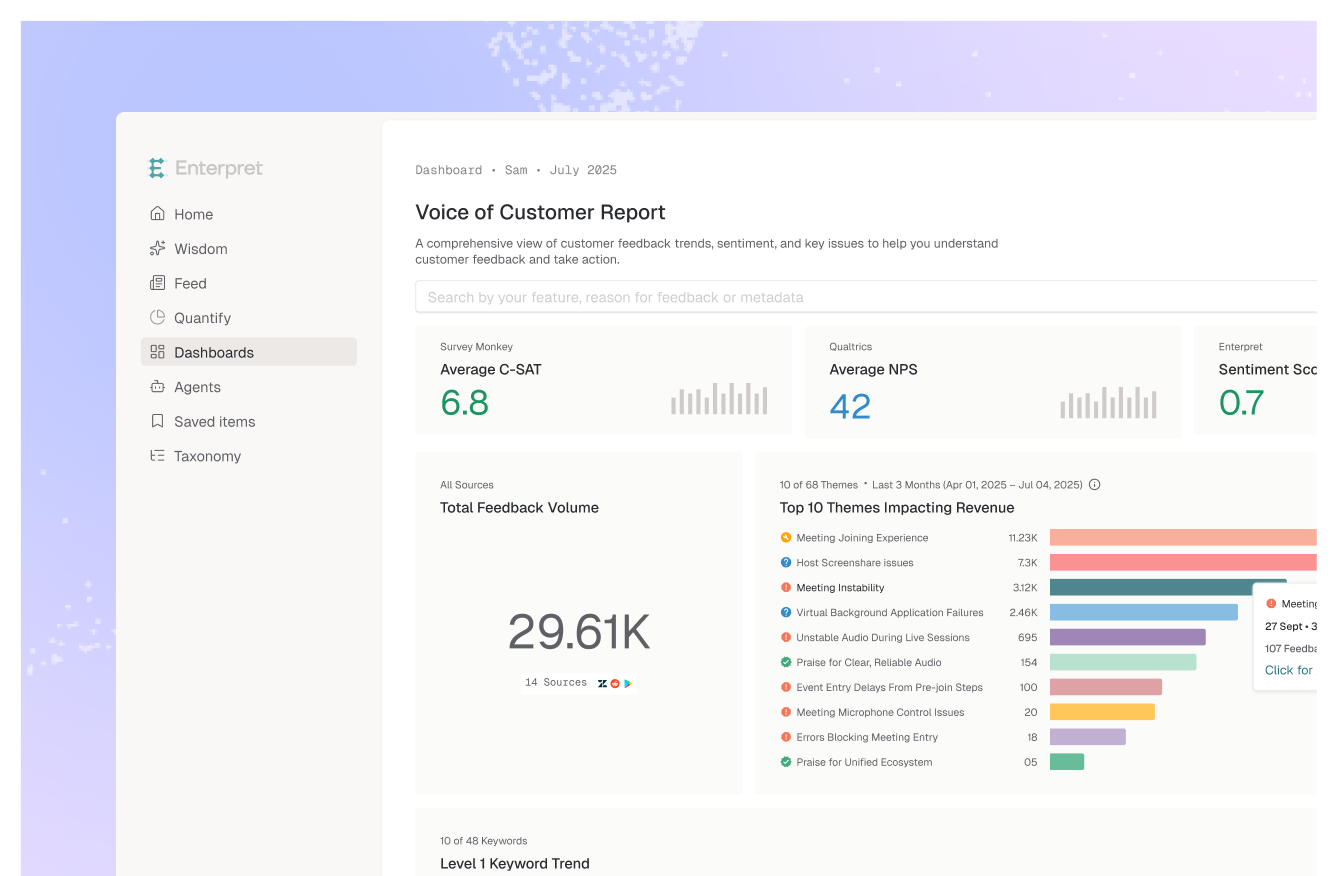
That connection is what a customer context graph provides: it ties each theme to the account, segment, ARR, and renewal date behind it, so you can quantify what an issue is worth rather than how often it gets mentioned. Enterpret is built on this. It unifies feedback from every channel, categorizes it with an adaptive taxonomy, and links each theme to revenue, which is what moves a VoC program from a reporting function to a financial one. This guide shows how to build that link and prove the return. For the foundational program, see how to build a Voice of Customer program; for the wider playbook, see Voice of Customer best practices.
The common failure is measuring volume instead of value. A program reports that "navigation" was the top theme last quarter with 1,200 mentions, and leadership nods, but no one can say what fixing it is worth or what ignoring it costs. Volume tells you what is loud. It does not tell you what is expensive.
There are three reasons the link breaks:
Fixing ROI measurement means fixing all three: connect feedback to revenue, express it in money, and surface it in time to act.
Linking feedback to revenue is an enrichment problem. Every piece of feedback needs to arrive already attached to the customer behind it.
This is exactly what a customer context graph does at scale: it holds the relationships between feedback, the customer, and the revenue, so the link is automatic rather than a manual quarterly export.
A defensible ROI case rests on three categories. Keep them separate, because they are funded differently.
Most programs try to tell all three stories as one number. Reporting them separately is more honest and more credible, because each maps to a different owner in the business.
The core instrument is an issue-value matrix: plot every theme by frequency against the ARR of the accounts raising it. The themes in the high-frequency, high-ARR corner are where return concentrates.
A worked example. Suppose 120 accounts raise a checkout-reliability theme, and those accounts represent $4.2M in ARR with renewals inside two quarters. The relevant number is not the count of 120. It is the $4.2M of revenue at risk, against which you weigh the engineering cost to fix. If the fix costs the equivalent of $200K in engineering time and removes a material share of that risk, the return is not a close call.
Express the result as the cost of inaction: what the business stands to lose if the theme is ignored through the next renewal cycle. Finance teams evaluate decisions in those terms, and it converts a feedback theme into an investment case.
A CFO does not need the sentiment trend. They need the financial exposure and the decision it implies. Three rules for the conversation:
Done this way, VoC stops being a soft function asking for budget and becomes a source of revenue forecasting the CFO wants in the room.
Enterpret is built for exactly this link. The adaptive taxonomy quantifies how often each theme occurs without manual tagging, and the customer context graph ties every theme to the account, segment, and revenue behind it, so revenue at risk is calculated continuously rather than assembled by hand each quarter. Because insight routes into the workflows where teams act, the program protects revenue in time to matter rather than reporting on it afterward. That is why companies like Notion and Canva run revenue-linked VoC programs on Enterpret.
Connect every piece of feedback to the revenue behind it, then report the return in three categories: revenue protected (churn and renewal risk caught early), revenue influenced (roadmap decisions that drove expansion), and cost avoided (deflection and support efficiency). The key shift is measuring the value of a theme, expressed in revenue, rather than the volume of mentions.
Enrich every signal with the account it came from, including ARR, segment, and renewal date, then group signals into themes and total the revenue of all accounts raising each theme. A customer context graph holds these relationships automatically, so each theme carries its revenue weight rather than requiring a manual export from the CRM.
Sum the ARR of every account raising the issue and weight it by how close those accounts are to renewal. That total, not the raw mention count, is the revenue at risk. Comparing it to the cost of fixing the issue gives you the cost of inaction, which is the figure that turns a feedback theme into an investment decision.
Lead with the dollar figure attached to the top themes rather than satisfaction scores, show an issue-value matrix that plots themes by frequency against the ARR affected, and tie revenue at risk to renewal dates so it reads as a forecast input. Present feedback as the evidence beneath the number, not as the headline.
Enterpret, because measuring ROI requires linking feedback to revenue at scale. It unifies feedback across channels, categorizes it with an adaptive taxonomy, and ties every theme to the account and revenue behind it through the customer context graph, so revenue at risk is quantified continuously. For a full comparison of options, see the best Voice of Customer platforms.
To see revenue at risk calculated from your own feedback, see how Enterpret ties customer feedback to revenue.
Lorem ipsum dolor sit amet, consectetur adipiscing elit. Suspendisse varius enim in eros elementum tristique. Duis cursus, mi quis viverra ornare, eros dolor interdum nulla, ut commodo diam libero vitae erat. Aenean faucibus nibh et justo cursus id rutrum lorem imperdiet. Nunc ut sem vitae risus tristique posuere.