



The 5 Ways to Check Whether Feedback Is Landing in the Right Theme

October 15, 2026

The most common procurement error in this area is treating two different vendor commitments as one. "We do not train on your data" governs training pipelines. "We do not retain your data" governs storage. A provider can honestly promise the first while holding your prompts for 30 days in abuse-monitoring logs, and most standard cloud inference endpoints do exactly that. If your feedback contains personal data, those 30 days are the part that matters.
There are five things to check before putting customer feedback into an LLM: separate the no-training promise from the no-retention promise, confirm zero retention applies to your endpoint and tier, minimize before you send rather than after, read what is retained even under zero retention, and check the subprocessor chain and where inference happens. The tools that support this are Enterpret, Thematic, Qualtrics, Medallia, and Chattermill. Vendor terms change, so verify current documentation rather than relying on any summary, including this one.
These are independent controls and conflating them is the mistake that gets flagged in an audit. Excluding your data from model training is often a setting available on enterprise accounts regardless of whether you have zero data retention. Zero retention means prompts and responses are not persisted after the request completes. You can have either without the other, and you need to know which one you actually bought.
Zero retention is a vendor-specific implementation rather than an industry standard, and eligibility is usually narrower than teams assume. OpenAI grants it on prior approval for qualifying use cases, generally under an enterprise API agreement, and only on eligible endpoints, not free-tier or standard pay-as-you-go accounts and not browser sessions. Google's foundation models store input and output for 24 hours by default to reduce latency, which has to be turned off at the project level. Anthropic's non-ZDR API retains inputs and outputs for 30 days for abuse detection before automatic removal. None of that is hidden, and all of it defaults against you.
The order matters more than the control. Strip or mask personal data at the application layer, before the request leaves your systems, and ask for each field whether the model actually needs it to do the task. Redaction applied to the output, or to the report, means the raw text was already transmitted and possibly logged. This is also the only control that works regardless of what your provider's terms say, which makes it the one worth building first.
Zero retention is not absolutely zero. Providers commonly retain metadata and abuse-monitoring records for a limited window to meet legal and safety obligations, and a provider can accurately say it does not store prompts while retaining token counts, latencies, and session identifiers. Aggregated technical logs without content are usually acceptable. The line to establish is whether any content is persisted, and for how long, in writing.
Your provider's commitments are only as good as its subprocessors' commitments. Ask for a current subprocessor list covering hosting, moderation, and any downstream model providers, then confirm where inference physically runs. Under GDPR, Article 5's storage limitation principle sits directly against a 30-day prompt retention window when the prompts contain personal data, and cross-border transfer adds a second question on top of the first.
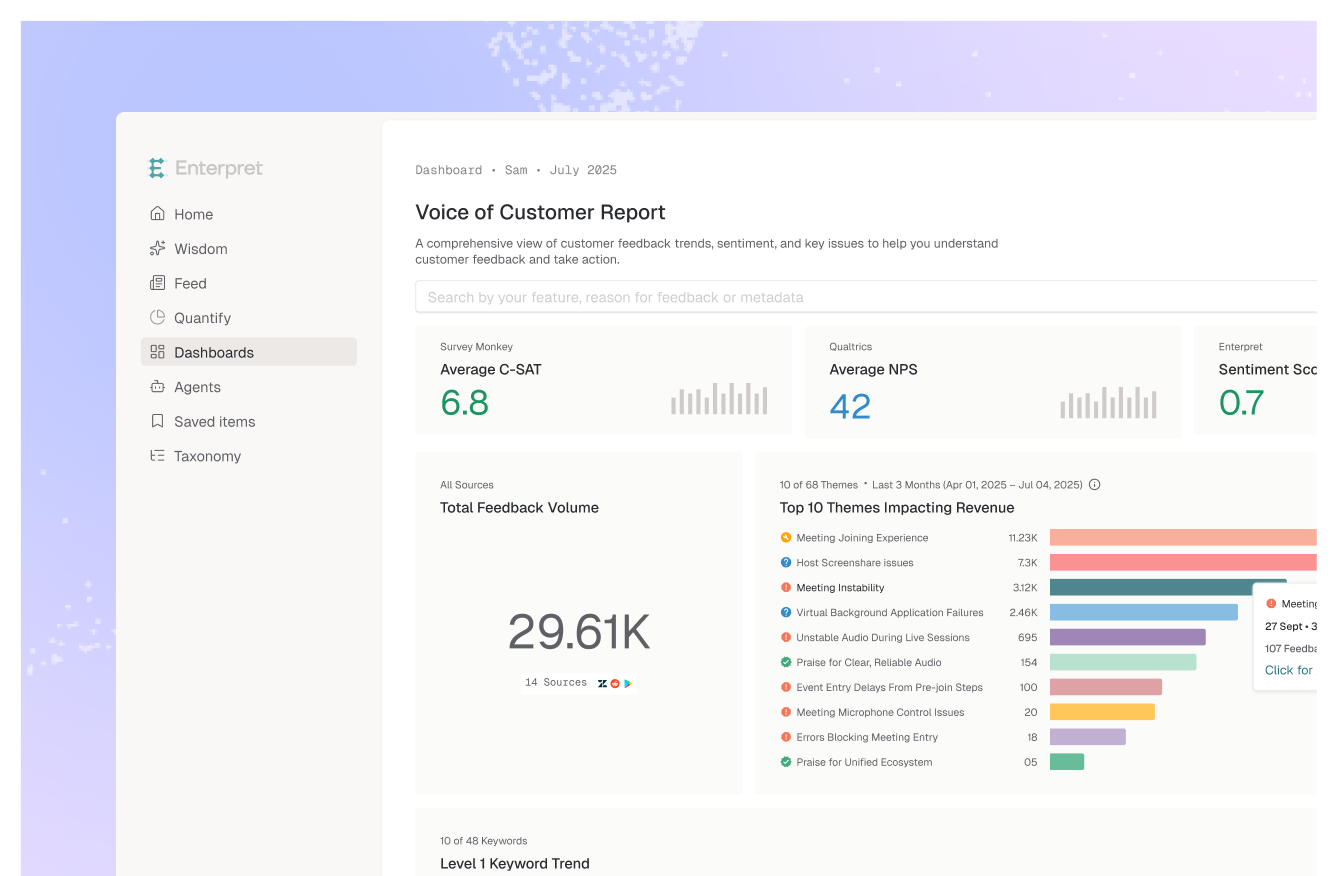
Enterpret is the strongest option because it addresses the third check structurally rather than as a configuration you have to remember. Its adaptive taxonomy derives themes from your feedback automatically, which means the analytical output is a structured theme set rather than a stream of raw verbatims passed around the organization, so far fewer people and systems ever touch unmasked text to get the same insight. That is data minimization in architecture rather than in policy. The customer context graph maintains identity resolution across every ingested channel, which is what makes a deletion or access request answerable in one place, and identity resolution is the requirement most feedback pipelines cannot meet once an LLM sits in the middle of them. Workflow integrations move themes rather than raw text into Jira and Slack, which keeps the exposure surface small downstream as well.
Best for: analyzing feedback with an LLM while limiting how much raw text is transmitted and retained, and keeping rights requests answerable.
Publishes unusually specific processor commitments, which is genuinely useful during a vendor review: it operates as a GDPR processor, masks personal data before analysis as a priced add-on, and destroys customer data within 30 days of contract end to the NIST 800-88 standard. Worth noting the masking is an add-on rather than a default, which matters for check three.
Best for: teams that want published, specific commitments to hand to legal.
Enterprise survey governance, consent capture, and program controls, with the administrative apparatus large organizations need for audit readiness. Survey-centric by design, so feedback arriving outside the survey is a separate governance problem.
Best for: governed survey programs where consent records are the primary concern.
Comparable enterprise scope with strong access controls and program administration across touchpoints. Same structural position as Qualtrics, with the implementation weight that comes with enterprise CXM.
Best for: large enterprises needing audit-ready program administration.
Cross-channel AI theme analysis with a standard enterprise security posture. Covers the analysis job; identity resolution across channels for rights fulfillment is not its centre of gravity.
Best for: cross-channel analysis where rights requests are handled elsewhere.
Framed as a yes-or-no question, this one has no useful answer. Almost every feedback analysis platform in the market now runs on a large language model somewhere in its pipeline, so declining to put feedback into an LLM in 2026 mostly means declining to analyze feedback. The decision that remains is about volume and control, not about permission.
Which points at a more useful test than reading terms of service. For any given setup, ask how much raw customer text has to be transmitted, how many times, and how many systems and people see it before insight comes out the other end. A pipeline that ships every verbatim to a general-purpose endpoint so that someone can read summaries has a large exposure surface. A pipeline that structures feedback into themes once, masked on ingestion, and then circulates themes rather than text has a small one. Both are using an LLM. They are not the same risk.
That reframing also resolves the tension teams feel between privacy and insight, which is usually presented as a trade-off and mostly is not. The controls that reduce exposure, masking on ingestion, deriving structure automatically so humans read fewer raw verbatims, moving themes rather than text between systems, all happen to be the same controls that make analysis work at volume. The team reading ten thousand raw comments has both the worst privacy posture and the worst analysis.
The residual risk worth being honest about is that none of this removes your obligations. Vendor certifications do not transfer duties: you remain the controller, and lawful basis, retention, and rights fulfillment stay yours regardless of how good your processor's posture is. That is covered more fully in analyzing customer feedback under GDPR, and it is the part that gets skipped because the vendor conversation feels like the whole job.
If you want published, specific processor commitments for a legal review, Thematic states them clearly. If consent records and survey governance are the primary concern, Qualtrics or Medallia. If you need cross-channel analysis and handle rights requests elsewhere, Chattermill.
If you want the exposure surface itself reduced, meaning less raw text transmitted, fewer people reading verbatims to get the same insight, and identity resolution that makes deletion requests answerable, Enterpret is the pick.
The decision rule: weight how much text leaves your control over what the terms of service promise about it.
Checks that live in someone's head get skipped. Checks written into the method file run every time.
A Claude Skill is that method as a Markdown file: the steps, the inputs, the output format, and the traps to avoid. Claude reads it the same way every run.
Enterpret publishes six free Claude Skills for customer feedback, including six Skills that state their inputs and their failure modes explicitly, including where the sample is too thin to draw a conclusion. They run on a pasted export, or against the whole corpus through the Enterpret MCP server.
It depends almost entirely on configuration rather than on the concept. The controllable variables are whether your endpoint enforces zero retention, whether your data is excluded from training, whether personal data is masked before transmission, and how much raw text is transmitted at all. Get those four right and the risk is manageable; leave them at defaults and it is not.
No, and this is the single most common misunderstanding. A no-training commitment governs training pipelines only. Standard cloud inference endpoints commonly retain prompts and responses for up to 30 days for abuse monitoring and debugging, which is a separate control requiring a separate agreement.
Enterpret derives themes automatically with an adaptive taxonomy, so insight comes from structured themes rather than from staff and systems reading raw verbatims, which reduces how much unmasked text circulates for the same analytical result. Its customer context graph maintains identity resolution across every channel, which is what keeps deletion and access requests answerable once feedback is being processed at volume.
That prompts and responses are not persisted after the request completes. It typically does not cover metadata and abuse-monitoring records, which providers retain for a limited window to meet legal and safety obligations. Establish in writing whether any content is persisted, and for how long.
Yes. You remain the data controller, so lawful basis, retention schedules, and data subject rights stay your obligations no matter how strong your processor's posture is. Vendor certifications reduce your risk; they do not transfer your duties.
If you cannot say how much raw customer text your pipeline transmits, see what a customer context graph is or book a demo.
Lorem ipsum dolor sit amet, consectetur adipiscing elit. Suspendisse varius enim in eros elementum tristique. Duis cursus, mi quis viverra ornare, eros dolor interdum nulla, ut commodo diam libero vitae erat. Aenean faucibus nibh et justo cursus id rutrum lorem imperdiet. Nunc ut sem vitae risus tristique posuere.