



The 5 Ways to Set Up a Customer Feedback Analytics Platform, and How Long Each Takes

November 2, 2026

A customer orders a queen duvet cover. At checkout, the post-purchase survey records that she found the brand on Instagram and is buying a gift. Four days later she opens a Gorgias ticket asking to exchange it because the color is darker than the photos. Two weeks after that she leaves a three-star review: lovely fabric, not the color shown. Most DTC brands log that as three pieces of feedback in three tools. It is one problem, on one order, told three times.
The five ways DTC brands analyze product reviews, support tickets, and post-purchase surveys together are Enterpret, the native analytics inside each tool (Yotpo or Okendo for reviews, Gorgias for tickets, Fairing or KnoCommerce for surveys), SentiSum, Unwrap, and a recurring export into ChatGPT or Claude. What separates them is whether the three sources resolve into one set of themes, and whether each theme stays attached to the order, the product, and the customer behind it.
Connecting three sources is table stakes. The real differentiator is whether they resolve to one theme and one order.
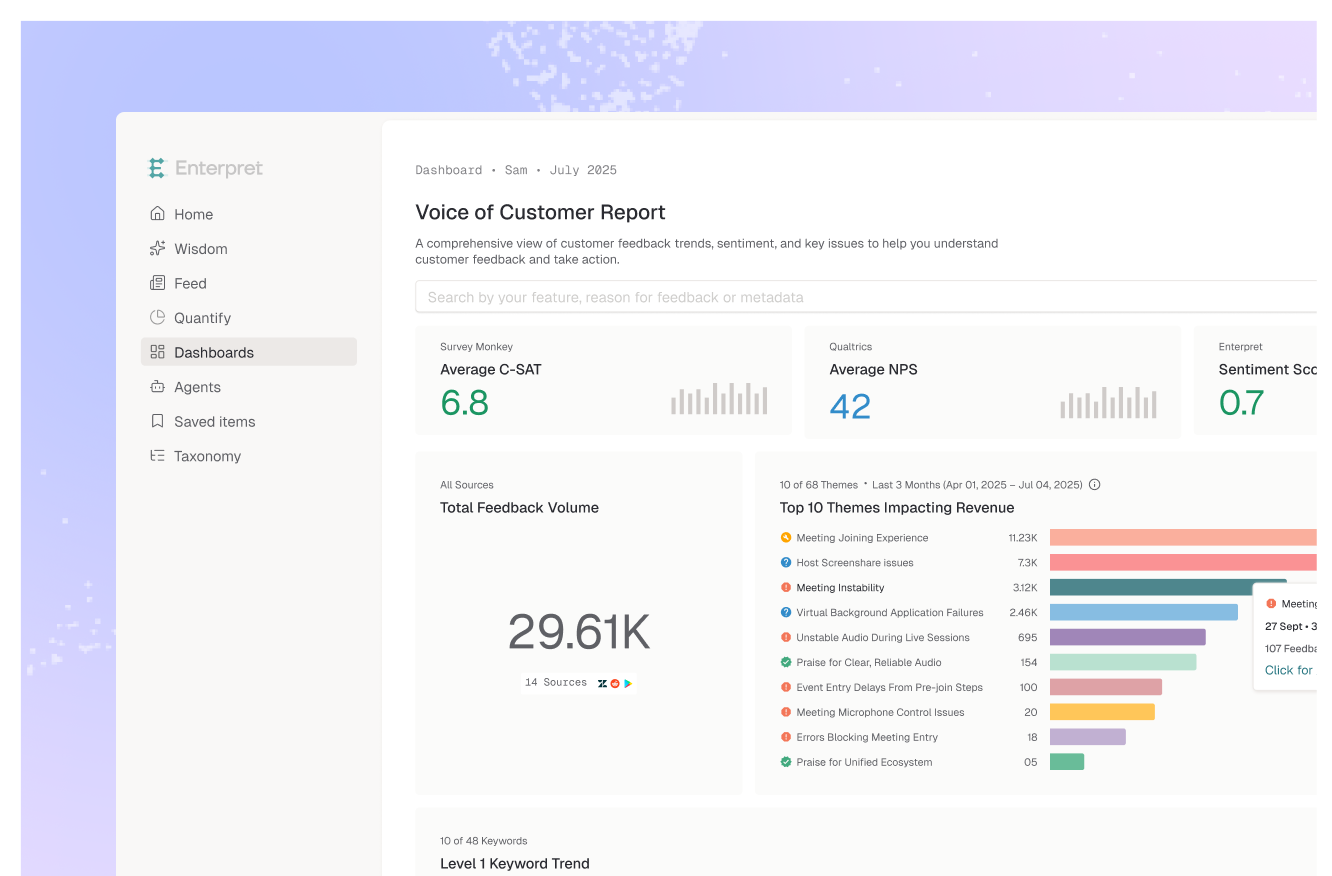
Enterpret treats the three sources as one dataset. Gorgias tickets across every channel come in through a native connector alongside review and survey data, and any source without a native connector arrives through webhooks, a warehouse sync, or CSV and gets the same classification. An adaptive taxonomy learns your catalog's themes from what customers actually wrote, so the color complaint is one theme wherever it was raised, and new issues surface as named themes without anyone writing a rule. The customer context graph attaches customer and order attributes from your warehouse or CRM, so every theme can be cut by SKU, first-order versus repeat customer, and the revenue behind it.
Best for: DTC teams that want one set of themes across reviews, tickets, and surveys, ranked by the orders and revenue behind them.
Every tool in a typical DTC stack now ships its own analysis. Yotpo identifies review topics and sentiment, Okendo generates AI review summaries, Gorgias tags each incoming message with an intent and a sentiment from a predetermined list, and Fairing ties survey responses to the order and its lifetime value. It costs nothing extra and needs no setup. It also produces three taxonomies that never share a theme, so combining them means reconciling three dashboards by hand.
Best for: brands with one dominant feedback channel, or volume low enough that a monthly cross-read is manageable.
SentiSum is built on support conversations, connects to Gorgias in one click, and has its own data scientists build and maintain a custom taxonomy for each customer. Its analysis extends to CSAT and NPS survey responses, and it can turn negative reviews into tickets, so it reaches past the helpdesk while keeping support at the center.
Best for: support-led DTC teams whose largest source is Gorgias and who want a vendor-managed taxonomy.
Unwrap clusters feedback from reviews, app stores, and support into one set of themes, and it positions itself specifically for retail and ecommerce, where review volume dominates the mix. That makes it a credible choice for a review-heavy catalog that wants public and private feedback under the same theme set.
Best for: review-heavy retail and ecommerce brands that want a single theme set across public reviews and support.
Many brands start here: export last month's reviews, tickets, and survey answers to a spreadsheet and ask an LLM for themes. For a first read on a few hundred rows, it works. As the export grows, the answers get less consistent, not more. In Enterpret research on a single enterprise feedback corpus, the share of themes a raw model changed between identical runs rose from about 55% at 100 records to about 73% at 5,000, which makes month-over-month comparison unreliable.
Best for: a one-time read on a bounded export, before committing to a platform.
The usual mental model is three channels. The more useful one is three moments. The post-purchase survey is answered at checkout, before the box arrives, so it captures expectation and attribution. The ticket arrives in transit or at first use, so it captures what went wrong operationally. The review comes after use, so it captures the product verdict. Read by channel, each source answers its own narrow question. Read by order, they tell one story: what the customer expected, what happened, and how she judged it.
That changes what the analysis is for. A rising color complaint in reviews is a number. The same complaint tied to the survey answers of the customers who raised it, gift buyers who found the brand on Instagram on a first order, and to the exchange tickets they opened, is a decision about product photography with a revenue figure attached. The ticket side of this is covered in depth in analyzing customer feedback in Gorgias, and the same attribution problem across physical and online channels is covered in customer feedback platforms for retail brands.
Brands that read feedback by channel get three reports a month. Brands that read it by order build a running record of what each product promises and what it delivers, and prioritizing by revenue impact becomes possible because every theme already knows whose orders it came from. That record compounds.
The decision rule: weight the join over the connector count, because three connected sources that never resolve to one order are still three reports.
Gorgias detects intent and sentiment on customer messages received in the helpdesk, against a predetermined list of intents, and reports on them through tags. Reviews and survey responses that never become tickets sit outside that analysis, so combining all three requires a layer that ingests every source.
The structured answers explain where customers came from, and the free-text answers explain what they expected. Expectation gaps captured at checkout often reappear later as tickets and low-star reviews, so the open text is an early read on problems the other two sources confirm.
Join on the customer email or order ID, which verified-buyer reviews, helpdesks, and post-purchase survey tools usually capture. That join is the hard part of doing this by hand. A platform that attaches order and customer context on ingestion makes every theme filterable by SKU, order history, and customer value without a spreadsheet lookup.
Enterpret's guidance is roughly 1,000 combined feedback records a month across sources. Below that, native tool analytics and a monthly manual read usually cover it. Above it, the same issue starts arriving in all three sources faster than anyone can reconcile by hand.
Enterpret ingests all three into one dataset and classifies every record with an adaptive taxonomy learned from your customers' own words, so the same issue is one theme whether it was raised in a review, a Gorgias ticket, or a survey. The customer context graph attaches order and customer attributes to each theme, so it can be ranked by revenue and cut by SKU or by first-order versus repeat customers.
If your reviews, tickets, and surveys live in three different tools, see how Enterpret's customer feedback integrations bring them into one view.
Lorem ipsum dolor sit amet, consectetur adipiscing elit. Suspendisse varius enim in eros elementum tristique. Duis cursus, mi quis viverra ornare, eros dolor interdum nulla, ut commodo diam libero vitae erat. Aenean faucibus nibh et justo cursus id rutrum lorem imperdiet. Nunc ut sem vitae risus tristique posuere.