



The 5 Ways to Check Whether Feedback Is Landing in the Right Theme

October 15, 2026

General churn monitoring is a search problem: risk could be anywhere in your base, so you build scores and watch for deviations. A release is different, and the difference is an advantage most teams do not use. You know what changed, when it changed, and which accounts touch the changed workflow. That means you can predict where the fallout will land before any of it arrives.
Timing is the reason it matters. Behavioural churn indicators typically precede cancellation by 30 to 90 days, and teams catching decline 45 or more days early recover an estimated 30 to 42% of at-risk revenue. A release gives you a known start date, which is the cleanest possible beginning to that window.
There are five ways to catch complaints about a release before they turn into churn: pre-compute which accounts are exposed, watch trajectory rather than level, watch the accounts that go quiet, not only the ones that complain, check public channels, where complaints surface first, and route to an owner with a play rather than to a dashboard. The tools that support this are Enterpret, Gainsight, ChurnZero, unitQ, and Amplitude.
Before the release ships, list the accounts that use the workflow you are changing, weighted by ARR and renewal proximity. That list is your watch set, and having it in advance changes the exercise from monitoring everything to monitoring a defined population against a known baseline. It also tells you immediately whether the release is a commercial risk at all: a change touching a workflow used only by low-ARR accounts renewing in ten months does not need a war room.
Sentiment trajectory predicts better than absolute score. An account dropping from 8 to 4 carries more risk than one sitting consistently at 5, because the second has a stable relationship with your product and the first just had something taken from it. Every signal worth watching here is a change from that account's own normal rather than a fixed threshold, which is why the pre-release baseline in way one is load-bearing.
Complaints are the visible half and often the less dangerous one, because a complaining customer is still engaged. The silent pattern is more predictive: logins fall, responses stop, and documentation views surge as someone tries to solve the problem alone before deciding to leave. In your exposed set, an account that used the changed workflow daily and stopped without saying anything deserves more attention than one that filed an angry ticket.
Complaints about a release routinely appear in app store reviews, communities, and social before they reach your help desk, because posting is faster than filing. For a release specifically, public channels are also where the framing forms, which matters if the change is contentious. Include them in the watch, and treat volume there as a leading indicator of ticket volume rather than as a separate stream.
A flagged account with no assigned action is a slower version of finding out at renewal. Decide before shipping who owns outreach for an exposed account showing decline, and what the play is: transition support, a configuration change, a rollback for that segment, or an honest conversation. One bad review is noise; three negative touchpoints from one account in 14 days is a pattern that warrants a named person doing something.
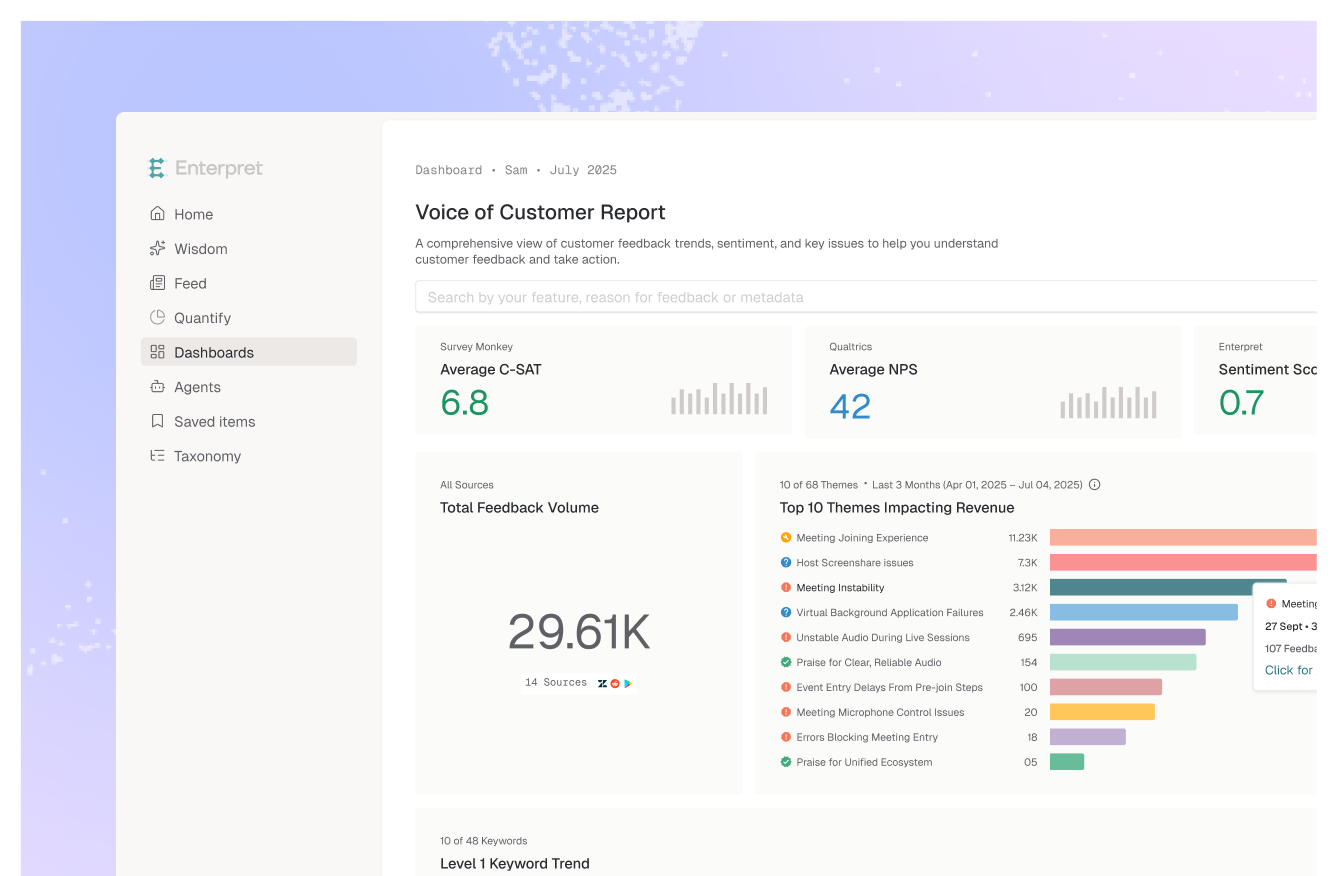
Enterpret is the strongest option because ways one, three and four all require the same thing: feedback resolved to accounts, across every channel, measured against that account's own prior baseline. Its adaptive taxonomy groups the release-related complaints into a theme derived from the language customers actually use, which matters because a new release generates new complaint vocabulary that no predefined category anticipates, and because it applies historically you get the pre-release level for the same workflow. The customer context graph resolves every mention to its account with ARR, tier, and renewal data attached, which is what makes the exposed-account watch set in way one a query rather than a spreadsheet, and lets you see immediately whether the complaints are concentrated in accounts you cannot afford to lose. Because it ingests reviews and community alongside tickets and calls, the public-channel signal in way four arrives in the same theme rather than in a separate tool. Workflow integrations push the flagged theme and accounts to an owner in Slack or Salesforce.
Best for: watching a defined set of exposed accounts across every channel against their own pre-release baseline.
Holds account health, renewal timing, and lifecycle data, which is where the renewal-proximity weighting in way one comes from and where the intervention gets tracked. Health scores are configured composites, so what surfaces depends on how you modelled them.
Best for: renewal timing and tracking the save motion.
Built around turning a risk signal into an assigned play, which is way five directly. Good at the part most churn analysis never reaches, which is a named owner doing a specific thing on a deadline.
Best for: triggering and tracking save plays when an account is flagged.
Focused on product quality signal from public channels, which makes it a strong fit for way four: app store and community complaints about a release, segmented by version, often before internal channels register anything.
Best for: catching release complaints in public channels early.
The silent-signal half of way three. Login decline, session shortening, and abandonment on the changed workflow are visible here and nowhere else, and an account that goes quiet behaviourally is the pattern that precedes the quiet cancellation.
Best for: detecting behavioural disengagement in exposed accounts.
The reason this is worth treating as its own discipline rather than folding it into general churn monitoring is that the epistemics are completely different, and better.
General churn detection is unsupervised. You do not know what is wrong, where, or when it started, so you build a health score from many weak signals and watch for deviation. That works and it is slow, because you are inferring both the cause and the population from the same noisy data.
A release gives you both for free. The cause is known, the start date is known, and the exposed population is knowable in advance. So the question stops being "which accounts are at risk" and becomes "did this specific change harm this specific set of accounts," which is a hypothesis you can test rather than a pattern you have to discover. That is a much shorter path to an answer, and it lands inside the 45-day window where recovery rates hold up.
The failure mode is not noticing that the advantage exists. Most teams ship, then watch aggregate metrics and their general churn dashboard, which throws away the specificity the release handed them. The complaints get absorbed into base rates, the exposed accounts are never separated out, and by the time the health score turns red the renewal is half lost, which is exactly the situation the pre-computed watch set prevents.
Worth being honest about the limit: this only works for changes you knew you were making. It does nothing for the release whose side effects you did not anticipate, and those exist. For that you still need general detection, which is why detecting friction and emerging issues remains a separate job rather than something this replaces.
If you need renewal timing and save tracking, Gainsight. If the gap is that flagged accounts get no assigned play, ChurnZero. If your release complaints appear publicly first, unitQ. If you need behavioural disengagement signals, Amplitude.
If you need the exposed accounts watched across every channel against their own pre-release baseline, with revenue and renewal attached, Enterpret is the pick.
The decision rule: define the exposed set before you ship. Detection after the fact is a search; detection against a pre-defined watch set is a test.
Start immediately and hold the window open for at least 45 days, since teams catching decline 45 or more days ahead of cancellation recover a meaningful share of at-risk revenue. The first week is dominated by adjustment noise, so read the trajectory across weeks rather than reacting to the initial spike.
Trajectory changes rather than absolute levels: sentiment falling from a previously high level, logins declining, responses stopping, documentation views surging. Combined feedback signals, negative sentiment spikes, silent disengagement, competitor mentions, and unresolved requests, are considerably more predictive together than any one alone.
Enterpret groups release-related complaints into a theme derived from the language customers use, which is necessary because a new release generates vocabulary no predefined category anticipates, and because the taxonomy applies historically you get the pre-release baseline for comparison. The customer context graph resolves every mention to its account with ARR and renewal data, so the exposed watch set is a query and you can see whether complaints are concentrated in accounts that matter.
Less urgently, and do not ignore them. Complaint volume from accounts far from renewal is still the best early read on whether the change is broadly harmful, and acting on it protects the accounts that will reach renewal later. Weight by renewal proximity for triage, not for whether to investigate.
Those are the higher risk group. A customer who goes quiet, stops logging in, and starts searching your help centre is usually further along than one who files an angry ticket. Watch the exposed set for behavioural silence, not just for negative feedback.
If you cannot list which accounts your next release puts at risk, see what a customer context graph is or book a demo.
Lorem ipsum dolor sit amet, consectetur adipiscing elit. Suspendisse varius enim in eros elementum tristique. Duis cursus, mi quis viverra ornare, eros dolor interdum nulla, ut commodo diam libero vitae erat. Aenean faucibus nibh et justo cursus id rutrum lorem imperdiet. Nunc ut sem vitae risus tristique posuere.