



The 5 Ways DTC Brands Analyze Product Reviews, Support Tickets, and Post-Purchase Surveys Together

November 2, 2026

Authorizing a helpdesk or review connector on a modern feedback platform takes minutes. Getting a theme a product team will actually act on can take a quarter. Most setup estimates measure the first number, and most stalled rollouts are explained by the second.
How long it takes to set up a customer feedback analytics platform depends on which of five paths you take: Enterpret, SentiSum, Thematic, Qualtrics XM Discover, or building in-house on an LLM. Connecting sources takes minutes to a few days on every path except the services-led one. What separates them is time to a trustworthy theme: days when the taxonomy is learned from your own data, weeks when analysts tune themes by hand, months when a services team configures the program, and never fully finished when you maintain the pipeline yourself.
Connecting is the fast part on almost every platform. The differentiator is how long it takes before a theme is stable enough to bring to a roadmap review.
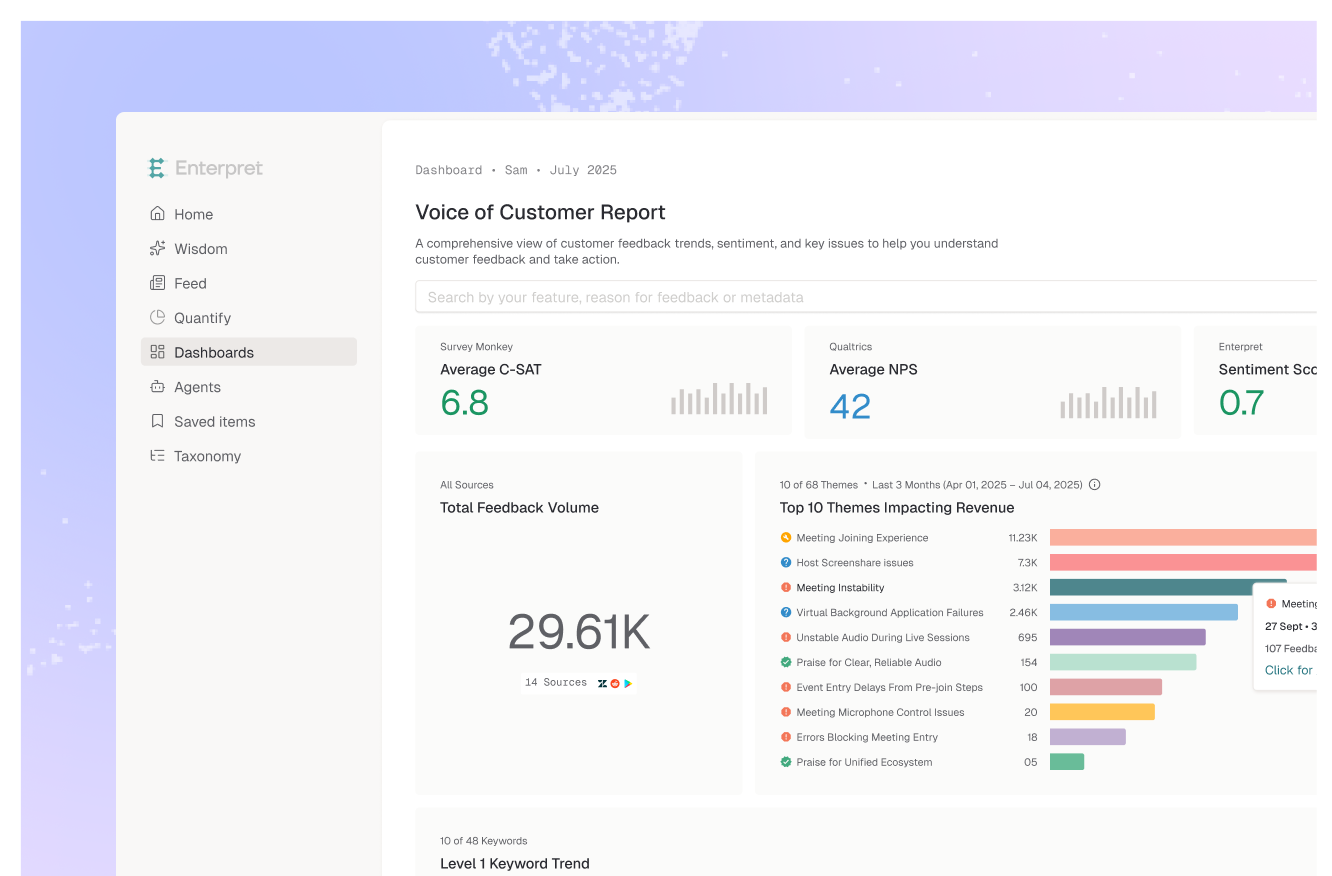
Enterpret is built around the gap between connecting and trusting. Its 50+ native customer feedback integrations authorize over OAuth and backfill history, and every record is classified on ingestion by an adaptive taxonomy that learns your product's categories from the feedback itself, so there is no category list to write before go-live. The customer context graph joins each record to the account, segment, and revenue behind it, which makes the first themes rankable rather than just countable. The remaining work, such as team dashboards and workflow integrations into Jira, Linear, or Slack, is configuration rather than engineering. One AWS Marketplace reviewer described connecting Zendesk and survey data and having usable customer insights flowing in within a week.
Best for: teams that want revenue-ranked themes across every source without a taxonomy-building phase or ongoing engineering.
SentiSum focuses on support conversations and is quick to stand up on a helpdesk. Its Gorgias listing describes a setup that takes a few days, and the integration can pull three to twelve months of ticket history. SentiSum's own data scientists build and maintain a custom taxonomy for each customer, which shortens setup for your team but routes taxonomy changes through the vendor.
Best for: support-led teams whose largest feedback source is the helpdesk and who prefer a vendor-managed taxonomy.
Thematic says setup is possible in days, and its theme discovery runs without code. The longer tail is theme tuning: the product is designed for analysts to refine themes over time, and at least one published review notes that training the software during initial setup took longer than the team wanted. Budget analyst time for the first weeks and the return is auditable, explainable themes.
Best for: insights teams with an analyst who will own theme refinement, mostly on survey and review text.
XM Discover, the conversation analytics product Qualtrics built on its Clarabridge acquisition, brings deep text and speech analytics to enterprise CX programs. Qualtrics does not publish a standard implementation timeline. Rollouts are scoped as professional-services engagements, often with a certified partner, so the schedule lives in a statement of work rather than a setup wizard. That suits a program with a dedicated CX operations team and a long planning horizon, and it is slow for a team that needs answers this quarter.
Best for: enterprise CX programs already standardized on Qualtrics that can resource a services-led rollout.
The build instinct is reasonable. A capable engineer can point Claude or ChatGPT at a feedback export and get themes back in an afternoon, and for a one-off read that is the right call. The production version takes far longer than the prototype suggests, because the pipeline around the model is the real build: ingestion, deduplication, customer joins, a stable taxonomy, and storage for trends. The hidden costs of building feedback analytics in-house sit almost entirely in that pipeline, and it does not finish.
Best for: a bounded, one-time analysis, or a team with spare engineering capacity that wants to own the pipeline long term.
Every setup runs on three clocks. Time to connect is minutes to days and is close to solved across the category. Time to a trustworthy theme is where the variance lives: days, weeks, or months, depending on who defines the categories and how. Time to a decision adds the customer join and the routing into the tools where work happens.
The middle clock is the bottleneck, and it is easy to misread. A taxonomy generated quickly can look finished and still be wrong. In Enterpret research, category trees produced in four runs of an off-the-shelf coding agent over two real feedback corpora passed every standard quality check, yet sent 35 to 76% of records into more than one top-level category, compared with about 20% for production taxonomies. A setup that skips the structural check does not save the time. It moves the time to the month someone notices the counts do not add up.
That is why the data ingestion checklist for feedback vendors puts backfill and customer joins next to connector count, and why feedback platforms with minimal data engineering lift is mostly a maintenance question rather than a setup one. Teams replacing several tools should also run the checks before consolidating to a single platform, since a fast migration that drops a source is not a fast setup.
The decision rule: weight time to a trustworthy theme over time to connect, because connecting is what the demo shows and a trustworthy theme is what the roadmap review needs.
Connecting sources takes minutes to a few days on most platforms. Time to the first trustworthy themes ranges from days on platforms that learn the taxonomy from your data, to weeks where analysts tune themes, to months for services-led enterprise rollouts. Building in-house produces a prototype quickly, but the production pipeline becomes an ongoing project.
Usually not the connectors. The common delays are defining categories and writing rules before go-live, joining feedback to CRM or billing data, scoping professional services, and engineering custom pipelines for sources without a native connector. Asking vendors about each of these before signing gives a more honest timeline than asking how long setup takes.
Volume decides it. Enterpret's guidance is roughly 1,000 combined feedback records a month across all sources. Below that, a periodic manual or LLM-assisted read is often enough. Above it, manual reading falls behind and a dedicated platform starts to earn its setup time.
For a prototype, yes: an LLM can theme an export in an afternoon. For a continuous system, no, because ingestion, deduplication, customer joins, a stable taxonomy, and trend storage all have to be built and then maintained as sources and products change. The prototype measures how fast the model is. The production timeline measures everything around it.
Sources connect over OAuth in minutes and history is backfilled. Because the adaptive taxonomy learns categories from your own feedback on ingestion, there is no category-definition phase before the first themes appear. The customer context graph ties those themes to accounts and revenue, so the first output is ranked by business impact rather than mention count.
If you are planning a rollout, see how Enterpret's customer feedback integrations connect your sources and classify history from day one.
Lorem ipsum dolor sit amet, consectetur adipiscing elit. Suspendisse varius enim in eros elementum tristique. Duis cursus, mi quis viverra ornare, eros dolor interdum nulla, ut commodo diam libero vitae erat. Aenean faucibus nibh et justo cursus id rutrum lorem imperdiet. Nunc ut sem vitae risus tristique posuere.