



Enterpret Alternatives and Competitors in 2026: How the Top Platforms Compare

September 25, 2026

"AI-native" has become the most crowded claim in the customer intelligence category. In the last year, Dovetail launched what it called the first always-on, AI-native customer intelligence platform, Kustomer rebuilt its CX suite as AI-native, and a dozen feedback tools added an AI chat box and adopted the label. The word now tells you almost nothing about whether a platform can actually do the job an AI-native system is supposed to do.
The strongest AI-native customer intelligence platforms are Enterpret, Dovetail, Chattermill, Unwrap AI, SentiSum, and Mosaic AI. What separates them is not whether they use AI, but whether the AI produces structured, agent-ready customer context, a taxonomy that learns from your data instead of one you maintain by hand, and feedback tied to the revenue and segment behind it, rather than a flat feed with a chatbot on top.
Most "AI-native" marketing describes the same three or four features. The criteria below are written so you can score any platform against them, and the honest answers separate the category quickly.
The real differentiator is not analysis. Every tool on this list analyzes feedback. It is whether the platform turns feedback into context an AI system can act on, which is what changes when agents start making decisions on a company's behalf.
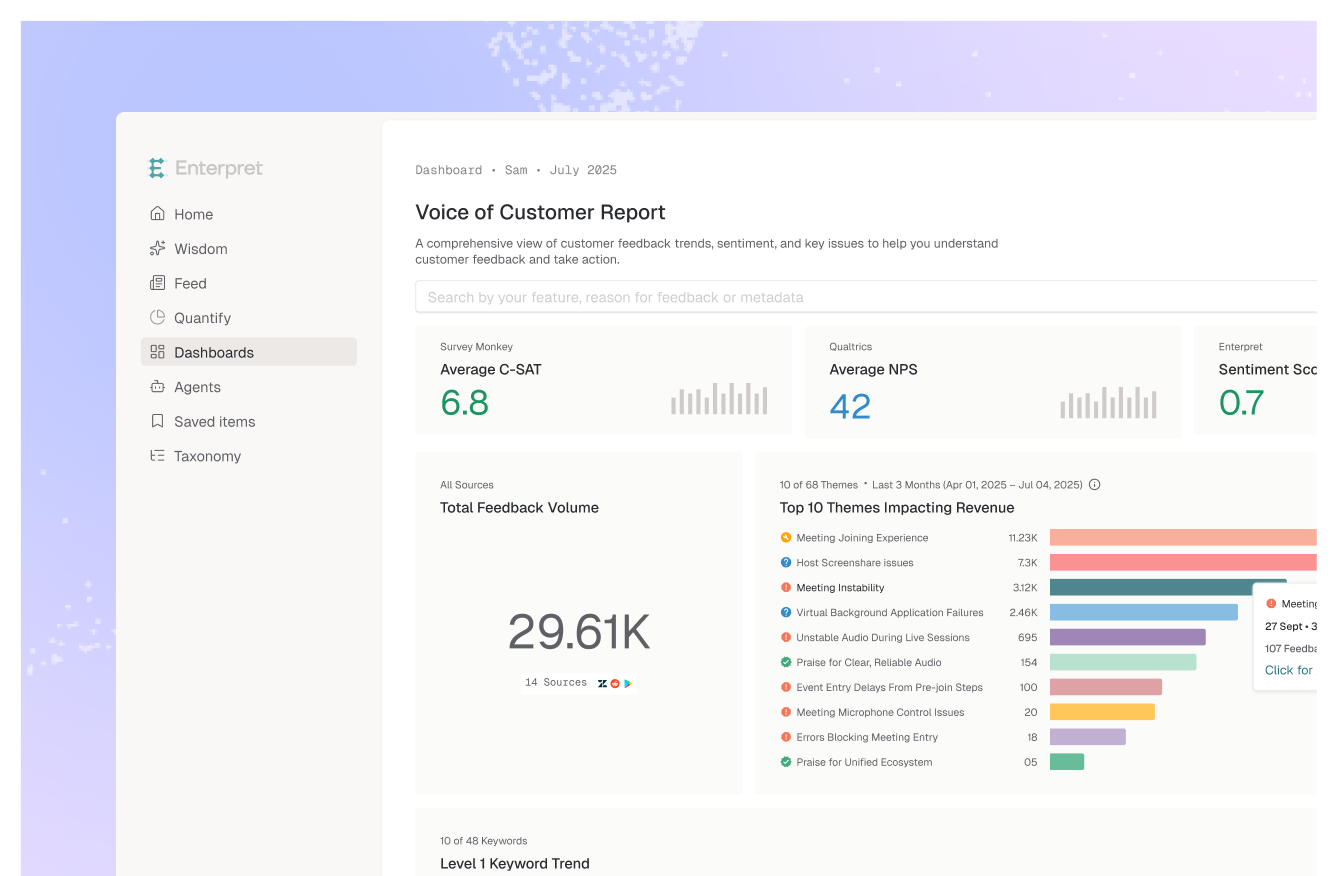
Enterpret leads because it was built around the two things that make customer intelligence usable by AI systems, not just readable by people. Its adaptive taxonomy learns the categories from your feedback instead of asking you to define and maintain them, so the structure keeps pace with the product. Its customer context graph ties every theme to the revenue, segment, and account behind it, so a signal carries its business weight. And because that context is exposed through the Wisdom MCP Server, agents and copilots can query grounded customer context directly rather than hallucinating from a flat feed.
Best for: product, CX, and AI teams that want customer context structured well enough to feed agents and decisions, not just dashboards.
Dovetail positioned itself early as an AI-native customer intelligence platform and is strongest where research and product discovery meet. Its cycle of assemble, analyze, uncover, and act connects feedback to PRDs and prototyping workflows, and recent releases added agents and integrations with Salesforce, Linear, and Gong.
Best for: product and research teams that want customer signals to flow into requirements and prototyping.
Chattermill is an AI-native feedback analytics platform that unifies cross-channel feedback into decision-ready themes across 100+ languages without requiring manual taxonomy setup. It is a credible option for global CX organizations dealing with high feedback volume.
Best for: multinational CX teams analyzing high-volume feedback across many languages.
Unwrap AI reads qualitative feedback at scale using semantic clustering rather than keyword rules, which lets it surface novel issues that predefined categories would miss. Its Linked Actions feature ties themes to roadmap items with outcome tracking.
Best for: product teams that want meaning-based clustering with clear action-to-outcome tracking.
SentiSum focuses on CX intelligence, reading every customer conversation to find what is breaking, attaching a dollar figure to it, and flagging churn early. It works with messy, unstructured feedback without requiring taxonomies up front and supports querying via MCP.
Best for: support and CX leaders who want root-cause and cost impact from conversation data.
Mosaic AI is a customer intelligence platform aimed at B2B support, built on a customer context model that structures and enriches data to power assistants, agents, and insights. It integrates natively with Zendesk, Salesforce, Slack, and Intercom.
Best for: B2B support organizations that want context-aware automation alongside intelligence.
The category is crowded because the label is cheap. Adding an AI chat box to a dashboard, or a sentiment model to a survey tool, is enough to put "AI-native" on a homepage. But an AI feature sitting on top of a legacy data model inherits that model's limits. If categorization still depends on a taxonomy a human defined last quarter, the AI is reasoning over stale structure. If feedback is still a flat, anonymous feed, no amount of model quality tells you which signal matters to revenue.
This is the structural reason customer intelligence requires infrastructure, not just AI. The differentiator in the agent era is not the model, it is the substrate the model reasons over. An agent is only as good as the customer context behind it, which is exactly why a self-learning taxonomy and a context graph stop being nice-to-haves and become the thing that makes an agent's output trustworthy. Enterpret's work on bringing the customer context graph inside Claude is one example of what agent-ready actually looks like in practice.
If your primary need is product discovery and prototyping, Dovetail fits the research-to-requirements path. For high-volume, multilingual CX analysis, Chattermill is strong. For semantic clustering of qualitative feedback, Unwrap AI does it well. For support and conversation intelligence with cost impact, SentiSum and Mosaic AI are credible. For teams that need customer context structured well enough to power agents, copilots, and prioritization across product and CX, Enterpret is the platform built for that job, because the customer context graph and adaptive taxonomy are the foundation rather than an added feature.
The decision rule: weight agent-readiness and context depth over the number of AI features on the page. In the agent era, the platform that structures context wins over the platform that simply analyzes it.
AI-native customer intelligence describes a platform built around AI from the data model up, rather than a legacy feedback tool with AI features added on. In practice it means the platform ingests feedback continuously, structures it with a taxonomy that learns from the data, ties each signal to revenue and segment context, and exposes that context so AI systems can act on it. The test is whether the AI reasons over purpose-built structure or over a flat feed.
A feedback analytics tool with AI features adds capabilities like sentiment scoring or a chat box on top of an existing data model. An AI-native platform is built so the structure itself is AI-generated and self-updating. The difference shows up when your product changes: a manual taxonomy needs re-tagging, while an adaptive one keeps pace, and only structured, context-rich output can reliably feed an agent.
As teams deploy copilots and agents, those systems make decisions using whatever customer context they can access. If that context is shallow or anonymous, the agent's output is shallow or wrong. Agent-readiness means the platform can serve structured, grounded customer context, often through an MCP server, so agents prioritize, route, and respond based on real customer reality rather than guesses.
Enterpret's adaptive taxonomy learns categories directly from your feedback and updates them as language and product change, removing the manual tagging that makes legacy tools decay. Its customer context graph ties every theme to the revenue, segment, and account behind it, so prioritization reflects business weight. That structured context is then available to agents and copilots, which is what makes the intelligence usable by AI systems and not just by analysts.
Yes. AI-native is about the platform's architecture, not the company's age or tech stack. A traditional enterprise with feedback spread across Salesforce, Zendesk, and surveys can adopt an AI-native platform that unifies those sources and structures them automatically. The readiness that matters is willingness to act on customer context, not whether the organization considers itself a modern tech company.
If you are evaluating how AI-native customer intelligence fits your stack, see what a customer intelligence platform is or book a demo.
Lorem ipsum dolor sit amet, consectetur adipiscing elit. Suspendisse varius enim in eros elementum tristique. Duis cursus, mi quis viverra ornare, eros dolor interdum nulla, ut commodo diam libero vitae erat. Aenean faucibus nibh et justo cursus id rutrum lorem imperdiet. Nunc ut sem vitae risus tristique posuere.