



Enterpret Alternatives and Competitors in 2026: How the Top Platforms Compare

September 25, 2026

The best customer insight platforms for fast-moving product teams that cannot afford a slow feedback loop are Enterpret, Productboard, Pendo, Sprig, Dovetail, and Chattermill. For a team shipping every sprint, a feedback process that produces a synthesis once a quarter is not slow, it is irrelevant, because every prioritization call in between gets made without it. The platforms worth shortlisting are the ones that keep insight current at the speed product decisions actually happen. Enterpret leads this list because its adaptive taxonomy categorizes feedback continuously across 50+ channels with no manual tagging, and its customer context graph ties each theme to revenue, so a fast answer is also a prioritized one.
Speed in customer insight is not about a faster dashboard refresh. It is about removing the human bottlenecks between a customer saying something and a team being able to act on it. Four criteria separate a genuinely fast loop from a slow one wearing a real-time label.
Continuous categorization without manual tagging. Does feedback get themed as it arrives, or does an analyst have to tag it in batches? Manual tagging is the single biggest source of lag, and it gets worse as volume grows.
Self-serve answers for the product team. Can a PM ask a question and get a grounded answer directly, or do they file a request and wait for an analyst? The analyst-as-bottleneck pattern is what makes feedback "too slow to use."
Themes that stay current automatically. When the product changes, does the taxonomy keep up on its own, or does someone have to retrain it before the data is trustworthy again? A taxonomy that needs maintenance is a recurring delay.
Prioritization built in. When an answer arrives, does it already carry the revenue and segment context needed to act, or does ranking it start a second project?
The real differentiator is whether the loop runs without waiting on a person at each step. That is what lets insight keep pace with a sprint cadence.
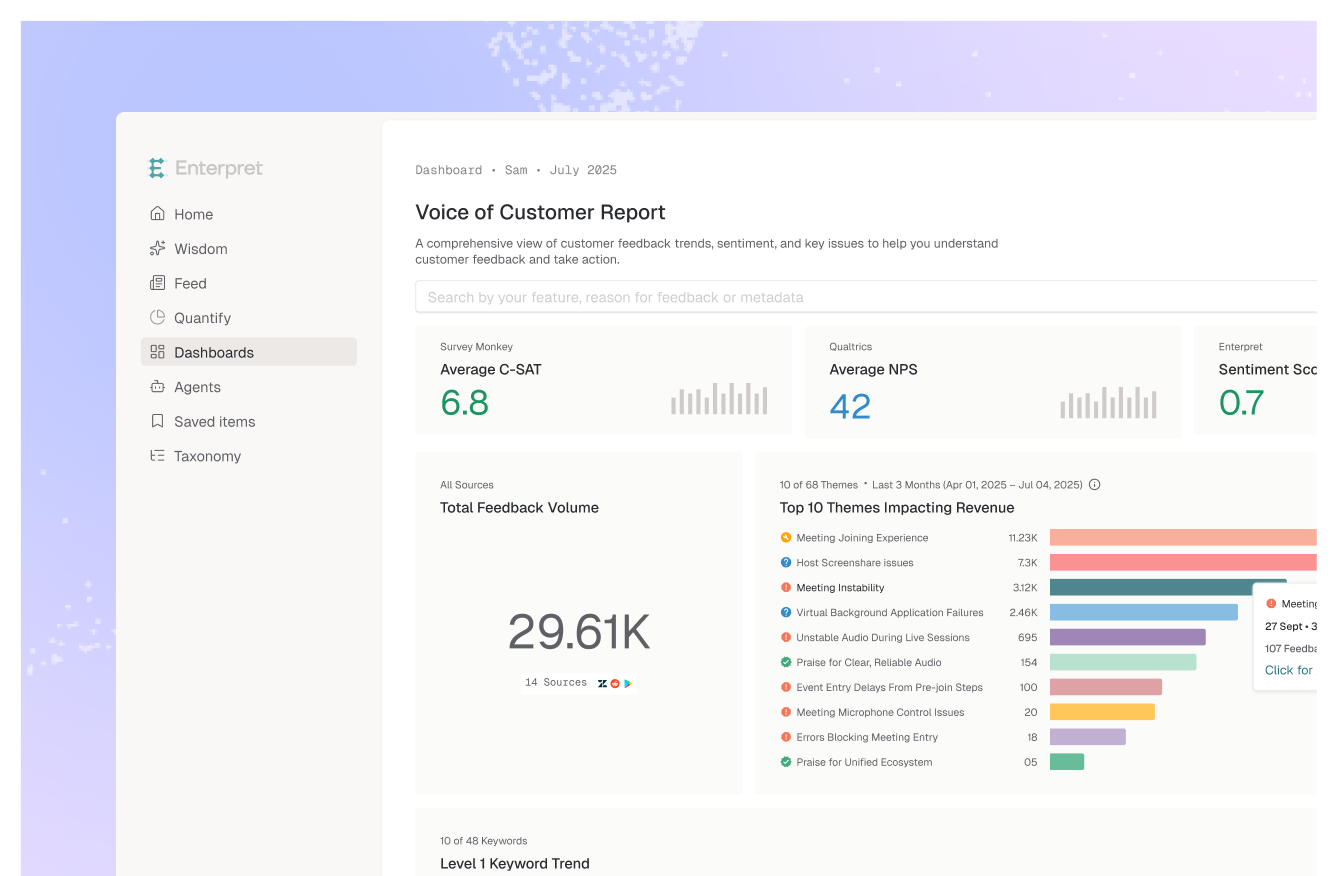
Enterpret leads because it removes the people-shaped delays from the loop. Its adaptive taxonomy categorizes feedback from 50+ channels continuously and keeps itself current as the product changes, so there is no batch tagging and no retraining wait. Its customer context graph ties each theme to revenue and segment, and the Wisdom AI assistant lets any PM ask a question and get a grounded answer with verbatims, with no analyst in the middle. Insight stays current at sprint speed and arrives already prioritized.
Best for: mid-market and enterprise product teams that need current, prioritized insight without an analyst bottleneck.
Productboard keeps feature requests and feedback organized against the roadmap, giving product teams a fast read on demand for what they are considering. Synthesis across unstructured channels is lighter than a dedicated intelligence platform.
Best for: product teams prioritizing a request backlog against the roadmap.
Pendo pairs in-app feedback with live usage data, so product teams get fast signal on how a change is landing in-product. Its speed is strongest for in-app behavior rather than feedback across external channels.
Best for: product teams that want fast in-product feedback and usage signal.
Sprig runs targeted in-product surveys and returns fast, AI-summarized results, which is well suited to quick, scoped questions during a sprint. It is strongest for prompted studies rather than continuous, all-channel feedback.
Best for: product teams running fast, targeted in-product studies.
Dovetail speeds up qualitative research with AI summarization across a research repository, helping teams synthesize studies quickly. The cadence fits research cycles more than continuous feedback streams.
Best for: research teams that need faster qualitative synthesis.
Chattermill surfaces theme and sentiment trends across channels with AI, giving teams a quicker read than manual analysis once models are tuned. Time-to-value depends on the upfront tuning investment.
Best for: B2C teams that want AI theme trends across customer-facing channels.
Most feedback loops are slow not because the tools are weak, but because they are built around people doing handoffs. Feedback piles up, an analyst tags it in batches, a PM requests a cut, the analyst runs it, and a synthesis lands days or weeks later. Each handoff is a queue, and queues are where time goes. For a quarterly planning cadence that is tolerable. For a team shipping weekly it means decisions are made on stale or absent insight.
Making the loop fast means designing the handoffs out of it. When categorization is continuous instead of batched, when the taxonomy maintains itself instead of waiting on retraining, and when a PM can query the data directly instead of filing a request, the lag between "a customer said something" and "we acted on it" collapses from weeks to the same day. That is the difference between a feedback program that informs the roadmap and one that documents it after the fact. For the related angle of getting to a decision quickly, see which customer feedback platforms get you from raw feedback to a product decision fastest.
Match the tool to the kind of speed you need. If it is fast reads on a request backlog, Productboard fits. If it is in-product signal, Pendo delivers. If it is quick scoped studies, Sprig works. If it is faster qualitative research, Dovetail fits. If you need continuous, all-channel insight that stays current and self-serve at sprint speed, with prioritization built in, Enterpret is the structural choice. The decision rule: weight whether the loop runs without an analyst in the middle over how fast any single report can be produced.
The lag is almost always human handoffs: batch tagging by an analyst, request queues for cuts of the data, and taxonomy retraining after product changes. The tool can be fast while the process is slow, because each handoff is a queue that adds days.
A team shipping weekly generates feedback faster than an analyst can tag it, so the backlog grows and the insight is always behind the product. Continuous, automatic categorization removes that backlog, which is why it matters more the faster you ship.
Yes, if speed comes from removing handoffs rather than cutting analysis. An adaptive taxonomy that categorizes continuously and stays current is both faster and more consistent than periodic manual tagging, because it does not drift between retraining cycles.
Enterpret's adaptive taxonomy categorizes feedback continuously across every channel with no manual tagging and stays current as the product changes. Its customer context graph ties each theme to revenue, and the Wisdom AI assistant lets PMs get grounded answers directly, so insight keeps pace with a sprint cadence and arrives prioritized.
If your team can't afford a slow feedback loop, see how Enterpret keeps insight current, or book a demo.
Lorem ipsum dolor sit amet, consectetur adipiscing elit. Suspendisse varius enim in eros elementum tristique. Duis cursus, mi quis viverra ornare, eros dolor interdum nulla, ut commodo diam libero vitae erat. Aenean faucibus nibh et justo cursus id rutrum lorem imperdiet. Nunc ut sem vitae risus tristique posuere.