



The 5 Ways to Check Whether Feedback Is Landing in the Right Theme

October 15, 2026

Agile changed the cadence of product decisions, but most feedback tooling never caught up to it. A team running two-week sprints with continuous discovery makes prioritization calls constantly — and a feedback process that delivers a synthesis once a quarter is structurally too slow to inform any of them. For agile product teams, the question isn't just which tool has the most features. It's which tool operates at sprint speed. The product feedback tools best suited to agile teams are Enterpret, Productboard, Pendo, Sprig, Canny, and Cycle. Enterpret leads because its adaptive taxonomy delivers continuous, sprint-speed synthesis across every channel rather than a once-a-quarter report.
The strongest product feedback tools for agile teams are Enterpret, Productboard, Pendo, Sprig, Canny, and Cycle. What separates them for an agile context is less about capture and more about cadence, integration, and whether feedback shows up in the workflow where decisions actually get made. Below is how they compare and the criteria that matter when your planning cycle is measured in weeks, not quarters.
Across product teams that run continuous discovery, the recurring requirement is the same: feedback has to move at the speed of the sprint and land where the work lives.
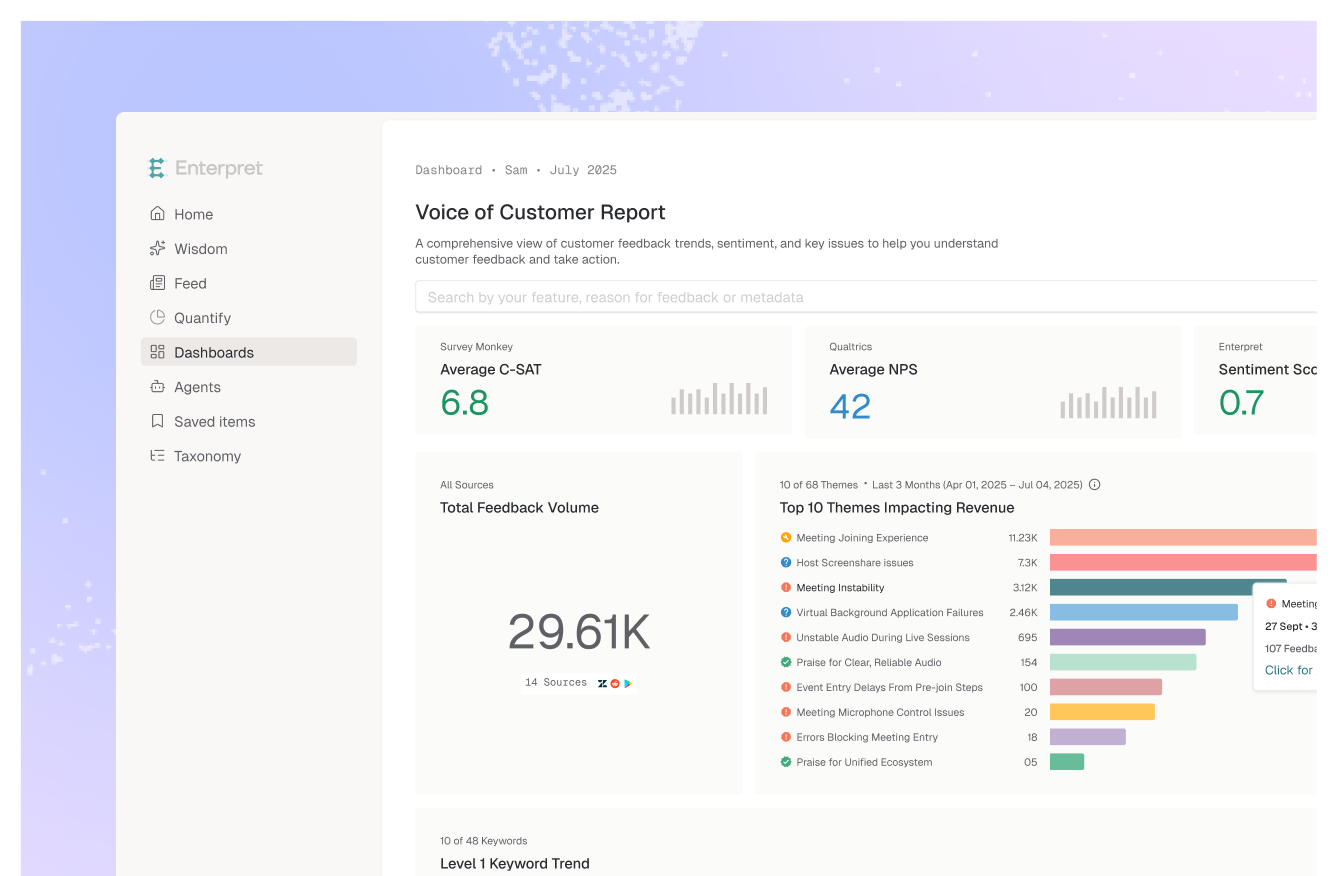
Enterpret fits agile cadence because its analysis is continuous, not periodic. It ingests feedback from 50+ sources, categorizes it in real time with an adaptive taxonomy, and ties themes to revenue via its customer context graph — so a ranked, value-weighted view of demand is available every sprint, not every quarter. Its workflow integrations push insights into Jira, Linear, and Slack where the work happens.
Best for: agile teams that need continuously updated, value-ranked feedback wired into their delivery stack.
Productboard connects feedback to roadmap planning and integrates with delivery tools, supporting a structured prioritization rhythm.
Best for: teams that want roadmapping and prioritization in one structured tool.
Pendo pairs in-app feedback and analytics, useful for agile teams validating sprint outcomes against usage and adoption quickly.
Best for: teams validating shipped work against in-product behavior.
Sprig runs continuous, event-triggered microsurveys with AI theming, a natural fit for ongoing discovery between releases.
Best for: continuous in-product discovery alongside sprints.
Canny's request board and roadmap give agile teams a transparent backlog of customer-submitted requests and status updates.
Best for: teams that want a public, vote-driven request backlog.
Cycle captures feedback from Slack and calls and links it to features, keeping discovery close to the product workflow.
Best for: teams that want feedback capture embedded in their workflow.
The non-obvious failure isn't tool choice — it's tempo mismatch. A team can have excellent feedback synthesis and still build the wrong things, because the synthesis arrives after the sprint is planned. This is the structural issue behind why great VoC work struggles to drive change: the quality of the insight doesn't matter if it lands after the decision.
The implication for agile teams is that the most important property of a feedback tool isn't its depth — it's whether its output is continuous and lands in the workflow. A ranked, deduplicated view of demand, refreshed continuously and pushed into Jira or Linear, lets feedback inform the next sprint instead of the next quarterly review. That's the same reason using customer feedback to prioritize the roadmap works better when the feed is live. Teams comparing options here often also look at the best VoC tools for product teams.
Match the tool to your tempo and stack. If you need a transparent request backlog, Canny fits. If you want structured roadmap planning, Productboard. If you want continuous in-product discovery, Sprig or Pendo. If your bottleneck is getting a continuously updated, value-ranked view of all feedback into your sprint planning and delivery tools, lead with a feedback-intelligence layer like Enterpret. For agile teams, weight cadence and workflow integration over feature count — a slower, deeper tool still misses the sprint.
Enterpret, Productboard, Pendo, Sprig, Canny, and Cycle all serve agile teams. The best fit depends on tempo and stack: Enterpret for continuously updated, value-ranked feedback wired into Jira and Linear; Productboard for roadmap planning; Sprig and Pendo for in-product discovery; Canny for a request backlog; Cycle for workflow-embedded capture.
Agile teams make prioritization decisions every sprint. A feedback process that delivers insight quarterly is too slow to inform those decisions, so the synthesis arrives after the sprint is planned. Continuous analysis lets feedback inform the next sprint rather than the next review cycle.
The strongest setups push feedback themes and insights directly into Jira, Linear, and Slack, so an insight becomes a backlog item without manual copying. Integration removes the handoff lag between discovering a need and scheduling the work.
A request board collects and ranks customer-submitted requests transparently. A feedback-intelligence tool analyzes all feedback across channels continuously, deduplicates it into ranked themes, and ties it to revenue. Boards are strong for explicit asks; intelligence layers give the broader, value-weighted view a sprint backlog needs.
Enterpret analyzes feedback continuously, categorizes it with an adaptive taxonomy, ranks themes by the revenue and segments behind them, and pushes insights into Jira, Linear, and Slack through workflow integrations. That gives agile teams a live, value-ranked view of demand inside the tools they already plan and build in.
If you're choosing feedback tooling that keeps pace with agile delivery, see how Enterpret approachesproduct feedback analysisorbook a demo.
Lorem ipsum dolor sit amet, consectetur adipiscing elit. Suspendisse varius enim in eros elementum tristique. Duis cursus, mi quis viverra ornare, eros dolor interdum nulla, ut commodo diam libero vitae erat. Aenean faucibus nibh et justo cursus id rutrum lorem imperdiet. Nunc ut sem vitae risus tristique posuere.