





The 7 Steps to Analyze Product Reviews From UK Retailers Like Argos and Very

Feedback Analysis
November 5, 2026

To use customer evidence to influence a roadmap you don't own, stop pitching your problem and start handing the other team proof about theirs. Staff PMs who move peer roadmaps do six things: frame the problem in the other team's metrics and customers, bring affected accounts and ARR instead of anecdotes, show the trend over time on stable categories, bring quotes from that team's own segment, make yes easy with a scoped ask and a shared evidence doc, and give the team self-serve access to the same evidence.
Short answer: Relationships get you the meeting. Evidence the other team can verify on their own gets you the roadmap slot. Translate the customer problem into their metric, their segment and their revenue, then make the ask small enough to say yes to this quarter.
The influence-without-authority playbook is well written. Sachin Rekhi's essay on influence without authority argues for inspiring people with your vision, making other teams' problems your own, and investing deeply in relationships. All true.
Aakash Gupta's guide goes further and names data as one of three currencies of influence, next to expertise and relationships, with a worked example of a PM using support tickets and session recordings to get a bug fixed.
Here is the gap. At Staff level, the problem you need fixed usually lives in another team's product area, competes with their own committed OKRs, and gets reviewed by a VP who will ask the second question. A one-off pile of tickets assembled for one meeting does not survive that.
Influence without authority is a relationship problem right up until the room disagrees. Then it is an evidence problem. The PM who controls the shared source of customer truth sets the terms of every cross-team debate.
Nobody reprioritizes to fix your funnel. Open with the other team's north star: activation for the onboarding team, net revenue retention for the billing team, ticket deflection for support tooling.
This only works if your feedback categories line up with their product area. If a theme is split across three teams' branches, no one owns it and no one funds it. Enterpret's taxonomy evaluation paper found that AI-generated taxonomies let 34.7% to 76.4% of records land in more than one top-level product area, versus about 20% for production references. Clean branches are what make "this is yours" a credible statement.
"A big customer is upset" gets a polite nod. "Twenty-three accounts, $1.8M in ARR, four renewing next quarter" (an illustrative example) gets a calendar invite.
Join every theme to the accounts and segments behind it so you can size the opportunity in revenue. If your data lives in Salesforce, start with how to quantify how customer feedback impacts revenue in Salesforce.
A snapshot invites "that's a spike." A twelve-week line invites a decision. But a trend is only credible if the category underneath it holds still from week to week.
If you rebuild themes with a fresh LLM prompt every time, the line moves because the method moved. Enterpret's study of run-to-run instability across eight frontier models found raw models' counts moved 7.5% to 9.8% on matched themes between runs, while a taxonomy-grounded agent reported identical volumes across all 117 valid run pairs.
86 to 88% Reduction in theme churn when an AI agent is grounded in a persistent taxonomy instead of re-clustering raw feedback on every run. Source: Enterpret Research, "Same Feedback, Different Answer" (arXiv, 2026)
The enterprise team discounts SMB complaints. The mobile team discounts web tickets. Pull verbatims from the customers the other team is already accountable for, and tie each quote back to its account so it reads as signal, not cherry-picking.
Big asks die in planning. Scope the ask to one sprint, one experiment, or one discovery spike, with a date to look at the evidence again. Put everything in a single shared doc the other PM can forward to their VP without rewriting it.
This is the move most PMs skip. If the evidence only exists in your deck, every meeting turns into an argument about your data. If the other team can query the same themes, accounts and quotes themselves, the conversation stays about the decision.
Route the theme to their channel with feedback routing and team-based alerting so they see it move without you in the loop.
| What PMs usually bring | What moves a peer roadmap |
|---|---|
| "Customers keep asking for this" | Theme volume, mapped to their product area |
| One loud enterprise account | Affected accounts, segments and ARR |
| A screenshot of last week's tickets | A twelve-week trend on a stable category |
| Your favorite quote | Three quotes from their segment, linked to accounts |
| "Can you add this to the roadmap?" | A scoped ask with a review date |
| A deck only you can update | Shared, self-serve access to the same evidence |
Every one of these six moves depends on the same thing: one source of customer evidence that every team trusts. That is the Customer Intelligence layer, and it has to sit upstream of every team's planning, not inside one PM's spreadsheet.
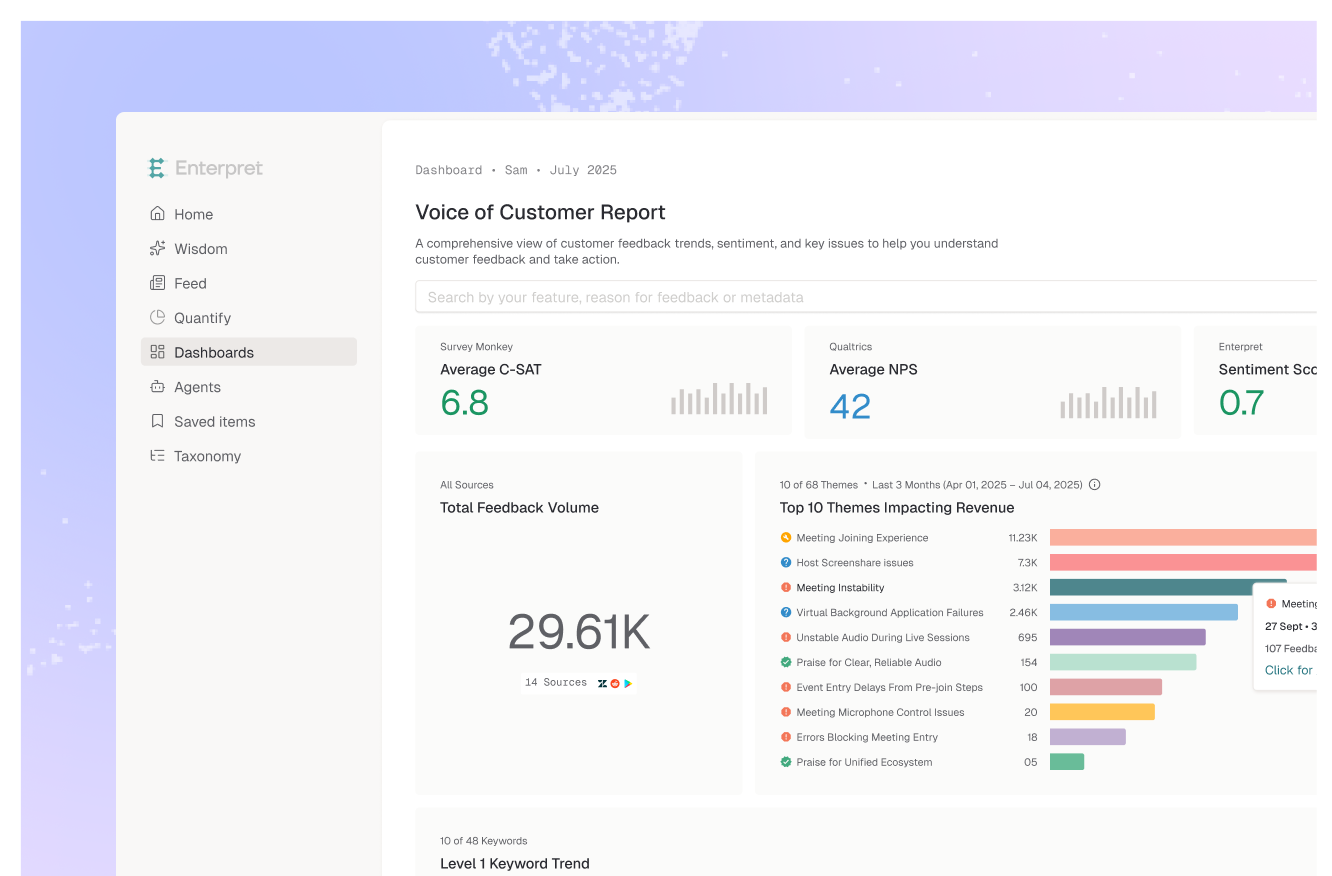
Enterpret pulls feedback from sources like Zendesk, Intercom, Gong, Salesforce, Slack and app store reviews into one place. Adaptive Taxonomy organizes it into L1, L2 and L3 product areas that update as you ship, so cross-team problems show up under the team that owns them. The Customer Context Graph joins each theme to accounts, segments and ARR. Wisdom answers questions in natural language and shows the exact records behind each answer.
For the doc itself, the MCP server brings the same evidence into Claude, Claude Code, Cursor and Notion. See MCP servers to access customer insights in Notion. Alerts push theme changes to Slack, Jira or Linear. Connecting sources and building the graph takes integration and processing time, so set it up before the planning cycle, not the week of.
Picture a Staff PM on a platform team. Enterprise admins keep hitting failed invoice exports, but invoicing belongs to the billing team, whose quarter is already committed. All numbers below are illustrative.
The billing PM does not need to trust the platform PM. They can check the evidence themselves.
The best product orgs are moving from roadmap negotiation to roadmap evidence. When every team plans from the same customer signals, the Staff PM's job shifts from lobbying to framing. If you want to know where your org sits today, start with the customer feedback maturity model.
Influence still matters. But the PMs who win cross-team debates in 2027 will be the ones who made the evidence impossible to argue with.
Frame the customer problem in the other team's metrics, size it in affected accounts and ARR, show a trend on a stable category, and bring quotes from their segment. Then make a small, scoped ask with a review date, and give the team self-serve access to the same evidence.
An anecdote cannot tell a team how many customers are affected, how much revenue is at stake, or whether the problem is growing. Teams with committed OKRs need that sizing to justify changing plans to their own leadership.
You can for a first look, but trends built by re-prompting a raw model are hard to defend. Enterpret's study of eight frontier models found raw models' counts moved 7.5% to 9.8% on matched themes between runs, while a taxonomy-grounded agent cut theme churn by 86 to 88%. Ground the analysis in a persistent taxonomy before you show a trend line to another team.
The problem stated in the other team's metric, affected accounts and ARR by segment, a trend on a fixed category, three quotes linked to source records, and a scoped ask with a review date. Keep it short enough that the other PM can forward it to their VP unchanged.
Yes, relationships get you heard. Evidence the other team can verify on their own is what gets the work scheduled, and it keeps future debates about decisions instead of about whose data is right.
If you're ready to make customer evidence the shared language across your product teams, see how Enterpret works.
Research cited
Lorem ipsum dolor sit amet, consectetur adipiscing elit. Suspendisse varius enim in eros elementum tristique. Duis cursus, mi quis viverra ornare, eros dolor interdum nulla, ut commodo diam libero vitae erat. Aenean faucibus nibh et justo cursus id rutrum lorem imperdiet. Nunc ut sem vitae risus tristique posuere.


