



The 6 Differences Between Voice of Customer Software and Customer Intelligence

September 15, 2026

Most help-center expansion projects do not reduce ticket volume, and the reason is visible in how they are scoped. Someone reviews the article list, notices gaps against the product surface, and writes to fill them. The resulting articles are accurate, well organized, and aimed at topics nobody was contacting about. Volume stays flat, and the conclusion drawn is that customers do not read documentation.
The six ways to reduce tickets with better documentation are writing from contact drivers rather than from the product map, fixing the articles that already fail, matching the customer's words instead of the product's, putting the answer in the first screen, surfacing the article at the moment of the contact, and measuring deflection per article. The first three decide what to write. The last three decide whether anyone finds it.
The real differentiator is whether the writing queue is ordered by contact volume, because ordering it by anything else is why these projects fail.
Rank intents by contact volume over the last quarter and write down the list. This is uncomfortable, because the top of the list is usually mundane, repetitive, and already covered somewhere, while the interesting gaps sit far below. The mundane items are where the volume is.
The highest-return work is usually not new content. It is the intent that has an article and still generates contacts, which means the article is wrong, outdated, hard to find, or does not answer the question customers are actually asking. Identifying those requires comparing contact volume per intent against article coverage, and it is the step almost every program skips in favour of writing something new. The tooling for finding out-of-date or wrong help center articles exists precisely because this is hard to see manually.
Title and open the article with the phrasing customers use in tickets, even when it is imprecise or names the feature wrongly. Search matches language, and internal terminology is the most common reason a correct article goes unfound. Pull the phrasing directly from the conversations rather than writing it from the product spec.
Watch for: intents where customers consistently use a word your product does not. That gap is worth an alias or a redirect, not just a mention.
Lead with the resolution, then explain. Documentation written as a narrative buries the answer below context that a customer in a hurry will not read, and the contact happens anyway. This is the same constraint that makes a direct-answer opening work for search: the reader decides within seconds whether the page contains their answer.
An article nobody sees does not deflect. Suggest the relevant article inside the contact form, in the chat widget before the conversation starts, and in the AI agent's first response. Placement typically moves deflection more than content quality does, and it is cheaper to change.
Track contact volume for each intent before and after the article ships, against a comparable window. Aggregate help-center metrics like pageviews and search volume measure reading, not deflection, and they will rise on an article that deflects nothing. Per-intent contact volume is the only measure that answers the question the project exists to answer.
Help-center programs get measured on articles published because that number is easy to produce and rises reliably. Contact volume, the thing the program is for, moves for many reasons and sometimes goes up during a successful quarter because the product grew. So the proxy gets adopted, and once the target is article count, the fastest route to it is writing about whatever is easiest to write about, which is systematically not the top contact drivers.
The second structural problem is that the gap analysis is usually done against the product rather than against the tickets. A gap in coverage relative to the product surface is only worth filling if customers are contacting about it, and the correlation between the two is weaker than teams expect. Ranking by contact volume inverts the queue, and the inversion is usually dramatic: the intents at the top are rarely the ones a content audit would have surfaced. That is the difference between filling a content map and closing help center content gaps found in support data.
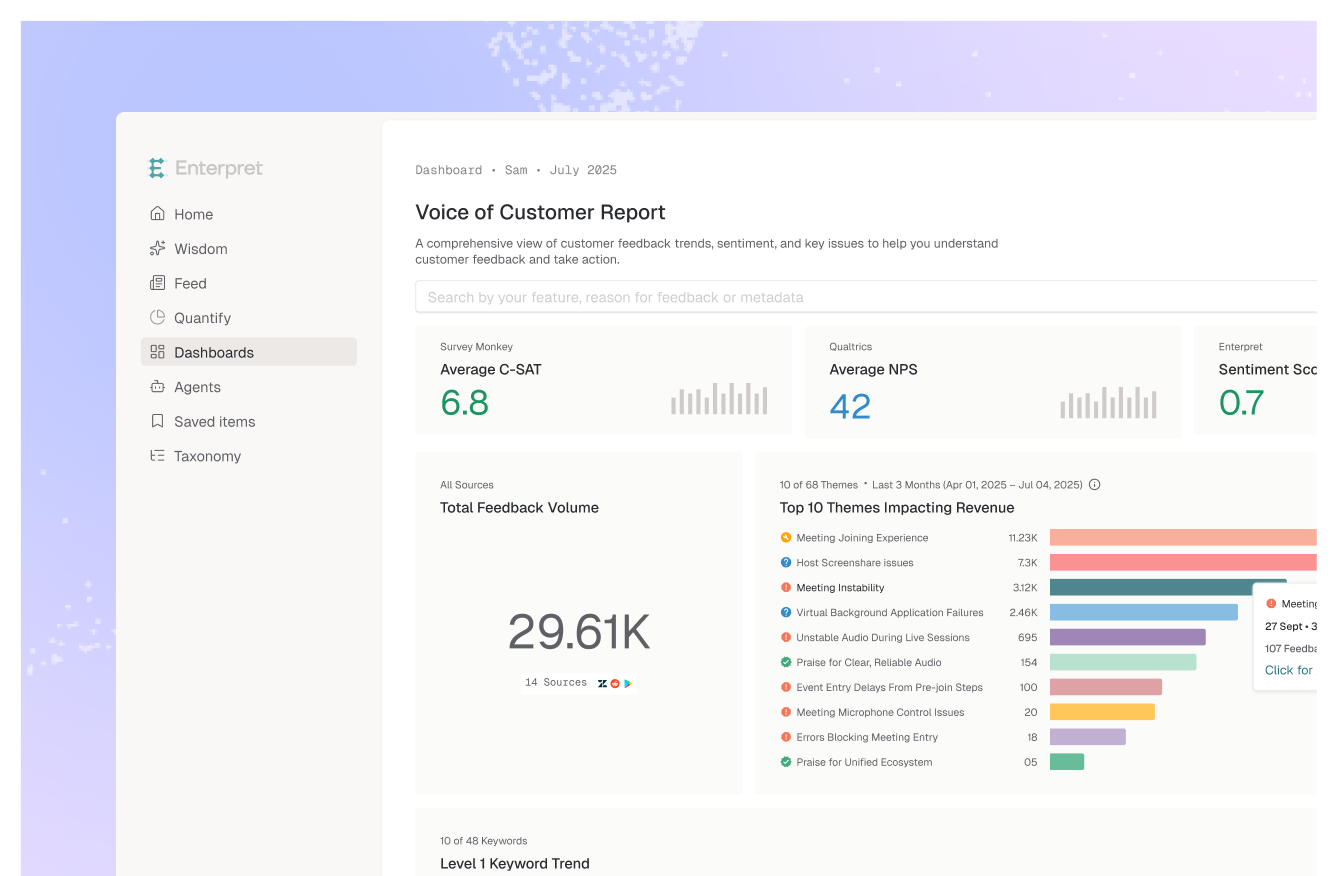
Enterpret fits the upstream half, which decides whether the writing is aimed correctly: it analyzes the full body of support conversations, builds intents from customer language through the adaptive taxonomy rather than from an agent tag list, and attaches segment and account context through the customer context graph, which is what produces a ranked contact-driver list and the per-intent before-and-after measure. Zendesk Guide and Intercom Articles are where the content lives and handle in-context surfacing. Document360 suits larger standalone knowledge bases. Algolia improves the search-matching layer once the language is right.
The decision rule: weight contact-driver ranking over authoring workflow. A fast publishing pipeline aimed at the wrong intents produces articles and no deflection.
Two to four weeks for the contact volume on that intent to stabilize, assuming the article is surfaced at the point of contact. Longer if discovery depends on organic search.
Both read the same content, and writing a clear direct answer first serves both. The AI agent is usually the stricter reader, since it cannot infer around a vague sentence.
Then it is a product problem, and documenting it is the workaround rather than the fix. Worth writing anyway, and worth flagging separately so the underlying issue reaches the roadmap.
Enterpret categorizes support conversations into intents built from customer language with its adaptive taxonomy, so the ranked list of contact drivers reflects what people actually ask rather than how agents tagged it. The customer context graph attaches segment and account context, which shows who is driving each intent, and the same theme volume provides the before-and-after measure once an article ships.
Measuring the program on articles published. It is the number that rises regardless of whether anything was deflected.
If your help center keeps growing while ticket volume does not fall, see how Enterpret ranks what customers actually contact about.
Lorem ipsum dolor sit amet, consectetur adipiscing elit. Suspendisse varius enim in eros elementum tristique. Duis cursus, mi quis viverra ornare, eros dolor interdum nulla, ut commodo diam libero vitae erat. Aenean faucibus nibh et justo cursus id rutrum lorem imperdiet. Nunc ut sem vitae risus tristique posuere.