



The 10 KPIs Product Ops Should Track for Customer Feedback

Product
November 3, 2026

Count the Slack messages you got this week that start with "quick question." What are customers saying about onboarding? Do enterprise accounts care about SSO? Can you pull quotes for the board deck? Each is reasonable. Together, they are a job nobody wrote down.
The best product operations playbook for operationalizing customer feedback has eight steps: inventory every source, unify feedback into one record tied to the customer, build a taxonomy that mirrors how you ship, give every branch an owner, set a review cadence, make it self-serve, close the loop with customers, and measure the system. The end state is not a better report. It is a system PMs query themselves.
Most feedback programs don't fail from lack of data. They fail from lack of ownership. Feedback lives in Zendesk, Gong, app reviews, NPS verbatims, and a Slack channel nobody reads. Product Ops becomes router, tagger, and analyst at once, and every answer is a one-off rebuilt next week.
Popular playbooks don't fix this. Templates give you a collection checklist and a review meeting. Glossaries tell you Product Ops "bridges" teams. Both assume the bottleneck is process. It isn't. A process that runs through you is still a queue.
The question most Product Ops leaders ask is "how do we answer feedback requests faster?" The better question is "what would it take for nobody to need to ask us?"
That swap changes the deliverable. You stop shipping reports and start shipping infrastructure: unified data, a shared language, clear owners, and an interface any PM can query alone. Answering is a service. Operationalizing is a system.
You shouldn't be the answer to every "what are customers saying?" You should be the person who built the system that answers it.
Steps one to five build the foundation. Six is the payoff. Seven and eight keep it honest.
List every place customers talk: support tickets, chat, sales and CS calls, NPS and CSAT verbatims, app store reviews, community forums, internal Slack channels. Note volume, system of record, and who grants access. This list is your integration plan.
Pull every source into one place and join each piece of feedback to the account, plan, revenue, and open tickets behind it. A complaint from your largest renewal and a complaint from a free trial are not the same signal. Without that join, every prioritization debate becomes a contest of anecdotes. This is the core of managing multi-source customer feedback well.
Structure categories the way your product is built: product area (L1), feature (L2), sub-feature (L3). Every leaf should name something specific, and every branch should map to a team that can own it. Then keep it current: a taxonomy frozen at launch drifts with every release and quietly hides new problems.
Plausible is not the same as useful. Enterpret's taxonomy evaluation paper found that AI-generated taxonomies passed every generic quality check, yet 97.7 to 100% of their leaf names just restated a parent's name, compared with 13.9% and 2.9% in production references. The ownership test failed too.
34.7% to 76.4% Share of records landing in more than one top-level product area in AI-generated taxonomies, versus about 20% in production references built with structural checks. Source: Enterpret Research, "From Plausible Hierarchies to Useful Taxonomies" (arXiv, 2026)
Map each L1 and L2 to a named PM or team. Then route automatically: new feedback in a branch lands in that owner's Slack channel, Jira project, or Linear team, with alerts when volume spikes. Routing only works if the taxonomy splits cleanly. When a record belongs to two branches, two teams own it, which means neither does. See how teams handle feedback routing and team-based alerting.
Decide who reviews what, and how often: a weekly digest per product area, a monthly cross-functional review, a quarterly input to roadmap planning. Push the weekly piece where people already are, using low-lift Slack delivery of a customer news feed. Rituals only work if the numbers hold still. If last week's top theme vanishes on a re-run, the meeting becomes a methodology debate.
In Enterpret's study of run-to-run instability across eight frontier models, raw models' counts moved 7.5 to 9.8% on matched themes between runs. A taxonomy-grounded agent reported identical volumes across all 117 valid run pairs. Stable is not correct, but a number that moves on its own can't anchor a ritual.
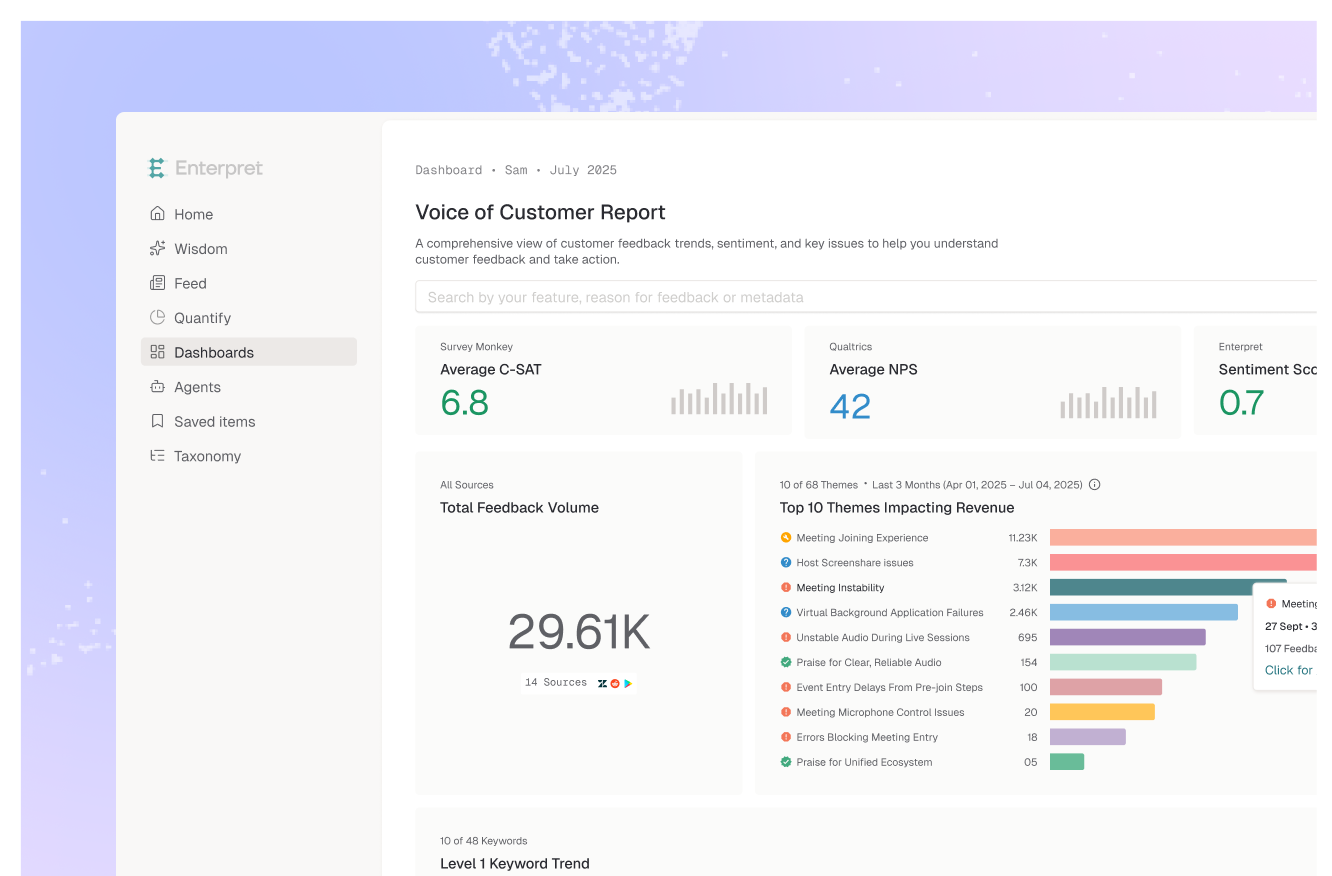
This is the step the others exist for. PMs ask a question in plain language and get exact records back, quantified by volume, segment, and revenue, inside the tools they already use: Slack, Notion, Jira, or Claude and Cursor through MCP servers to access customer insights in Notion and beyond. Get customer data out of the dashboard and into the work. Your job shifts from answering questions to curating the system that answers them.
When a fix ships, find every customer who asked for it and tell them. From said, to done, to heard. Skip this and customers learn feedback disappears, so they stop giving it. The mechanics of closing the customer feedback loop at scale depend on step two: you can only notify the accounts you linked.
Report volume tells you how busy you are. These five metrics tell you whether the system is replacing you.
To benchmark where your program sits today, map it against the customer feedback maturity model.
You can run this playbook with spreadsheets and a tagging rota for a while. It breaks at the steps that must stay current without a human in the middle: taxonomy, customer joins, routing, and self-serve. That is the part Enterpret is built for.
Connects 50+ feedback sources into a Customer Context Graph that joins each record to accounts, revenue, tickets, and owners. Adaptive Taxonomy is built from your docs and changelogs as product area, feature, and sub-feature, and updates as you ship. Wisdom answers natural-language questions with exact records. AI agents and alerts route spikes to owners in Slack, Jira, Linear, and Notion, and an MCP server brings the same data into Claude and Cursor. Integrations and processing take time before the graph is complete: this is infrastructure, not a plugin.
The taxonomy-grounded approach Enterpret uses is the one the stability study measured: themes and record-level predictions built once and reused, not re-clustered every time someone asks.
Picture a billing PM at a mid-market SaaS company who wants to know whether invoice-export complaints are concentrated in enterprise accounts. The old way: a DM to Product Ops, a CSV export, an afternoon of tagging, an answer by Thursday. The new way: the PM asks in Slack, gets the count by segment, the revenue attached, and the records behind it, and pastes them into the PRD.
Product Ops never sees the question. That is the point.
Every question the system answers is time back for the work only you can do: sharpening the taxonomy, tightening ownership, teaching PMs to ask better questions. Each makes the next answer better. The answer desk scales with headcount and resets every Monday.
The queue never ends. The system compounds. Pick one.
Product Ops should own the system: the source inventory, the taxonomy, routing rules, review cadence, and the self-serve layer. PMs own decisions within their branches, and support and CS own capture quality at the source. Product Ops should not be the default analyst for every customer question.
Mirror the product: product area, feature, sub-feature, with each branch mapped to a team that can own it. Test whole-tree usefulness, not just whether labels look right. Enterpret's taxonomy research found AI-generated taxonomies passed every generic quality check while 34.7% to 76.4% of their records leaked across top-level branches, versus about 20% for production references.
For one-off exploration, yes. For recurring rituals, a raw model re-clusters every time, so themes and counts shift between runs. Enterpret's stability study found that grounding the agent in a persistent taxonomy cut theme churn by 86 to 88% with the model held constant. The fix is to connect the LLM to a persistent taxonomy through an MCP server instead of pasting exports.
It depends on how many sources you have and how clear ownership already is. The inventory and owner mapping are internal work; any platform also needs integration and processing time before the data is joined and categorized. Start with your highest-volume sources and one product area, prove self-serve there, then expand.
If you're building this system for your product org, see how Enterpret works.
Research cited
Lorem ipsum dolor sit amet, consectetur adipiscing elit. Suspendisse varius enim in eros elementum tristique. Duis cursus, mi quis viverra ornare, eros dolor interdum nulla, ut commodo diam libero vitae erat. Aenean faucibus nibh et justo cursus id rutrum lorem imperdiet. Nunc ut sem vitae risus tristique posuere.