



The 10 KPIs Product Ops Should Track for Customer Feedback

Product
November 3, 2026

To use customer feedback in annual product roadmap planning, pull twelve months of feedback organized by product area, read trend lines instead of snapshots, weight themes by revenue and segment, separate loud requests from large ones, map what survives to your strategic bets, bring evidence packs into the planning room, define what you will measure next year, and close the loop on what you won't build. Eight steps, in order. Each removes a different kind of noise.
Picture the second week of November. A product ops lead has a Zendesk export open, last quarter's NPS deck, and a Gong clip a sales leader swears represents "the whole market." Planning starts Monday. Every PM will ask: what are customers saying about my area?
Most teams don't lack feedback. They lack a way to read a year of it at once. So planning defaults to memory, biased toward what was recent, escalated, or attached to a big logo.
That produces two category mistakes. The first: treating a snapshot as a trend. The theme that blew up in October looks bigger than the one that grew quietly every month since January. The second: treating loud as large. One frustrated enterprise champion can outweigh two hundred accounts that hit the same wall and never filed a ticket.
Product ops pays for both. In planning season you become the human query engine for every "can you pull what customers said about X." You shouldn't be the answer to every one of those questions. You should build the system that answers them.
Annual planning is not a review of feedback. It is a review of evidence about change: which problems grew, which shrank after you shipped, and how much revenue sits behind each.
That reframe has a hard requirement: your counting method has to hold still. If the way you group and count feedback shifts between runs, a trend line measures your method, not your customers.
Enterpret's study of run-to-run instability across eight frontier models, by Enterpret researchers Viraj Bagal, Raviraja G, and Prabhath Chellingi, ran each model ten times on the same support feedback. At 100 records, a raw model changed more than half of its top themes between two runs on average. At 5,000, nearly three quarters.
7.5 to 9.8% How much raw frontier models' counts moved between runs on the same matched themes and the same data. A taxonomy-grounded agent showed zero volume disagreement across all 117 valid run pairs. Source: Enterpret Research, "Same Feedback, Different Answer" (arXiv, 2026)
Stability is not accuracy. A system can repeat the same wrong answer. But without it, you can't even ask whether a theme grew.
The steps are not equal. The first three build the evidence base. The middle three are judgment. The last two decide whether next year starts smarter.
Bring every channel into one view: tickets, call transcripts, NPS and CSAT verbatims, reviews, community threads, sales notes. Organize by product area, feature, and sub-feature, not by channel. Roadmap lines are owned by product areas, so evidence should arrive in that shape.
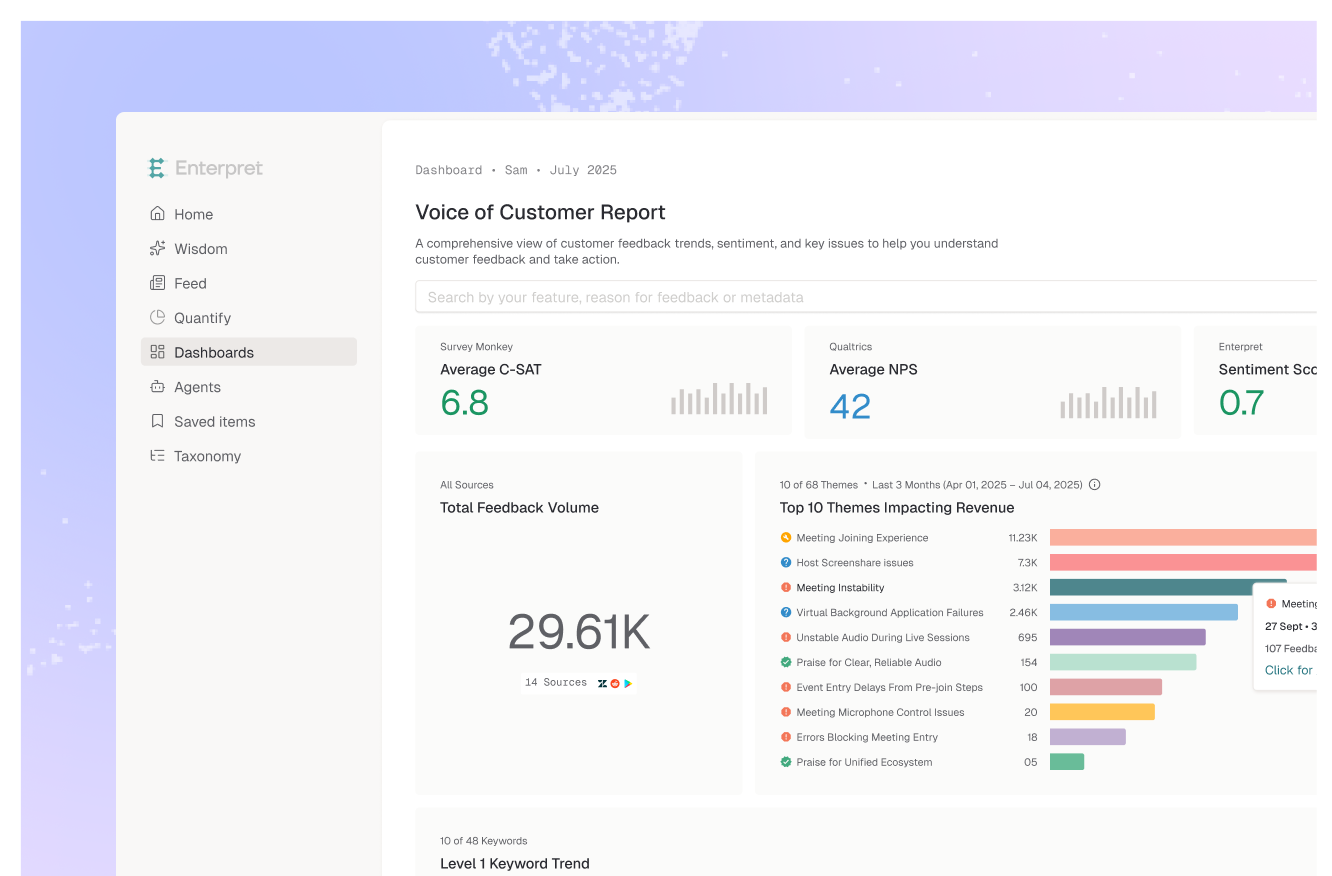
Plot monthly volume per theme and compare it with last year. Look for acceleration, not just size. A mid-sized theme growing every quarter usually matters more than a large one that peaked in March. This is the job of customer voice tools for identifying trending product issues, and it only works if counts are repeatable.
Join feedback to ARR, plan tier, segment, and renewal date. Forty mentions from enterprise accounts renewing next quarter and four hundred from free users are different problems. If your CRM holds the revenue, learn how to quantify how customer feedback impacts revenue in Salesforce before planning, not during it.
Loud is escalations, executive emails, one big logo. Large is breadth: distinct accounts and segments hitting the same problem. Count accounts, not mentions. Loud goes to account plans. Large goes to the roadmap.
Feedback informs strategy. It does not replace it. Attach supporting themes to each of next year's bets. A large theme with no bet is a missed bet or a deliberate no. A bet with no theme is a hypothesis. That's allowed, if everyone knows which is which.
Every proposed roadmap item gets a one-page evidence pack, built the same way, so items compete on evidence instead of storytelling. Put it where PMs already write plans. Teams working in Notion can pull it directly through MCP servers to access customer insights in Notion.
| Evidence pack field | What it answers |
|---|---|
| Theme and product area | What exactly is the problem, and which team owns it? |
| 12-month trend | Is it growing, flat, or shrinking, and versus last year? |
| Accounts and ARR | How many distinct accounts, and how much revenue sits behind it? |
| Segments | Is it universal or concentrated in one persona, tier, or region? |
| 3 to 5 verbatims | What does the problem sound like in customers' words? |
| Strategic bet | Which of next year's bets does this support? |
For each committed item, name the theme you expect to shrink, its baseline, and the target. Keep the same taxonomy so next November compares cleanly with this one. Without a feedback metric, a roadmap is a list of outputs. With one, it is a set of testable bets.
List the large themes you chose not to fund and tell the accounts that asked, with a reason. A no with a reason keeps trust. Silence spends it. Hand the list to CS and treat closing the customer feedback loop at scale as part of planning, not an afterthought.
The eight steps work with any tooling. They get much cheaper when the evidence base exists before planning starts. That is Enterpret's job.
A note on timing: Enterpret connects through 50+ feedback integrations and needs processing time to build the graph. Start in October, not the Friday before planning.
A snapshot is not a trend. A loud account is not a large problem. Annual planning goes wrong when it confuses the two.
Picture two PMs pitching for the same headcount. The first brings an escalation email from a major account and a hunch that "everyone wants better permissions." The second brings an evidence pack: permissions confusion grew every quarter, spans a few dozen enterprise accounts renewing in the first half, concentrates in admins, and ties to next year's enterprise expansion bet. It also names the metric that should drop if the work lands.
Both PMs believe they are customer-driven. Only one can be checked next November.
Most teams treat annual planning as an event that starts from zero. Teams moving up the customer feedback maturity model treat it as one turn of a loop. This year's step 7 becomes next year's step 2 baseline.
That compounds. A team with three years of comparable data plans against evidence. A team rebuilding its view every December plans against memory. The gap widens every cycle.
Use at least twelve months, organized by product area, and compare against the prior year if you have it. That comparison only holds if themes were grouped and counted the same way in both years.
Not on raw exports if you need comparable numbers. In Enterpret's stability study, raw frontier models changed more than half of their top themes between runs at 100 records, and counts on matched themes moved 7.5 to 9.8%. Grounding the model in a persistent taxonomy cut theme churn by 86 to 88%.
Separate loud from large. Count distinct accounts and revenue, not raw mentions. One big account's request usually belongs in an account plan; a problem spread across many accounts in a target segment belongs on the roadmap.
List the large themes you chose not to fund, find the accounts that raised them, and give CS a short, honest reason to share. A clear no protects trust better than silence, and the conversation can surface a workaround or a narrower need.
If you're preparing for planning season and want your evidence base ready before the first review, see how Enterpret works.
Research cited
Lorem ipsum dolor sit amet, consectetur adipiscing elit. Suspendisse varius enim in eros elementum tristique. Duis cursus, mi quis viverra ornare, eros dolor interdum nulla, ut commodo diam libero vitae erat. Aenean faucibus nibh et justo cursus id rutrum lorem imperdiet. Nunc ut sem vitae risus tristique posuere.