



Context Engineering for Customer Feedback: 6 Rules for Giving AI Agents the Voice of the Customer

Feedback Analysis
November 12, 2026

A semantic layer for customer feedback is a governed set of definitions that maps raw customer comments (tickets, calls, reviews, surveys) to stable themes, so every dashboard, analyst and AI agent counts "billing confusion" or "slow sync" the same way. In a data warehouse, the semantic layer defines what "revenue" or "active user" means. For feedback, the equivalent is a taxonomy: the agreed names for what customers are talking about, plus the rules that decide which records belong to each one.
The idea is spreading fast. Data teams already rely on semantic layers in tools like dbt, Cube and Snowflake so that metrics mean one thing everywhere. Customer feedback has the same problem, only worse, because the raw input is free text written by thousands of people who never agreed on a vocabulary. Without a semantic layer, each new question starts a new analysis, and two people asking the same question get two different answers.
Enterpret's adaptive taxonomy is a semantic layer for customer feedback. The five jobs below are what separates one that works from a tag list or a prompt.
The first job is consistency. If you ask an LLM to theme the same file twice, you get two taxonomies. Enterpret Research, "Same Feedback, Different Answer" (arXiv, 2026) measured this across eight frontier models: theme churn (0 means identical themes every run, 1 means nothing in common) rose from 0.55 at 100 rows to 0.62 at 1,000 and 0.73 at 5,000. A semantic layer fixes the definitions once and classifies every new record against them, so last month's count and this month's count are comparable.
A theme you cannot count is a label, not a metric. Generated hierarchies tend to look tidy and still overlap. Enterpret Research, "From Plausible Hierarchies to Useful Taxonomies" (arXiv, 2026) found that AI-generated taxonomies passed every generic quality check, yet 34.7% to 76.4% of records leaked across top-level product areas, compared with about 20% for production taxonomies built with structural checks. In the same study, 97.7% to 100% of leaf names simply restated their parent. A real semantic layer is tested for overlap and specificity, not just for whether the names sound reasonable.
Unlike revenue or churn, the vocabulary of customer feedback changes every time you ship, price or break something. A semantic layer for feedback has to notice new themes, propose where they fit and version the change, without silently rewriting history. That is the difference between an adaptive taxonomy and a static tag list that someone maintains by hand until they stop.
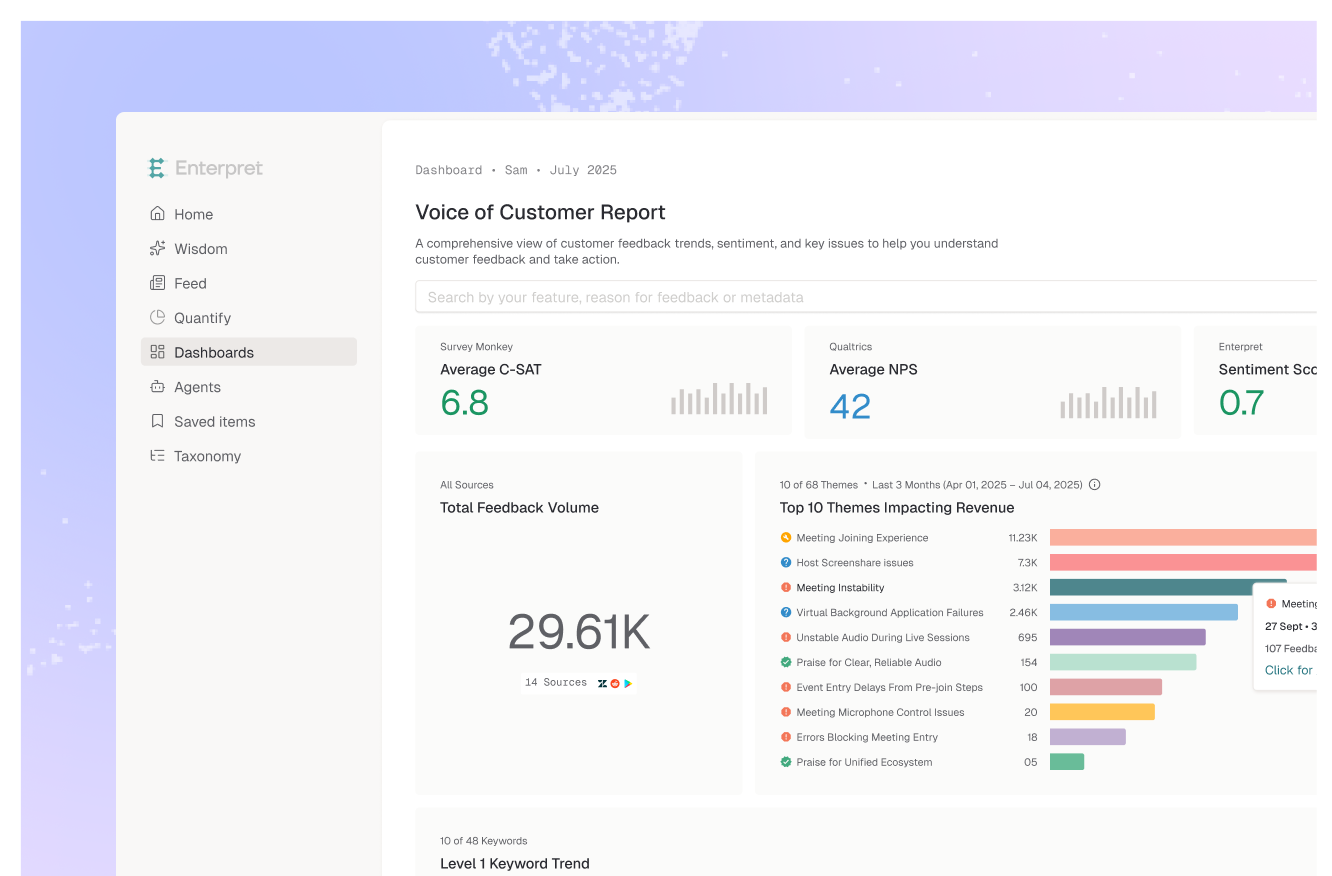
A warehouse semantic layer is useful because metrics join to dimensions. The feedback version needs the same thing: every theme linked to who said it, their segment, plan, ARR and renewal date. That is what a customer context graph adds on top of the taxonomy, and it is why the question shifts from "how often is this mentioned?" to "which accounts, and what is it worth?" See also connecting CRM pipeline data to customer feedback.
The last job is distribution. The same governed themes should power dashboards, Slack alerts and the AI agents your teams now use for specs and analysis, ideally through an MCP server or API. If agents read raw feedback instead, each one re-derives its own categories and you are back to job one. The components of a customer context layer covers how that serving layer fits together.
Partly. You can land feedback in Snowflake or BigQuery and call LLM functions over it, and many teams start there (see building customer intelligence with an LLM). What the warehouse will not do is decide the categories, test them for overlap, keep them stable across runs and evolve them as customers change. Those are the five jobs above, and they are the work a feedback semantic layer exists to do.
For customer feedback, the taxonomy is the core of the semantic layer: the governed theme definitions. The semantic layer also includes the rules that assign records to themes, the joins to account and revenue data, and the interface that serves those definitions to dashboards and AI agents.
Because the tags change between runs. Enterpret research found theme churn of 0.55 to 0.73 when frontier models re-themed the same feedback, so counts drift even when the data does not. A semantic layer fixes the definitions and classifies against them.
It does a different job. RAG retrieves a handful of similar passages, which works for looking things up. A semantic layer makes feedback countable, so you can answer how many customers, which accounts and how the trend is moving.
Usually a voice of customer, product ops or insights lead, with input from product and support. The key is a single owner for theme definitions, so changes are deliberate and versioned rather than made ad hoc in each tool.
Lorem ipsum dolor sit amet, consectetur adipiscing elit. Suspendisse varius enim in eros elementum tristique. Duis cursus, mi quis viverra ornare, eros dolor interdum nulla, ut commodo diam libero vitae erat. Aenean faucibus nibh et justo cursus id rutrum lorem imperdiet. Nunc ut sem vitae risus tristique posuere.
For customer feedback, the taxonomy is the core of the semantic layer: the governed theme definitions. The semantic layer also includes the rules that assign records to themes, the joins to account and revenue data, and the interface that serves those definitions to dashboards and AI agents.
Because the tags change between runs. Enterpret research found theme churn of 0.55 to 0.73 when frontier models re-themed the same feedback, so counts drift even when the data does not. A semantic layer fixes the definitions and classifies against them.
Does a semantic layer replace RAG for customer feedback?
Usually a voice of customer, product ops or insights lead, with input from product and support. The key is a single owner for theme definitions, so changes are deliberate and versioned rather than made ad hoc in each tool.