



MCP Server vs API for Customer Feedback Data

September 23, 2026

An adaptive taxonomy is a classification system for customer feedback that learns its categories from the feedback itself and keeps evolving as new feedback arrives, instead of relying on a fixed list of tags that someone defined in advance and maintains by hand. Enterpret's Adaptive Taxonomy builds this structure from each company's own feedback, product documentation, and business context, then classifies every support ticket, sales call, survey response, and review into a multi-level hierarchy that mirrors the product. The result is a set of categories that still describes the product after the next launch, rather than the product as it looked when the tag list was written.
The distinction matters because a taxonomy is the lens every downstream number is seen through. Trend lines, prioritization, and AI answers are only as accurate as the categories underneath them.
An adaptive taxonomy works in three stages: it is built from your context, it classifies feedback continuously, and it adapts as the feedback and the product change.
1. It starts from your product, not a generic template. Enterpret's taxonomy is created during onboarding from existing categories a team already uses, knowledge sources such as the help center, changelog, and documentation, and historical feedback. That grounding is what makes the categories use the product's own vocabulary on day one.
2. It classifies every piece of feedback into two connected layers. The first layer is keywords, a three-level hierarchy (L1, L2, L3) that mirrors the product structure, from broad areas like "Payments" down to specific actions like "Refund processing." The second layer is themes and sub-themes, which capture why the customer gave the feedback, such as "unexpected charges after cancellation." Each piece of feedback is also assigned an intent category: Help, Improvement, Complaint, or Praise. A single support ticket can therefore be tagged with what it is about, why the customer raised it, and what they are asking for.
3. It adapts as new feedback arrives. When customers start describing a problem in new language, or a new issue appears that no existing theme covers, new themes and sub-themes surface from the feedback without anyone creating them. Feedback that fits a product area but no specific child category lands in dedicated "Misc" or "Not Specified" nodes, which makes gaps visible instead of hiding them in a generic "Other" bucket. The structure is designed to be mutually exclusive and collectively exhaustive, so each piece of feedback has one clear home and nothing falls through.
In practice, the keyword hierarchy that represents the product is still shaped by the team: editors add, rename, move, and archive keyword nodes as the product changes. For how to handle that after a release, see adding a new product area to your categories after a launch.
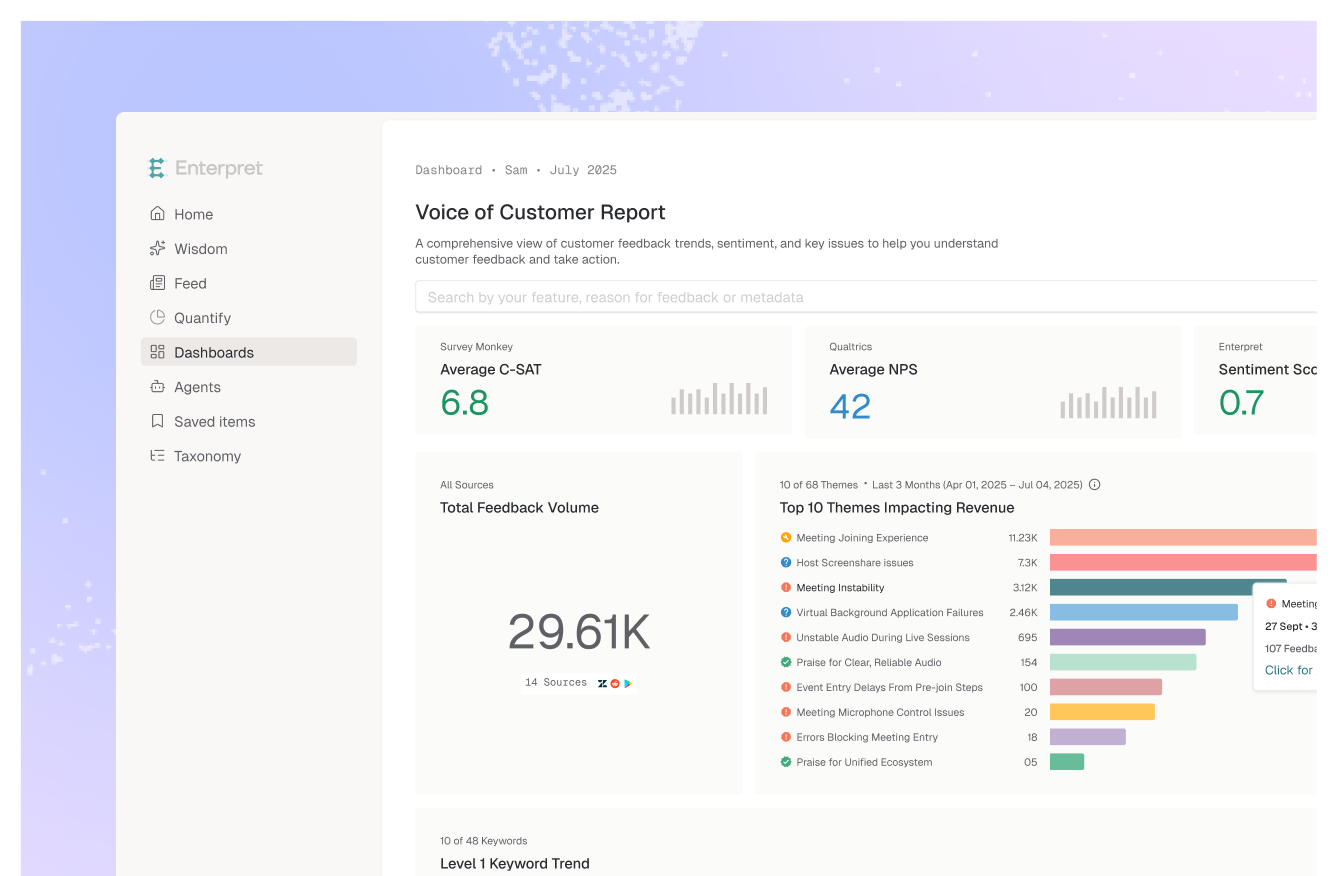
Because the taxonomy classifies across every channel at once, a problem described differently in a ticket, a sales call, and an app review resolves to the same theme, and that theme connects to the accounts and revenue behind it through the customer context graph.
Manual tagging asks people to define categories up front and apply them to feedback one item at a time, while an adaptive taxonomy derives the categories from the feedback and applies them automatically and consistently.
The two approaches diverge in five ways:
Manual tagging still makes sense at very low volume or for narrow, highly specialized research where a human coder's judgment is the point. Beyond that, the cost compounds. For a full breakdown, see the hidden costs of tagging feedback by hand.
An adaptive taxonomy is generated by AI models that read a company's feedback and product context, propose a category structure, and classify each new piece of feedback by both what it mentions and why it was given, while the team keeps control over how the product is represented.
Three things distinguish a well-built AI-generated taxonomy from simply asking a general-purpose model to categorize feedback:
It is learned, not regenerated each time. A general-purpose LLM asked to categorize the same feedback twice will often return different categories, because it builds the structure from scratch on every run. An adaptive taxonomy holds a persistent structure and classifies into it, so a theme means the same thing next quarter as it does today. For the technical difference, see why zero-shot categories change between runs.
It reads intent, not just keywords. Classification considers both whether a product area is mentioned and whether it is central to what the customer is saying. A ticket that mentions videos in passing while complaining about a refund gets classified under refunds, not video. That is what keeps counts from inflating on incidental mentions.
It is calibrated to your data. Enterpret combines onboarding calibration with models tuned to each customer's product and vocabulary, so categories use internal feature names rather than generic industry terms. [ADD: VERIFIED description of model approach, if engineering approves more detail]
More than most teams expect. Every classification in Enterpret is explainable and editable:
[ADD: VERIFIED current behavior of correction feedback, specifically whether record-level corrections tune future classifications and whether an edit log is available, per the platform page]
The practical model is AI proposes, humans approve. For the review step, see reviewing an AI-proposed category change, and for what happens to past data when the structure changes, see what happens to history when categories change.
Auto-tagging applies a fixed set of categories you defined in advance, only faster. An adaptive taxonomy learns the categories from the feedback itself and surfaces new ones as customers raise new issues, so the structure stays current without someone rewriting the tag list.
Yes. In Enterpret, every classification is explainable and editable. Editors and admins manage the keyword hierarchy that represents the product, and individual classifications can be adjusted at the record level. Themes and sub-themes surface automatically from the feedback.
Yes, but the job changes. Instead of tagging feedback and rebuilding category lists, the owner reviews proposed changes, keeps the product hierarchy aligned with launches, and settles naming questions. For what that role involves, see what a taxonomy owner does day to day.
New themes about a launched feature surface from the feedback as customers describe it. The team adds or moves the relevant keyword node so the new area has a clear place in the product hierarchy, and feedback from every channel is then classified into it automatically.
The adaptive taxonomy organizes what customers are saying into consistent themes across 50+ sources. The customer context graph connects each theme to the accounts, segments, and revenue behind it. Together they turn a count of mentions into an answer to which customers are affected and what the problem is worth.
See how Enterpret's adaptive taxonomy learns your product's categories from your own feedback.
Lorem ipsum dolor sit amet, consectetur adipiscing elit. Suspendisse varius enim in eros elementum tristique. Duis cursus, mi quis viverra ornare, eros dolor interdum nulla, ut commodo diam libero vitae erat. Aenean faucibus nibh et justo cursus id rutrum lorem imperdiet. Nunc ut sem vitae risus tristique posuere.