





Enterpret vs unitQ
Both turn customer feedback into structured insight with AI. unitQ was built to find what is broken; Enterpret was built to decide what to do about it. This page shows where each one is stronger today.
Learned from your own data. Maintains itself as you ship.
The account and revenue behind every signal.
Work lands in Jira, Linear, and Slack with the evidence attached.
Two good tools. Two different jobs.
unitQ grew out of app quality monitoring and is strongest at catching defects fast. Enterpret was built for product, CX, and revenue teams that need every signal tied to the account behind it.
- Your main job is catching app and product quality issues as they emerge.
- You want competitive benchmarking, support QA, and AI interviews from one vendor.
- Engineering is the primary buyer, with PagerDuty and GitHub in the loop.
- Product, CX, and revenue teams all need to act on the same feedback.
- You want themes ranked by the accounts and revenue behind them, not by mention count.
- Nobody on your team has time to re-tune a taxonomy after every launch.
- You want insight to land in Jira, Linear, Slack, or your AI agent with the evidence attached.
Where Enterpret is stronger.
Detecting what is broken is one layer. These four tell you why, which customers it affects, what it is worth, and whether the fix worked.
A taxonomy that maintains itself.
Enterpret learns your product structure from your feedback, help docs, and changelogs, usually in about two days. When you ship, rename a surface, or customers start using new words, it proposes the update. A predefined category tree gives you predictable reporting; if that matters more than adaptation, it is a fair trade.
The account underneath every signal.
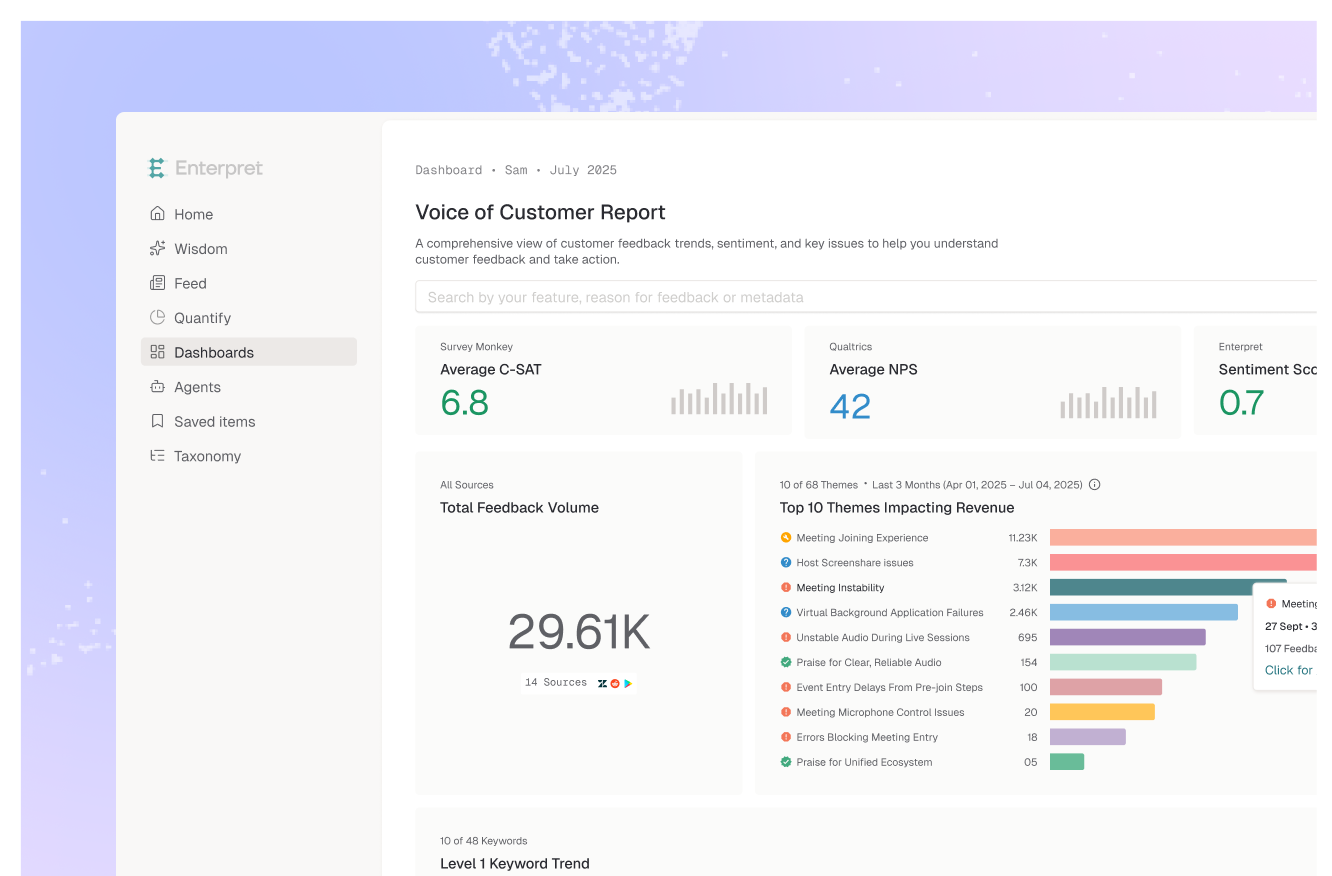
The Customer Context Graph joins each ticket, review, and call to the user, account, segment, opportunity, and revenue behind it. “340 complaints about export speed” becomes “six of them are accounts in renewal.”
Work lands where work happens.
Feedback agents detect a pattern, triage it, and open the issue in Jira, Linear, or Zendesk with the evidence attached. Then they monitor whether the fix actually moved the feedback. You decide what runs on its own and what waits for a person.
One source for product, CX, and revenue.
Product managers rank the roadmap by revenue at risk. Support leads catch regressions the day after a release. Sales sees what an account said before the renewal call. Same data, same taxonomy, no exports.
Want to see this on your own feedback?
Book a Demo →Side by side, row by row.
Each row reflects what both companies publish as of November 2026. A green dot marks the stronger side where one is clear. No dot means it is a judgment call.
- AI categorization of tickets, reviews, surveys, and social.
- An MCP server for Claude, ChatGPT, and Cursor.
- Plain-language questions, answered from real feedback.
- Real-time alerts on emerging issues.
- Jira integration for turning issues into tickets.
Feature names differ between vendors, so every row is a judgment call. If we got one wrong, tell us and we’ll correct it.
Credit where it’s due.
If these matter most to your team, unitQ is a sound choice. We would rather you hear it here than in month six.
Quality monitoring at the core.
unitQ started in app quality and it shows. It surfaces defects from app reviews, tickets, and social as they emerge, with a quality score to track the trend line.
Competitive benchmarking.
unitQ Compete tracks competitors’ public feedback inside the same taxonomy. Enterpret has no built-in equivalent today.
More modules under one roof.
Support QA, social listening, and AI-led interviews ship as part of unitQ’s platform. If you want those from one vendor, that breadth is real.
Four questions to ask both of us.
Demos look alike. These questions separate platforms in month eighteen, when the product has changed and the person who set things up has moved on.
What is the team doing in week one: configuring, or reading?
And who does that work six months from now, after a launch changes the vocabulary?
Can I see which accounts sit behind a theme, without an export?
A count is a starting point. Six accounts in renewal is a decision.
Where does an insight go after it is found?
A dashboard, an alert, a ticket with evidence attached, or an agent your team already uses. Ask to see the last step, not the first.
What does the program cost in headcount over three years?
License price is the visible number. The analyst who owns the taxonomy is the one that decides total cost.
Common questions.
Short answers. The table above has the detail.
Is Enterpret or unitQ better?
Neither, in the abstract. unitQ is the stronger fit when the core job is catching product and app quality issues fast, especially with engineering as the buyer. Enterpret is the stronger fit when product, CX, and revenue teams need to act on the same feedback, tied to the accounts behind it.
Does unitQ have an MCP server?
Yes. unitQ launched an MCP server in May 2026 that connects its feedback data to Claude, ChatGPT, Cursor, and other agents. Enterpret has one too. The difference is in what comes back: Enterpret’s answers carry the account, segment, and revenue context from the Customer Context Graph.
Which one costs less?
Neither publishes list pricing; both are sales-led with custom quotes. Ask both for a three-year total that includes the people needed to keep the taxonomy current.
Can Enterpret do competitive benchmarking like unitQ?
Not as a built-in module today. If tracking competitors’ public feedback inside your own taxonomy is central to your program, unitQ is ahead on that row.
How do you keep this page accurate?
Every unitQ claim comes from unitQ’s own site, blog, or public review data, listed below, and we re-check it monthly. If you work at unitQ and see something wrong, email us and we’ll fix it.
See what your own feedback looks like.
Bring a sample of tickets, reviews, or calls. We’ll show you the taxonomy your data builds and the accounts behind each theme.
