



The 7 Things That Should Go Into a Company Context Layer for AI Agents

Feedback Analysis
November 20, 2026

Product marketers use customer feedback to find what customers actually value, the words they use to describe it, the objections that stall deals and the alternatives they compare against. The strongest positioning is rarely invented in a workshop; it is recognized in sales calls, reviews, tickets and win-loss data, then tested. Six ways to do it:
Look for the outcomes customers mention without being asked, in reviews, renewal calls and NPS promoter comments. If they consistently praise speed and you lead with flexibility, your positioning is off.
Pull the phrases customers use to describe the problem before they found you. Those words become headlines, ad copy and website H1s. Classified feedback makes this systematic: filter a theme and read the 50 most representative quotes.
Classify objections across every sales call and lost deal, not just the ones reps mention. Each recurring objection needs a message, a proof point and an enablement asset. See turning sales call objections into product priorities.
Count which alternatives buyers mention, including spreadsheets and doing nothing. Position against what buyers actually compare you with, which is often not the competitor on your slide.
Cut themes by role, company size and plan. Enterprise buyers and self-serve users usually value different things, and one message rarely fits both. See segmenting feedback by persona and account tier.
After a launch, watch whether customers repeat the new language and whether objections shift. Feedback becomes a continuous message-testing loop instead of a one-time research project.
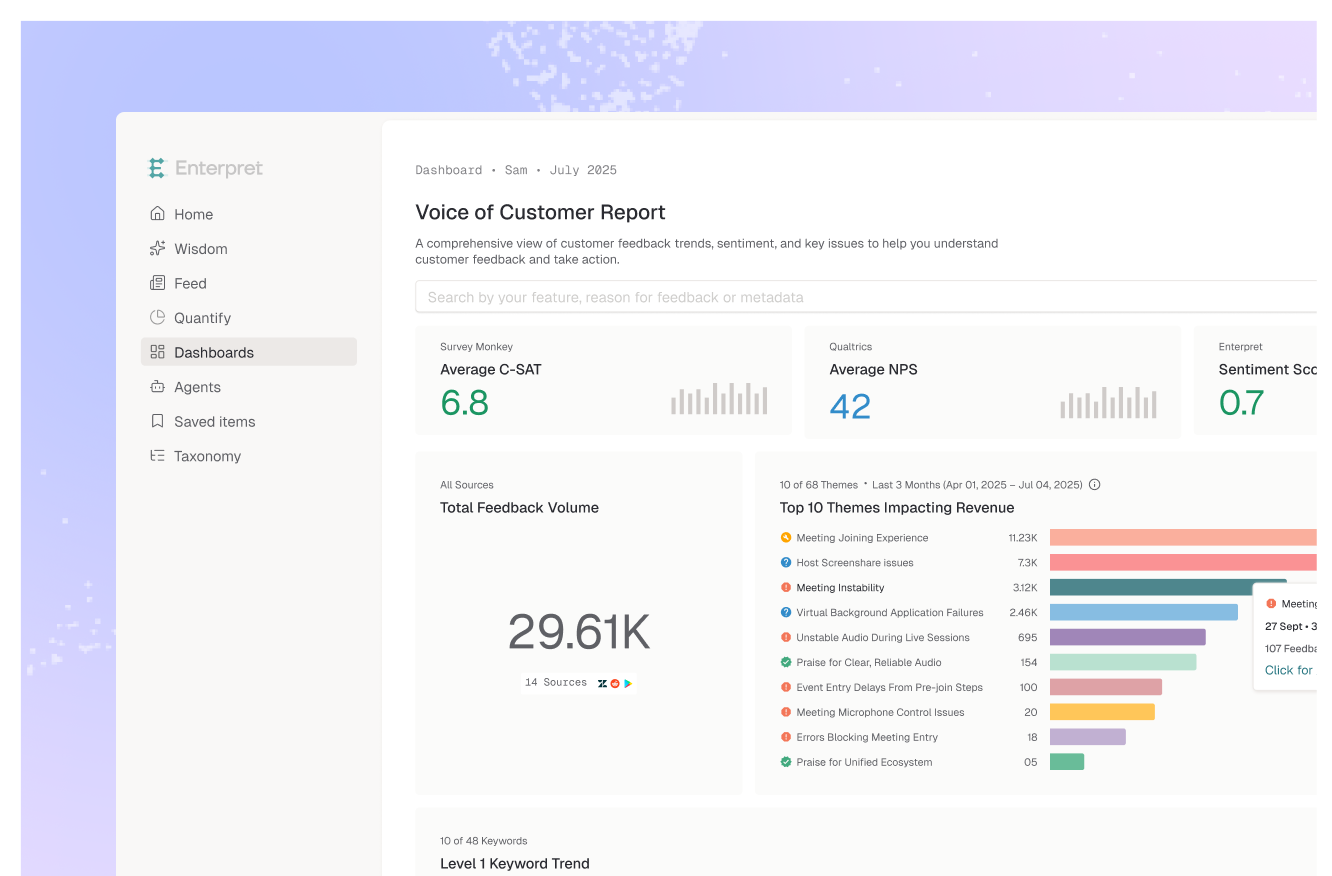
Enterpret classifies sales calls, reviews, tickets and surveys with one adaptive taxonomy, so PMMs can see value themes, objections and competitor mentions by segment, with quotes attached. PMMs can also query it from Claude through MCP. See tools to analyze customer feedback for messaging and positioning.
Messaging built from customers' own words and priorities, gathered from calls, reviews, surveys and tickets, rather than from internal assumptions.
Sales and renewal call transcripts, win-loss data, reviews on G2 and app stores, and NPS comments. Support tickets reveal pain language and objections.
Continuously monitor themes and objections, and formally review positioning each quarter or after major launches and competitive shifts.
Classify feedback into themes, then count how often each value, objection or competitor appears by segment over time.
Lorem ipsum dolor sit amet, consectetur adipiscing elit. Suspendisse varius enim in eros elementum tristique. Duis cursus, mi quis viverra ornare, eros dolor interdum nulla, ut commodo diam libero vitae erat. Aenean faucibus nibh et justo cursus id rutrum lorem imperdiet. Nunc ut sem vitae risus tristique posuere.
Messaging built from customers' own words and priorities, gathered from calls, reviews, surveys and tickets, rather than from internal assumptions.
Sales and renewal call transcripts, win-loss data, reviews on G2 and app stores, and NPS comments. Support tickets reveal pain language and objections.
How often should PMMs revisit positioning with feedback?
Classify feedback into themes, then count how often each value, objection or competitor appears by segment over time.