



The 7 Signals That Separate Product Problems From Operational Problems in Customer Feedback

Product
November 23, 2026

A customer data platform (CDP) collects behavioral and profile data, resolves identity and builds audiences for marketing activation. A customer context layer serves AI agents a structured understanding of customers at the moment they act, including what customers say in their own words, organized into themes and linked to accounts and revenue. A CDP answers "who is this and what did they do?" A context layer also answers "what do they need, why, and how much does it matter?" Most companies need both, and the context layer usually draws on the CDP.
CDPs were built for marketers and activation tools: email platforms, ad networks, personalization engines. A context layer is built for AI agents and the people working through them: coding agents, support agents, PMs asking Claude questions.
A CDP centers on events and attributes: page views, purchases, traits, consent. A customer context layer adds unstructured voice of customer data (tickets, call transcripts, reviews, survey comments) plus the themes, owners and outcomes derived from it. Behavior shows a customer stopped using a feature; feedback explains why.
A CDP's unit is the profile. A context layer's unit is often the relationship: this account raised this theme, which this team owns, which was resolved in this release. That graph shape is what lets an agent reason across customers rather than look one up.
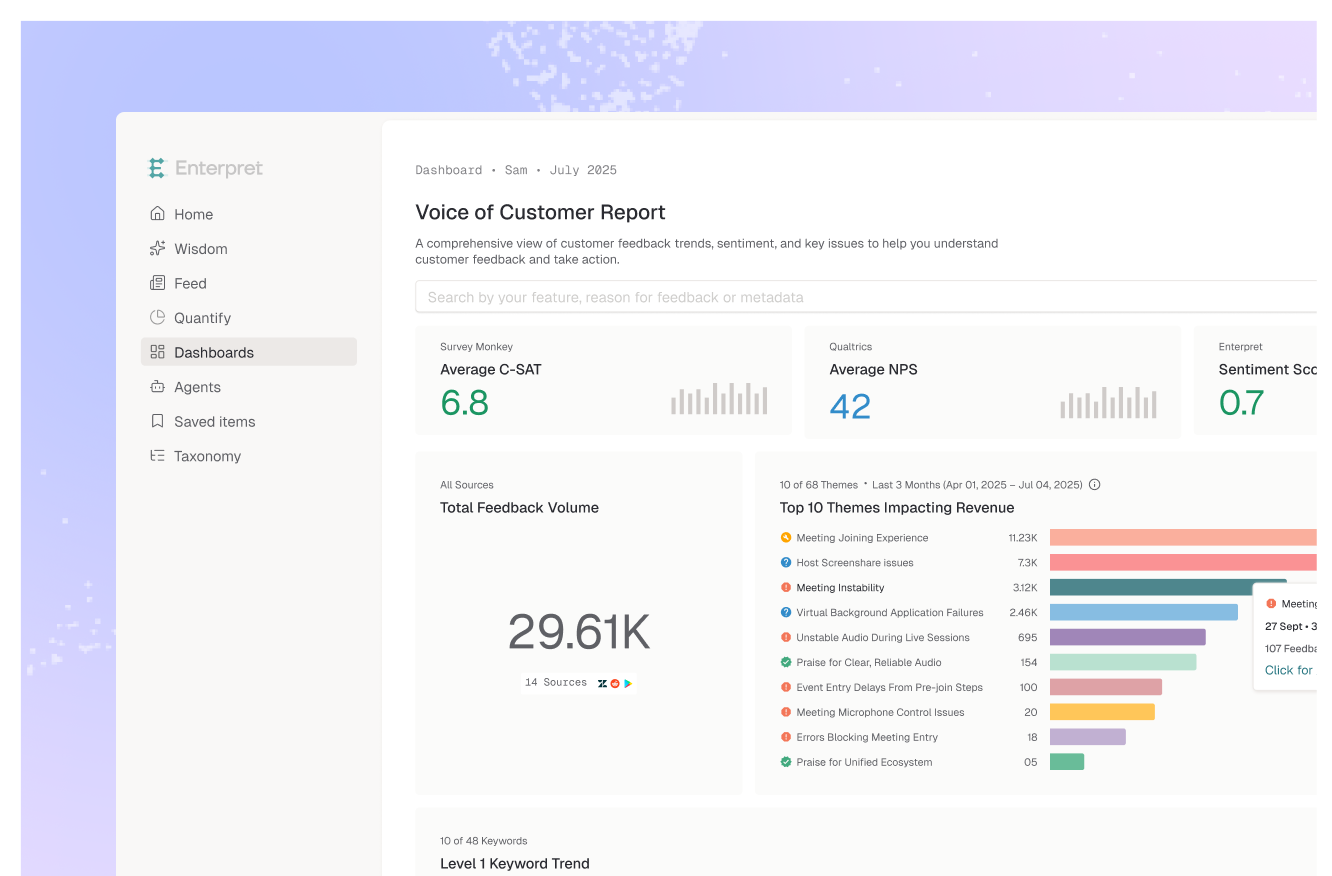
CDPs answer segmentation questions: which users did X in the last 30 days? Context layers answer analytical questions: what is driving enterprise churn this quarter, and which accounts are affected? Those need aggregation across unstructured records, where retrieval alone falls short. Enterpret research comparing VoC AI architectures found an agent grounded in a persistent customer context graph scored 0.961 on real voice-of-customer questions, against 0.651 for Agentic RAG.
CDPs push audiences and traits to downstream tools through connectors and reverse ETL. Context layers are pulled on demand by agents, usually through an MCP server or API, at reasoning time.
Use the CDP for identity resolution and behavioral traits, and feed those into the context layer so feedback can be joined to the right user and account. The context layer then serves the combined picture to agents. See what a customer context graph is for the data model, and tools that give AI agents customer context for options.
Some CDP vendors now describe agent-facing features as a customer context platform. The distinction that matters is whether it includes structured feedback and relationships agents can reason over, not only profiles and events.
No. A context layer can resolve identity from CRM and product data directly. If you have a CDP, it is a useful input.
It can store survey scores or tags as traits, but CDPs are not built to classify millions of free-text records into themes or keep a taxonomy current.
The CRM holds accounts, opportunities and revenue. A context layer joins feedback to those records so agents can weigh issues by account value.
Lorem ipsum dolor sit amet, consectetur adipiscing elit. Suspendisse varius enim in eros elementum tristique. Duis cursus, mi quis viverra ornare, eros dolor interdum nulla, ut commodo diam libero vitae erat. Aenean faucibus nibh et justo cursus id rutrum lorem imperdiet. Nunc ut sem vitae risus tristique posuere.
Some CDP vendors now describe agent-facing features as a customer context platform. The distinction that matters is whether it includes structured feedback and relationships agents can reason over, not only profiles and events.
No. A context layer can resolve identity from CRM and product data directly. If you have a CDP, it is a useful input.
Can a CDP store customer feedback?
The CRM holds accounts, opportunities and revenue. A context layer joins feedback to those records so agents can weigh issues by account value.