



The 10 KPIs Product Ops Should Track for Customer Feedback

Product
November 3, 2026

Give product managers a system they can question, not another dashboard to read. Self-serve access to customer feedback works when four things are true: PMs can ask a question in plain language and get back exact records, every team sees the same categories, every answer is quantified by segment and revenue, and answers show up where PMs already work (Slack, Jira, Linear, Notion, Claude). There are five common ways to set this up, from a shared spreadsheet to a customer intelligence platform with an MCP server. Here is a teardown of each against those four tests.
The metric to judge them by: ad-hoc "what are customers saying about X?" requests landing on Product Ops per week. On Enterpret's self-serve feedback views page, one Head of Product Ops who gave every product area its own filtered, auto-updating view saw those requests drop by over 60%. Design for that number, not dashboard count.
A dashboard answers the questions someone anticipated. "What are enterprise accounts on the new plan saying about SSO since the 4.2 release, and how much ARR is behind it?" crosses three filters, a date boundary, and a revenue join. No pre-built chart has that cut, so the PM pings Product Ops.
The fix is moving from display to query: a governed feedback layer any PM can interrogate, with Product Ops owning the system instead of answering every request.
Self-serve is not a permission setting. It is an architecture: one taxonomy, one customer context, many entry points. The platform stays the same. The entry point changes per team.
Each test maps to a failure mode that kills self-serve rollouts.
Can a PM ask a question nobody pre-built and get the underlying records, not a summary to trust blindly?
If two PMs ask the same question and get different themes, self-serve creates arguments. The taxonomy must be shared, granular (product area to feature to sub-feature), and updated as you ship.
A quote is a signal. A count split by plan, segment, and ARR is a prioritization input. Feedback must be joined to accounts before anyone asks.
Usage of a separate tool decays. Answers delivered into Slack, Jira, Linear, Notion, or an AI assistant get used while the decision is being made.
Test 02 is the one teams skip. In Enterpret's study of run-to-run instability across eight frontier models, researchers Viraj Bagal, Raviraja G, and Prabhath Chellingi reran identical feedback questions on identical data. At 100 records, raw models changed more than half of their top themes between two runs on average.
86 to 88% Reduction in theme churn when an AI agent is grounded in a persistent taxonomy instead of re-clustering raw feedback on every run (0.104 vs 0.765 for the raw model, same model, 1,000 records). Source: Enterpret Research, "Same Feedback, Different Answer" (arXiv, 2026)
Product Ops exports tickets, verbatims, and call notes into a sheet or Notion database, tags them, and shares the link. Near-zero cost, one day of setup.
Where it breaks: tagging is manual, so categories drift with whoever tagged that week, and coverage falls behind volume within a quarter. No revenue join unless someone maintains a VLOOKUP. PMs can read it but not ask it anything.
Pipe feedback into the warehouse, join it to account data, and chart it per product area. The revenue join is real, so test 03 passes.
Where it breaks: BI tools count structured fields. Open text still needs categorizing upstream, and every new question becomes a data team ticket. The bottleneck just moved to analytics.
These centralize feature requests. In Canny, boards hold posts that users vote and comment on. In Productboard, contributors submit front-line customer requests to the product team.
Where it breaks: they capture what someone chose to submit, not the full stream of tickets, calls, and reviews. Votes measure loudness, not revenue at risk.
Upload a CSV to ChatGPT or Claude and let PMs ask questions. It passes test 01 on day one (here is our guide to leveraging ChatGPT AI for customer feedback analysis).
Where it breaks: test 02. The same stability study found raw models' counts moved 7.5 to 9.8% on matched themes between runs, so two PMs asking the same question can walk into planning with different numbers. Exports also go stale and carry no revenue context.
Platforms such as Enterpret and Chattermill ingest feedback from every channel, categorize it automatically, and let PMs query it in plain language. Several now expose an MCP server so answers reach Claude and other assistants directly (Chattermill, for example, offers one for Claude).
Where it breaks: it is the most expensive option and needs integrations plus processing time before answers are trustworthy. Test the taxonomy and account join, not the demo chat. Our guide on how to evaluate a customer insights platform lists the questions to ask.
| Approach | Answers questions | Consistent categories | Segment and revenue | Where PMs work |
|---|---|---|---|---|
| Spreadsheet or Notion repo | No | Manual, drifts | Manual | Partial (Notion) |
| BI dashboards | Pre-built only | Depends on upstream tagging | Yes | No |
| Feedback boards | Partial | Request-level only | Partial | Partial (Jira sync) |
| AI chat over exports | Yes | No, shifts run to run | No | Yes |
| Customer intelligence platform with MCP | Yes | Yes, if taxonomy is persistent | Yes, if accounts are joined | Yes |
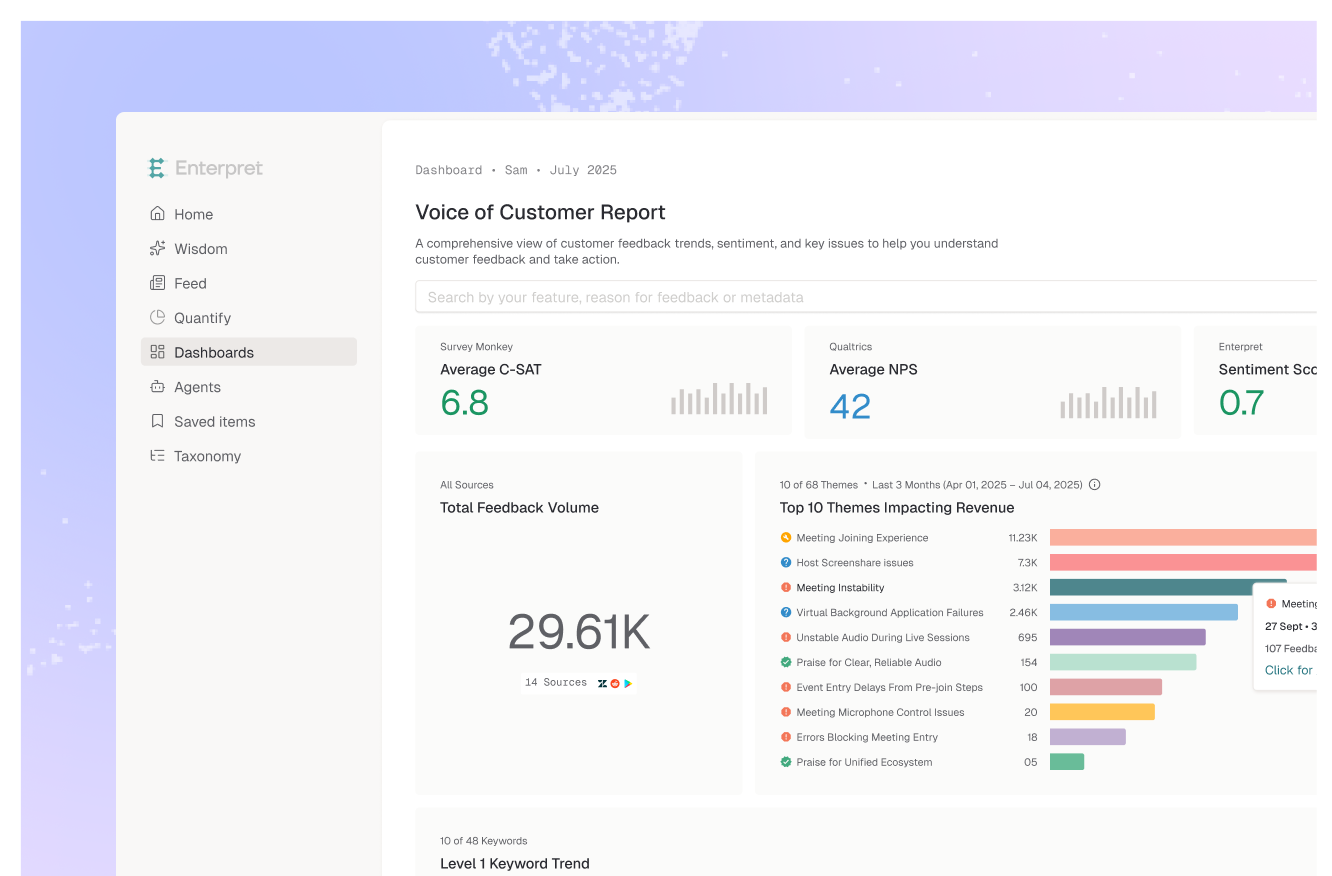
Adaptive Taxonomy builds an L1/L2/L3 hierarchy (product area, feature, sub-feature) from your docs and changelogs and updates it as you ship, which covers test 02. The Customer Context Graph joins feedback from 50+ integrations to accounts, revenue, tickets, and owners, which covers test 03. Wisdom answers plain-language questions with exact records, and the MCP server, Slack, Jira, Linear, and Notion integrations cover test 04.
Enterpret research comparing Agentic RAG, a Deep Research Agent, and a context graph agent notes that "a top-k retrieval result cannot establish corpus prevalence." In that exploratory benchmark of 30 real VoC questions, the context-graph-backed agent scored 0.961 vs 0.710 and 0.651.
Self-serve views per product area, Wisdom for ad-hoc questions, agents that alert a PM's Slack channel when a theme rises, and an MCP server. Expect an integration and processing period before the context graph is complete.
Picture a Product Ops lead supporting 12 PMs across four product areas. Whatever the tool, the permutation is the same: one taxonomy, one view and one alert per area, one query surface.
Next, PMs stop "going to" feedback at all. An agent drafting a PRD in Claude or a ticket in Linear pulls customer evidence itself through MCP, with counts and accounts attached. That only works if the taxonomy is persistent and the context is joined. My hypothesis: Product Ops will be measured on the quality of the system, not the speed of its replies. Run the four tests on your current setup and tell me where it breaks.
It means a PM can answer their own customer questions without filing a request to Product Ops or analytics. That requires a shared taxonomy, feedback joined to account and revenue data, and plain-language querying in the tools PMs already use.
For one-off exploration, yes. For shared decisions, it is risky: Enterpret's 2026 stability study found raw frontier models changed more than half of their top themes between runs on the same 100 records, while an agent grounded in a persistent taxonomy cut theme churn by 86 to 88%. Connect the assistant to a governed feedback layer through MCP instead.
Track ad-hoc requests to Product Ops per week, weekly active PMs querying feedback, time-to-first-answer, and the share of PRDs citing quantified customer evidence.
A spreadsheet takes a day, BI dashboards take weeks of data work, and a customer intelligence platform needs time to connect integrations and process historical feedback. See how long it takes to set up customer feedback analytics for a breakdown.
If you are evaluating customer intelligence platforms for Product Ops, see how Enterpret works.
Research cited
Lorem ipsum dolor sit amet, consectetur adipiscing elit. Suspendisse varius enim in eros elementum tristique. Duis cursus, mi quis viverra ornare, eros dolor interdum nulla, ut commodo diam libero vitae erat. Aenean faucibus nibh et justo cursus id rutrum lorem imperdiet. Nunc ut sem vitae risus tristique posuere.