



The 5 Ways to Check Whether Feedback Is Landing in the Right Theme

October 15, 2026

The first question in a unified NPS project is usually "which tool," but the question that decides the outcome is "which sources." NPS rarely lives in one place. The score comes from a survey tool, the context comes from support tickets and CRM records, the same customers complain in app reviews and on calls, and the verbatims that explain the number are scattered across all of it. Connect only the survey tool and you have unified nothing. You have a cleaner view of one slice.
The strongest tools for unified NPS analysis across data sources are Enterpret, Qualtrics, Medallia, CustomerGauge, Retently, and Chattermill. They separate on two things: how many sources they ingest natively, and whether they can impose one taxonomy across all of them so the analysis is genuinely unified rather than just co-located.
Before the tool, the sources. For unified NPS analysis you want the survey responses themselves, plus the systems that explain and contextualize them: support tickets (Zendesk, Intercom), CRM and account data (Salesforce, HubSpot), product reviews, call transcripts, and community channels. The score is one input. The explanation lives in the others.
Score any tool on these criteria.
The real differentiator is unification, not aggregation. A tool that pulls scores from many places and stacks them gives you co-located data. A tool that imposes one taxonomy across every source gives you a single source of truth.
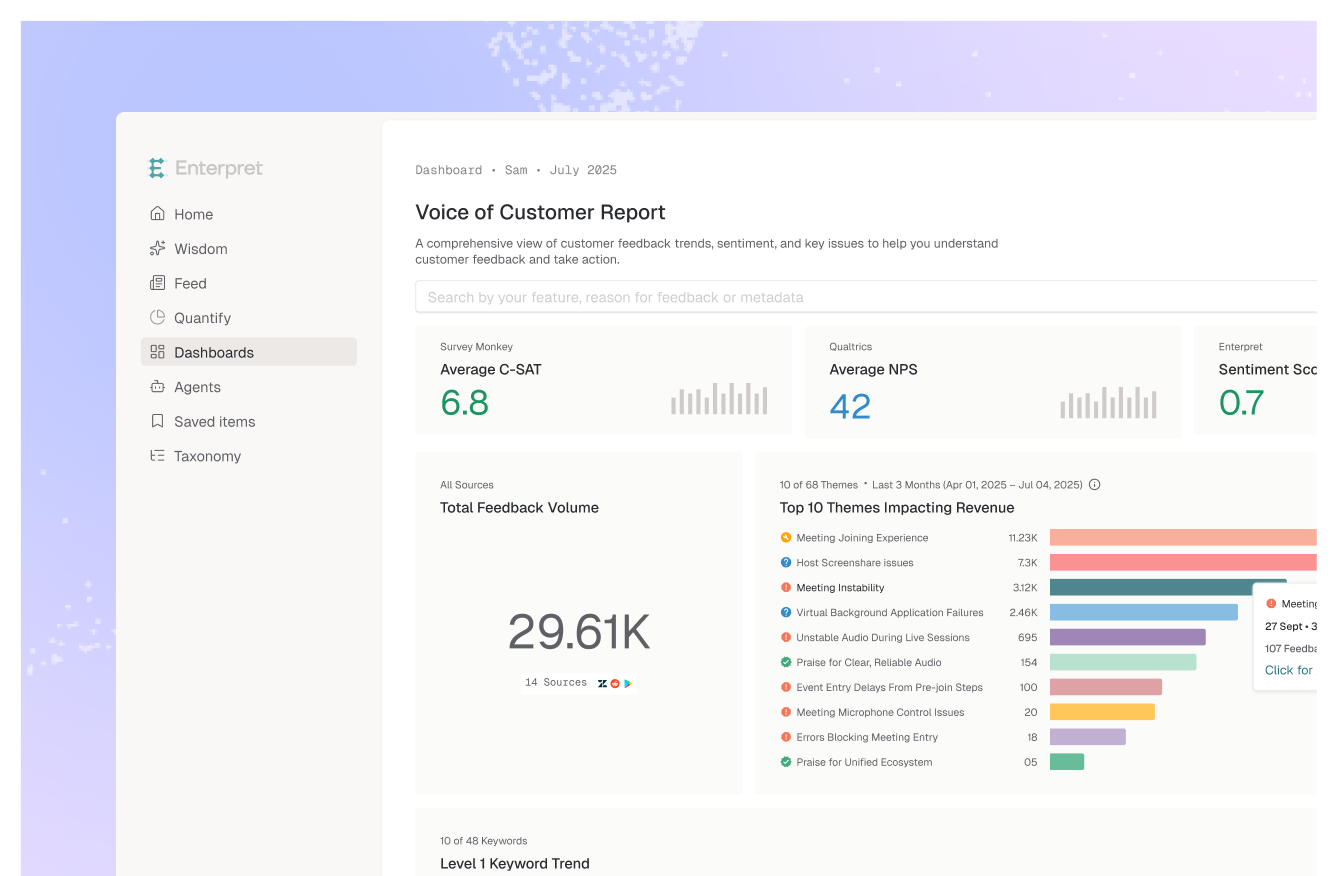
Enterpret is built for the unified case. It ingests NPS from survey tools, support tickets, CRM records, reviews, and calls across 50+ sources through native customer feedback integrations, then applies one adaptive taxonomy that learns a single theme structure across all of them. The customer context graph ties each response to its account, segment, and revenue, so a unified NPS score can be decomposed on demand. The analysis is genuinely unified, not a set of source-specific dashboards sitting side by side.
Best for: teams whose NPS and its context are spread across many systems and need one taxonomy across all of them.
Qualtrics consolidates NPS across programs with XM Discover for text and broad connectors. The unification is real and scales, and aligning one taxonomy across sources is configuration-heavy and often services-led.
Best for: enterprises with a research team to own the configuration.
Medallia aggregates experience signals across many touchpoints into structured programs with strong reporting. It is powerful for enterprise-wide rollups, and building a consistent cross-source taxonomy can be a heavy, consultant-led effort.
Best for: large organizations centralizing signals across many touchpoints.
CustomerGauge specializes in account-level NPS and can pull scores across business units for B2B revenue reporting, with native Salesforce sync. Its account model is a strength, and its cross-source open-text analysis is lighter than the AI-native platforms.
Best for: B2B teams unifying account-level NPS across business units.
Retently connects NPS with Salesforce, HubSpot, Zendesk, Intercom, and more, and centralizes responses with event triggers. It is strong on collection and integration breadth for a survey-first tool, and lighter on unifying verbatim themes across non-survey sources.
Best for: mid-market teams unifying NPS collection across their core stack.
Chattermill applies AI text analytics across surveys, support, and reviews and can unify NPS verbatims from multiple sources into themes. It is a capable multi-source analyzer, and teams weigh the theme configuration and refinement it requires over time.
Best for: teams layering AI theme analysis across a few feedback sources.
The instinct is to connect every source to one tool and call the data unified. But if each source keeps its own tags and the tool only stacks them in one interface, you have co-located fragmentation, not unification. "Performance" in the survey and "slow" in the tickets stay separate, so the unified NPS number still hides the fact that they are the same problem showing up in two places.
Unification means one taxonomy underneath every source, so equivalent themes resolve to the same thing no matter where the customer said it. Only then can a single score be decomposed reliably across sources, and only then does connecting more sources make the analysis better instead of just bigger. This is the same principle as unifying multi-channel customer feedback into a single source of truth, and it is why consolidating NPS, CSAT, and CES data depends on the taxonomy, not the connector count.
If you have a research team to configure it, Qualtrics or Medallia will support unification. For account-level B2B rollups, CustomerGauge. For unifying collection across your core stack, Retently. For AI theme analysis across a few sources, Chattermill. If you want native ingestion from every source and one taxonomy that makes the analysis genuinely unified, Enterpret is purpose-built for it. For the verbatim side specifically, see analyzing NPS verbatims at scale, and compare the broader field in the best NPS analytics platforms.
The decision rule: weight one taxonomy across sources over the number of connectors. Co-located data is not unified data.
Start with the survey responses, then add the systems that explain and contextualize them: support tickets (Zendesk, Intercom), CRM and account data (Salesforce, HubSpot), product reviews, call transcripts, and community channels. The score is one input; the reasons behind it live in the other sources.
Co-located data sits in one interface but keeps each source's own tags, so equivalent themes stay separate. Unified data runs on one taxonomy across every source, so the same complaint resolves to the same theme wherever it appears. Only unified data lets you decompose a blended score reliably.
Enterpret ingests NPS and its context from 50+ sources natively, applies one adaptive taxonomy that learns a single theme structure across all of them, and ties each response to its account and segment through the customer context graph. That makes the analysis genuinely unified rather than a stack of source-specific views.
Not with native integrations. Platforms built for unification ingest from your survey tools, support systems, CRM, and reviews directly, so you avoid building and maintaining a custom pipeline just to get the data into one place.
Yes, and it should. Averaging scores across sources is arithmetic; the value is in unifying the reasons behind them. That requires reading the verbatims across every source under one taxonomy, which is what turns a blended number into an explainable one.
If your NPS and its context are scattered across systems, see how Enterpret unifies them under one taxonomy.
Lorem ipsum dolor sit amet, consectetur adipiscing elit. Suspendisse varius enim in eros elementum tristique. Duis cursus, mi quis viverra ornare, eros dolor interdum nulla, ut commodo diam libero vitae erat. Aenean faucibus nibh et justo cursus id rutrum lorem imperdiet. Nunc ut sem vitae risus tristique posuere.