



Context Engineering for Customer Feedback: 6 Rules for Giving AI Agents the Voice of the Customer

Feedback Analysis
November 12, 2026

Hospitals and clinics can analyze patient feedback across surveys, reviews and support by bringing every source into one place, removing protected health information before analysis, and classifying all of it against one taxonomy built around the patient journey. The six steps: inventory sources and where PHI appears, de-identify and sign the right agreements, build one care-journey taxonomy, classify every comment rather than sampling, segment by location, department and service line, and route each theme to an operational owner with a closed loop. Survey scores tell you that something changed; the comments behind them tell you what.
Most health systems already collect more patient feedback than they can read: CAHPS survey comments, online reviews, portal messages, call-center notes, complaints and grievances. The problem is not volume. It is that each source lives with a different team, in a different tool, with a different set of categories.
Three things make healthcare different from other feedback programs.
Scores alone do not solve this. A dip in a communication score says something changed in a unit; the comments say whether it was discharge instructions, nurse response times or a new scheduling system.
Scores tell you where to look. Comments tell you what to fix. The work is reading every comment consistently, across every source.
List each feedback source, its owner, its volume, and whether it contains PHI. Typical sources: CAHPS and other survey comments, post-visit surveys, Google and other online reviews, patient portal messages, call-center notes, complaints and grievances, and staff-reported concerns. Note which ones are tied to a visit or encounter, because those can later be segmented by department and provider.
Decide whether analysis will run on identified or de-identified data. The safer default is to strip identifiers before text leaves your environment: names, dates, phone numbers, addresses, emails, record numbers and other HIPAA identifiers, plus staff names if you do not want individual-level reporting. If any vendor will process PHI, confirm a Business Associate Agreement before sending data, and ask how the vendor handles model training, retention and subprocessors. Our guide to security certifications to require from a feedback vendor lists what to request.
Use the same categories for every source, organized around the journey: access and scheduling, wait times, check-in, clinical communication, nursing care, pain management, environment and noise, food, discharge and follow-up, billing and insurance, and digital tools. Leaf themes should be specific enough to act on ("discharge instructions not explained") rather than restating their parent ("discharge issue").
LLMs can do this classification well. A study of inpatient HCAHPS comments from a New Jersey health system, Large Language Models for Patient Comments Multi-Label Classification, found GPT-4 Turbo classified comments into ten topics such as noise, staff issues, wait times, food and discharge with a zero-shot F1 of 76.12%, well ahead of traditional baselines. The authors redacted HIPAA identifiers with a rule-based step before any comment reached a model.
Classify all comments, not a sample, and make sure the same comment gets the same theme every time. Consistency matters more in healthcare than most industries, because results are compared across units, months and facilities. In Enterpret's study of run-to-run instability across eight frontier models, a raw model asked twice for the top themes in the same feedback changed more than half its theme set at 100 records and nearly three quarters at 5,000. A unit should not look worse because the analysis ran twice.
86 to 88% Reduction in theme churn when analysis is grounded in a persistent taxonomy instead of re-analyzing raw feedback on every run (same model and data). Source: Enterpret Research, "Same Feedback, Different Answer" (arXiv, 2026)
Caveat: that study measured stability, not accuracy, and it used enterprise support feedback rather than patient comments. Validate accuracy on your own comments with clinical and patient experience staff.
Attach each comment to its facility, department, service line and visit type where the source allows. A system-wide "wait times" theme is not actionable; "wait times in the orthopedic clinic at one site since a scheduling change" is. Watch for comments that span several departments, because they are the ones most likely to fall between teams.
Map every theme to an owner: unit leaders for care themes, facilities for environment, food services, revenue cycle for billing, digital for portal issues. Alert owners when a theme spikes in their area, track what was changed, and check whether the theme declines afterward. Pair this with service recovery for individual complaints, which still need a person to respond.
| Source | Strength | Limit |
|---|---|---|
| CAHPS and post-visit survey comments | Tied to a visit and unit; comparable over time | Arrive weeks later; only respondents |
| Online reviews | Public, unprompted, shape reputation | Hard to tie to a visit; skew to extremes |
| Portal messages | Real-time, specific | Mixed with clinical questions; heavy PHI |
| Call-center notes | Access and scheduling pain in volume | Agent summaries, not patient words |
| Complaints and grievances | Serious issues, formal process | Low volume; owned by risk or quality |
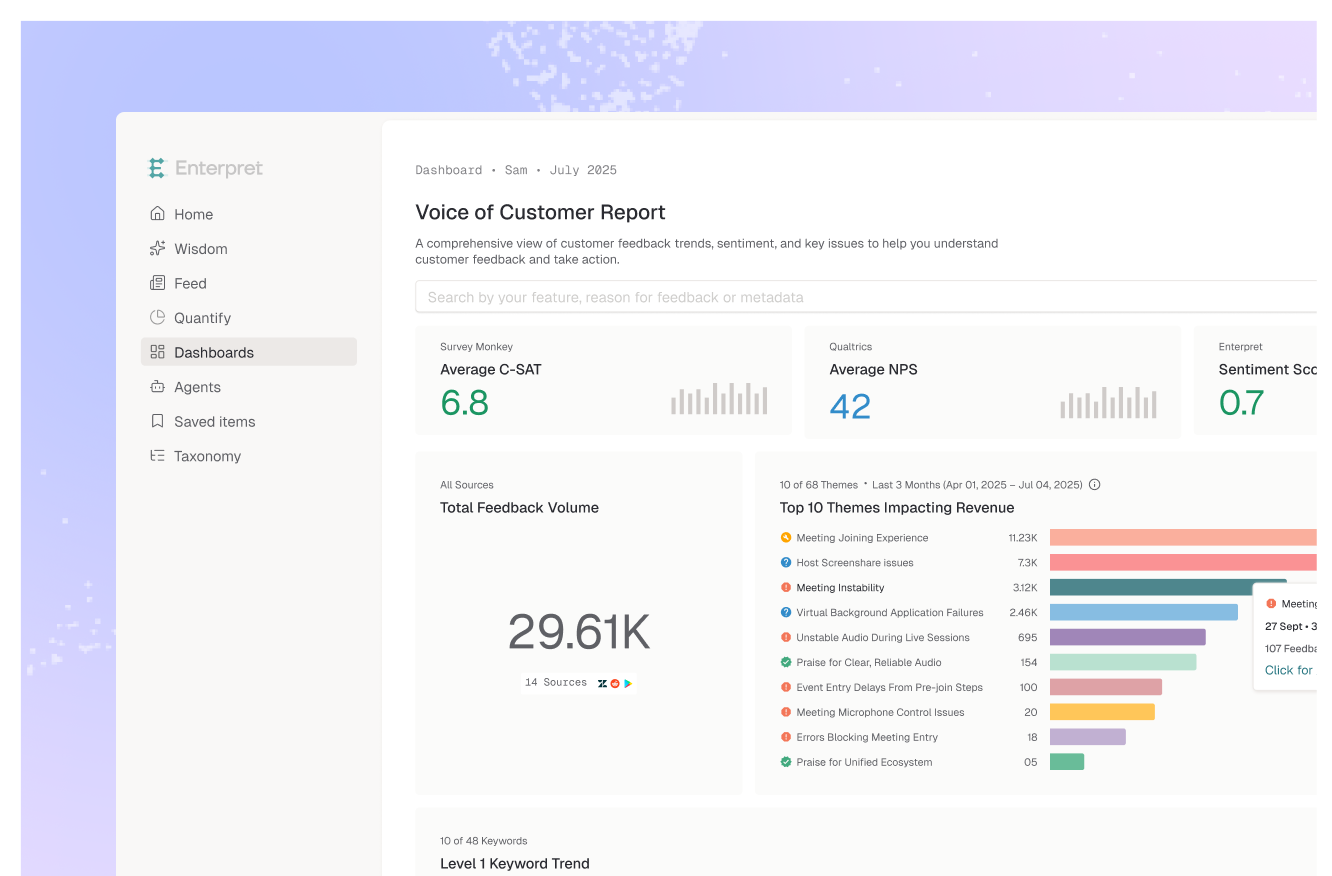
Enterpret brings feedback from 50+ channels, including surveys, reviews, support and call notes, into one place and classifies it with Adaptive Taxonomy, a model built for your organization that updates as services change. The Customer Context Graph links themes to locations, owners and other attributes you send with each record, and AI agents and alerts flag spikes to the right team. Enterpret holds a SOC 2 Type 2 report. As with any vendor, confirm whether a BAA is available before sending PHI, or de-identify comments before they are ingested. For organizations outside healthcare with similar multi-team structures, see feedback platforms for security and compliance.
Picture a hospital where one unit's quiet-at-night score fell for two quarters. The unit added signage and adjusted night routines, with little change. Classifying every comment across surveys, reviews and portal messages showed the noise comments were concentrated on patients awaiting discharge, who described being kept overnight while paperwork was finished. The fix sat with discharge planning, not the unit. What worked: one taxonomy across sources, segmented by unit and stay length. What did not: the first pass sampled 200 comments and missed the pattern entirely.
As AI makes it practical to read every comment, patient experience teams can move from quarterly score reviews to weekly operational signals. The organizations that benefit will be the ones that solve privacy, consistency and ownership first, so that faster insight reaches the right unit leader instead of another dashboard.
Yes, with the right controls. De-identify comments before analysis where possible, and if a vendor will process PHI, put a Business Associate Agreement in place first and confirm how data is retained and whether it is used for model training.
Promising but worth validating. A study of HCAHPS comments found GPT-4 Turbo reached a zero-shot F1 of 76.12% across ten topics, well above traditional baselines. Validate on your own comments with clinical and patient experience staff.
Yes, with one taxonomy across both. Surveys tie to visits and units; reviews are public and unprompted. Together they show whether an issue is local or system-wide.
Map every theme to an owner, segment by location and department, and alert owners when their themes spike. Track whether the theme declines after a change.
If you want one view of patient feedback across sources, see how Enterpret works. Start by listing every source and its owner; most teams find at least one they had forgotten.
Research cited
Lorem ipsum dolor sit amet, consectetur adipiscing elit. Suspendisse varius enim in eros elementum tristique. Duis cursus, mi quis viverra ornare, eros dolor interdum nulla, ut commodo diam libero vitae erat. Aenean faucibus nibh et justo cursus id rutrum lorem imperdiet. Nunc ut sem vitae risus tristique posuere.