



The 5 Ways DTC Brands Analyze Product Reviews, Support Tickets, and Post-Purchase Surveys Together

November 2, 2026

A live game's Discord can produce thousands of messages after a single patch. Bug reports, balance rants, feature wishlists and memes all land in the same channels, and the loudest thread of the week is rarely the one that matters most for retention. Most studios end up with a community manager reading everything and a roadmap meeting where nobody can say how many players are affected.
The 6 steps game studios use to turn Discord feedback into roadmap input are structuring intake with forum channels and tags, separating bugs from balance complaints from feature ideas, weighting each signal by player segment, tying feedback to specific patches and builds, checking Discord against data and quieter channels, and closing the loop in patch notes. What separates studios that do this well is not how much they read, but whether every message ends up in a consistent category, attached to who said it and which build they were on.
The real differentiator is the second criterion. Most studios can collect Discord messages. Far fewer can categorize them the same way every week, which is what makes a patch-over-patch comparison trustworthy.
Start by making Discord easier to analyze before you analyze it. Discord's developer guide for game communities recommends a forum channel, not a regular text channel, for feedback, because forum posts become threads that can carry tags like "Under Review" or "Implemented." It recommends the same for bug reports, with guidelines asking players to include reproduction steps, platform and game version. For playtests, the guide suggests a Community Invite that automatically assigns a Beta Tester role, which keeps playtest feedback separated from the general server.
The tradeoff: players and moderators apply forum tags, so they drift. Treat them as a first pass.
Best for: any studio whose feedback currently lives in a single #feedback text channel.
These three types of feedback route to different teams and run on different clocks. Bugs go to QA and engineering, usually this sprint. Balance complaints go to design and need to be weighed against match data. Feature ideas go into a backlog that gets reviewed against the game's direction. Becky Matthew of indie studio Gumbug described this backlog approach in a Game Developer post on community-led design: keep a dedicated feedback channel, document ideas in a backlog, and spread community ideas evenly across sprints rather than in big batches. She also cautioned that vocal users are often a minority.
The hard part is that players do not label their own messages. "The new map is unplayable" could be a frame-rate bug, a spawn-balance issue or a design preference. Splitting them needs a categorization model that reads intent, not keywords. Plausible-looking categories are not enough: in Enterpret's taxonomy evaluation paper, AI-generated taxonomies passed every generic quality check, yet 34.7% to 76.4% of records leaked across top-level product areas, versus about 20% in production references.
Best for: teams whose roadmap reviews mix crash fixes and feature requests in the same ranked list.
A Discord server over-represents your most engaged players. Games user researcher Steve Bromley makes this point directly in his guide to running playtests with a Discord community: your community is not the same as your typical players, which can distort conclusions about tutorials, difficulty and motivation. He recommends separating first-time players from returning playtesters, since prior exposure is the biggest source of sample bias.
Apply the same logic to live feedback. Useful segments include new versus veteran players, spend tier (high spenders versus non-payers in free-to-play), platform (PC, console, mobile) and region. Riot's Greg Street gave a GDC talk on balancing League of Legends for every skill level, "from Bronze to Bengi," which is the same idea applied to balance: a change that delights pros can frustrate new players, and the reverse.
Best for: free-to-play and live-service games where a small segment drives a large share of revenue.
Every message should carry a timestamp you can map to a release. Then you can answer which themes spiked after the last patch and whether a fix actually reduced reports. Measuring a fix needs stable counts: in Enterpret's study of run-to-run instability, raw models' counts on matched themes moved 7.5 to 9.8% between runs, while a taxonomy-grounded agent's counts did not move across 117 valid run pairs. For mobile titles, do the same with app store reviews by version; our guide on analyzing app store reviews by app version covers that side.
Best for: studios shipping weekly or biweekly patches that need to know whether a spike is a regression or noise.
Discord is one input, not the verdict. Bromley's guidance is to analyze observed behavior before opinions and to check opinions against game data. Riot has described Valorant balance as combining player sentiment, game data and design philosophy, while relying on human judgment rather than being entirely data driven. Cross-check Discord themes against telemetry, tickets, store reviews and surveys. If a complaint is loud on Discord but absent from tickets and reviews, it may be a power-user preference. If it shows up everywhere, it is a roadmap item.
Best for: design teams deciding whether a balance outcry reflects a real problem or a vocal subset.
Discord's developer guide is explicit: when a player's suggestion or bug report leads to something, tell them publicly. In practice that means updating the forum tag to "Implemented," crediting community reports in patch notes, and posting a short "what we heard, what we changed" note in announcements. Some large studios run public issue trackers for the same purpose; Epic, for example, has used a public Trello board to show the status of known Fortnite issues.
Best for: every studio. It is the cheapest step and the one most often skipped.
Enterpret is a customer intelligence platform that handles steps 2 through 6 across Discord and the rest of your feedback. Its feedback integrations connect to the Discord channels you select (private channels need the Enterpret bot added), along with Apple App Store and Google Play reviews, support tools like Zendesk and Intercom, surveys, and YouTube and TikTok comments. New data can take up to 24 hours to become available for analysis, so this is not instant.
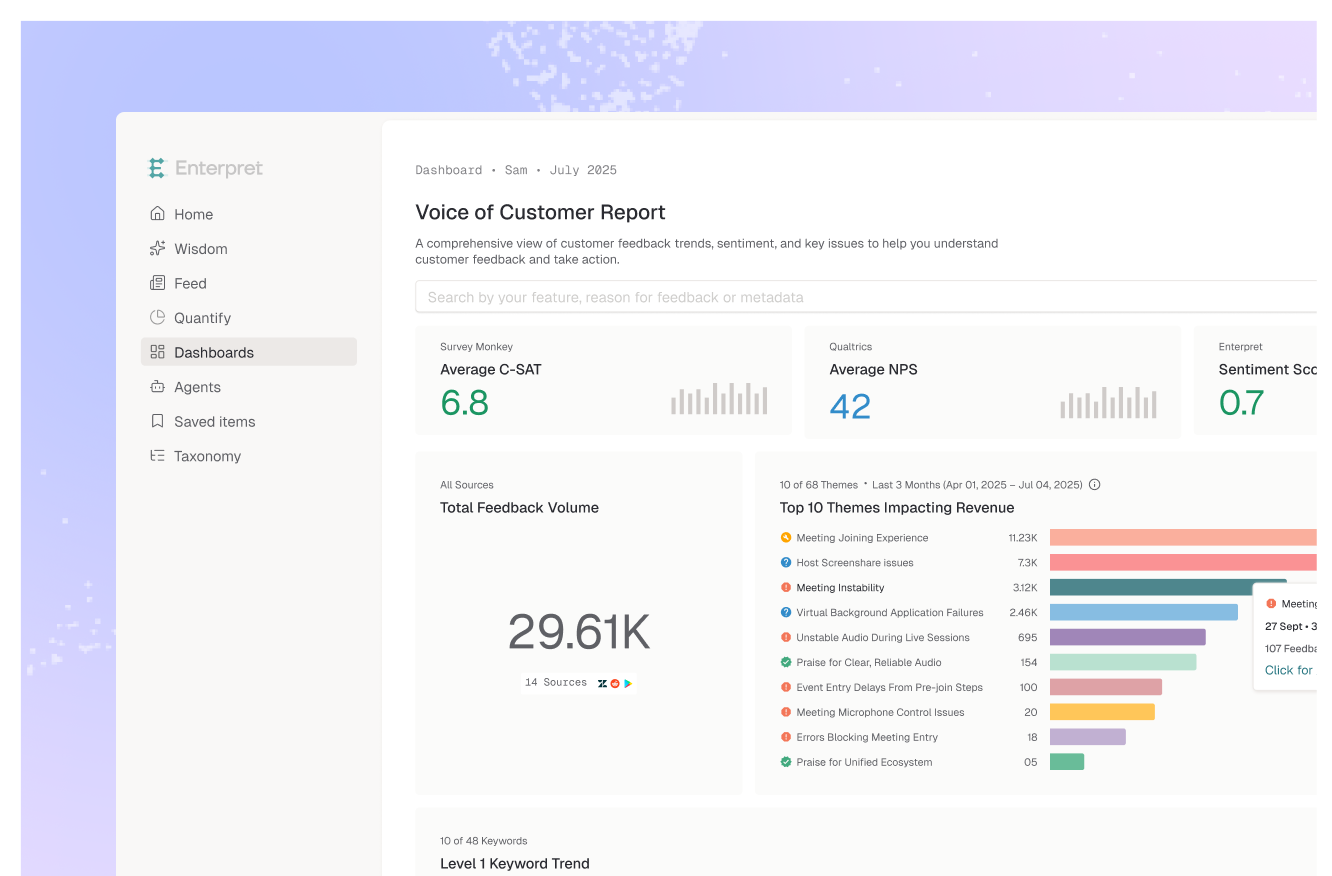
Adaptive Taxonomy learns a multi-level set of categories from the feedback itself, so "crash on load," "sniper too strong" and "add ranked duos" land in separate branches without a hand-built tag list, and the categories stay consistent from patch to patch. Your team can edit it as the game changes. The Customer Context Graph links feedback to users, segments and revenue, which is how spend tier or platform weighting becomes possible, provided you connect player data through sources like Segment, Amplitude, Mixpanel or Snowflake. Themes can be pushed to Jira or Linear, and AI agents can alert a Slack channel when a theme spikes after a release.
The honest caveat: Steam reviews are not on Enterpret's published integrations list. Studios that rely on Steam would need to bring that data in through CSV or another route, so confirm this during evaluation.
Discord rewards volume and timing. A post with a few hundred emoji reactions and a heated thread looks like a priority. It may be one. It may also be twenty veteran players who dislike a change that new players needed. Without segment and build context, a community manager has no way to tell the difference, and the roadmap tilts toward whoever posts most.
The second problem is consistency. Many teams now paste Discord exports into a general-purpose LLM and ask for themes. Enterpret's research across eight frontier models found that the most consistent one still changed more than 60% of its theme set between identical runs on the same 100 records. If the categories move every time you ask, you cannot compare this patch to the last one, and patch-over-patch comparison is the whole point. We cover the tooling side in tools to analyze community feedback from Discord and Reddit, and the query side in MCP servers for Discord community feedback.
The third problem is that Discord is not where most players go. Their feedback shows up as a store review, a support ticket or a quiet uninstall. Consumer apps face the same split; see customer feedback tools for consumer social apps. Treating Discord as one weighted signal among several is what keeps the roadmap honest.
The decision rule: once you can no longer say how many players, in which segment, on which build, raised an issue, manual Discord review has stopped being a roadmap input and started being a guess.
Most studios use dedicated channels for bug reports and suggestions, and Discord's developer guide recommends forum channels so each post becomes a taggable thread. Bug-report guidelines typically ask for steps to reproduce, platform and game version. Playtests often run in role-gated channels or separate servers so that tester feedback stays apart from general chat.
Reactions are a useful visibility signal but a weak prioritization signal. They over-represent the most active members and whoever saw the post first. Use them to surface ideas, then weigh those ideas by player segment, build and evidence from other channels before they reach the roadmap.
Enterpret connects to the Discord channels you select and categorizes messages with Adaptive Taxonomy, a multi-level set of categories learned from the feedback itself. The Customer Context Graph links that feedback to user segments and revenue when player data is connected, and themes can be compared over time, pushed to Jira or Linear, and used to trigger Slack alerts.
Yes, for a one-off read of an export, a general-purpose LLM can summarize themes quickly. The limit is consistency: Enterpret's research found that even the most consistent of eight frontier models changed more than 60% of its theme set between identical runs on the same records. That makes patch-over-patch comparison unreliable unless categories are fixed and stored.
Update forum tags such as "Under Review" and "Implemented," call out community-reported fixes in patch notes, and post a short summary of what changed in your announcements channel. Discord's developer guide recommends telling players publicly when their report or suggestion leads to something. Visible follow-through keeps players reporting.
If your studio is ready to treat Discord as one structured signal next to reviews and tickets, see how Enterpret works for product teams.
Research cited
Lorem ipsum dolor sit amet, consectetur adipiscing elit. Suspendisse varius enim in eros elementum tristique. Duis cursus, mi quis viverra ornare, eros dolor interdum nulla, ut commodo diam libero vitae erat. Aenean faucibus nibh et justo cursus id rutrum lorem imperdiet. Nunc ut sem vitae risus tristique posuere.