





The 7 Steps to Analyze Product Reviews From UK Retailers Like Argos and Very

Feedback Analysis
November 5, 2026

To get product, sales, and CS aligned on the same customer priorities, stop negotiating priorities and start sharing evidence. Each team holds a different slice of the customer: sales has Gong calls and lost deals, CS has tickets and QBR notes, product has surveys and reviews. Every roadmap fight is really a data fight. The fix is six steps: one shared customer evidence layer, one taxonomy all three teams use, a revenue weighting everyone signs off on, a standing request intake that replaces the big customer escalation, a monthly priorities review, and a closed loop back to sales and CS.
Short answer: Alignment is not a meeting cadence. It is three teams looking at the same customer evidence, categorized the same way, weighted by the same revenue math. Get the evidence right and most of the arguing stops on its own.
Picture the quarterly roadmap meeting. The VP of Sales opens with three deals lost to a competitor over SSO. The VP of CS counters with a renewal at risk because of reporting bugs. The head of product points to a survey where neither issue ranks in the top ten. Everyone is right, each from a different dataset.
Most advice on this topic covers sales and CS handoffs and leaves product out. That misses where the friction lives. Product owns the roadmap, so product is where every other team's customer evidence goes to be judged. If product can't see that evidence, it gets discounted as anecdote.
| Team | Evidence it holds | What it over-weights |
|---|---|---|
| Sales | Gong calls, lost-deal notes, CRM opportunity fields | Prospects and the loudest deal this quarter |
| CS | Support tickets, QBR notes, health scores, renewal risk | The biggest account currently escalating |
| Product | Surveys, NPS verbatims, app reviews, usage data | Volume from the broad user base |
Each view is partial. A fight between partial views is not won on merit. It is won on seniority, volume, or whoever escalated last.
The question is not "how do we get these teams to agree?" It is "why are these teams looking at different customers?" Agreement is downstream of shared context. Fix the context and you are arguing about decisions, not about whose data is right.
Pull every channel into one place: support tickets, sales and CS call transcripts, surveys, reviews, community threads, internal Slack. Start with the slice product rarely sees: extract feature requests and competitor mentions from Gong calls and put them next to tickets and survey responses. The test: can a PM, an AE, and a CSM all open the same raw quote? If not, you have three evidence layers.
Sales says "reporting gap," CS says "dashboard bugs," product says "analytics v2." One problem, counted three ways, never looks big enough. You need one hierarchy of product area, feature, and sub-feature that every team reads from, and it has to hold still long enough to compare quarter over quarter.
That last part is where AI shortcuts break. In Enterpret's study of run-to-run instability across eight frontier models, raw models changed more than half their top themes between two runs on the same data. If sales and product each paste feedback into a chatbot, they will walk into the meeting with different lists. The same study found an agent grounded in a persistent taxonomy cut that churn sharply and reported identical theme counts across every valid run pair.
86 to 88% Reduction in theme churn when an AI agent is grounded in a persistent taxonomy instead of re-clustering raw feedback on every run. Source: Enterpret Research, "Same Feedback, Different Answer" (arXiv, 2026)
The taxonomy also has to split cleanly by owner. Enterpret's taxonomy evaluation paper found AI-generated taxonomies that passed every generic quality check still let 34.7% to 76.4% of records land in more than one top-level product area. A taxonomy that leaks across teams recreates the ownership fight you were trying to end.
Volume alone favors product's view. Logo size alone favors sales and CS. Write the weighting down before anyone brings a request: ARR of affected accounts, open pipeline citing the issue, accounts renewing in the next two quarters, and strategic segment. That requires every piece of feedback joined to account and CRM data, which is why teams invest in quantifying how customer feedback impacts revenue in Salesforce. Once the formula is agreed, a theme's rank is a result, not a negotiation.
The escalation email is the enemy of alignment. One large account, one VP forwarding a thread, and the roadmap bends. Replace it with a standing intake: every request from sales or CS gets logged against a taxonomy node and an account, and lands in the same evidence layer as everything else. The big customer still counts. It counts at its real weight, alongside every smaller account asking for the same thing. Feedback routing and team-based alerting keeps the right owner seeing it without anyone forwarding anything.
One meeting, three functions, one ranked list generated from steps 1 to 3. The agenda: what moved, what is new, which accounts and how much revenue sit behind each top theme, and what product commits to. Quarterly is too slow; by the time a theme reaches a QBR, the deal is lost or the renewal is signed. Monthly with the same data each time is fast enough to act and stable enough to trust.
This is the step that keeps the other five alive. When product ships, or decides not to, sales and CS need to know which accounts asked and what to tell them. Reps who never hear back stop logging requests and go back to escalating. Closing the customer feedback loop at scale turns a shipped feature into a renewal conversation and a reason to re-engage a lost deal. A report is not a response.
The six steps are vendor-portable. Steps 1 to 3 are infrastructure, though, and infrastructure is where homegrown spreadsheets rot at scale.
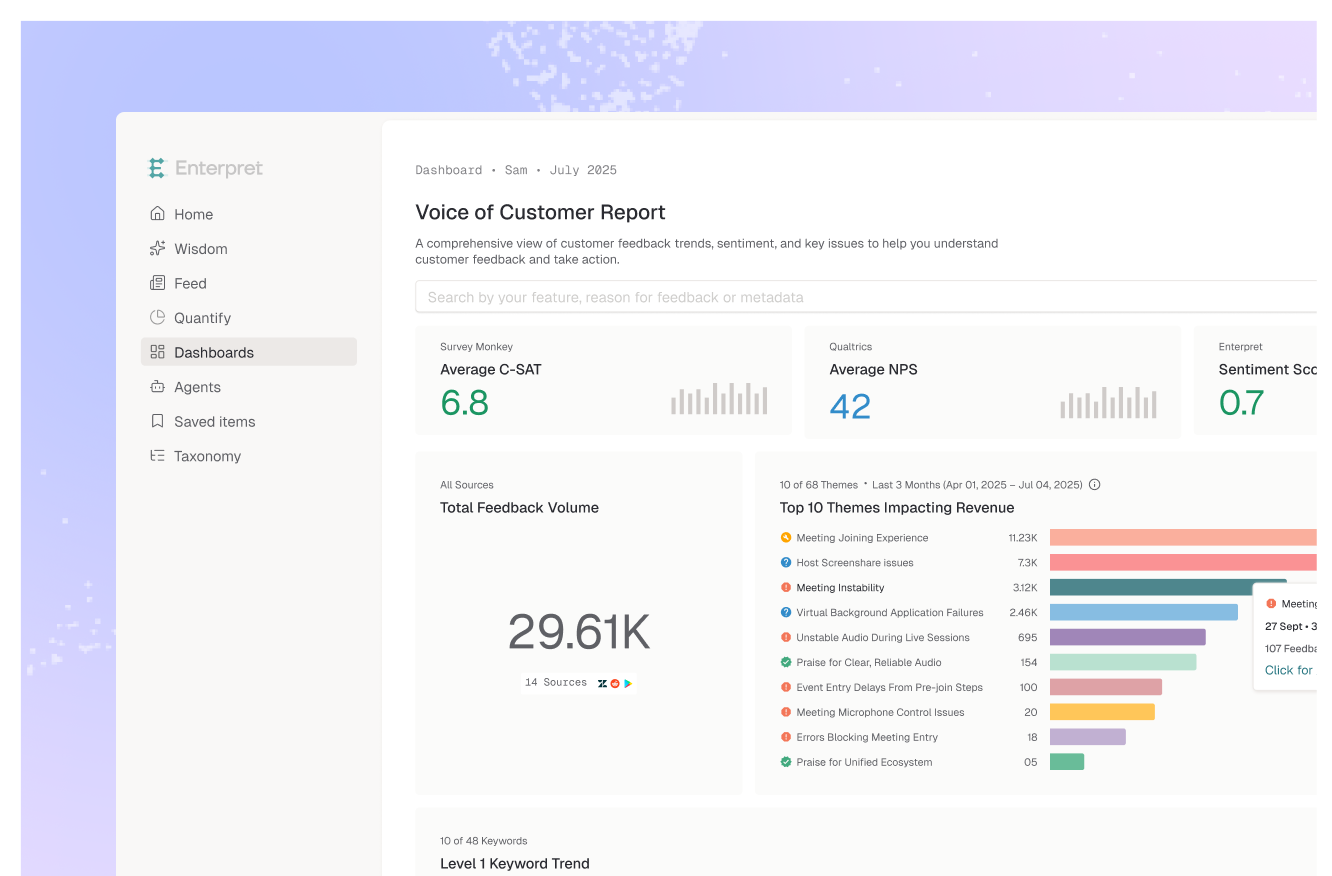
Enterpret is built for that infrastructure. It connects 50+ feedback sources into one evidence layer. Its Adaptive Taxonomy keeps L1, L2, and L3 categories consistent and updates them as you ship, so this quarter's trend compares to last quarter's. The Customer Context Graph joins each piece of feedback to account, segment, ARR, renewal date, and owner, so themes can be weighted by revenue rather than volume. Wisdom lets an AE, a CSM, or a PM ask a question in plain language and get the same exact records back, and AI agents and alerts deliver emerging issues into Slack, Jira, Linear, or Notion. Connecting sources and building the graph takes integration and processing time, so plan for it before the first priorities review.
Picture a mid-market SaaS company before and after. Before: sales wants SSO, CS wants reporting fixes, product wants onboarding, and the CEO breaks the tie.
After: the monthly review opens on one ranked list. Reporting reliability sits at the top, cited in tickets, in QBR notes, and on calls with accounts renewing next quarter. SSO ranks lower than sales expected, but the list shows exactly which open opportunities cite it, so sales and product agree on a targeted fix for that segment. Onboarding drops because the volume is real but the affected accounts are low ARR. Nobody won the argument. The evidence did.
Every month the teams share one evidence base, the taxonomy gets sharper, the revenue math gets more trusted, and escalations get rarer. Every month they don't, each team builds a stronger case for its own slice. That gap compounds. As AI assistants start answering from whatever context you give them, that shared evidence layer becomes the context every team and every agent runs on.
Because each team sees a different slice of customer evidence. Sales sees calls and lost deals, CS sees tickets and QBRs, and product sees surveys and reviews. The disagreement is about data, not judgment.
Product should own the final roadmap decision, but not the evidence. The evidence layer, taxonomy, and revenue weighting should be shared infrastructure that sales and CS contribute to and can inspect that product ops or a customer intelligence function often runs.
Agree on a revenue weighting before requests arrive, and route every escalation through a standing intake tied to the shared taxonomy. The big account still counts at its real ARR, next to every other account asking for the same thing, so its weight is visible rather than assumed.
Not if you want them to agree. Enterpret's research on eight frontier models found raw models changed more than half of their top themes between two runs on the same data, while grounding the agent in a persistent taxonomy cut that churn by 86 to 88%.
Monthly works for most mid-market and enterprise teams. Quarterly misses deals and renewals in flight; real-time alerts cover urgent issues between reviews.
If you are trying to put product, sales, and CS on one customer evidence base, see how Enterpret works.
Research cited
Lorem ipsum dolor sit amet, consectetur adipiscing elit. Suspendisse varius enim in eros elementum tristique. Duis cursus, mi quis viverra ornare, eros dolor interdum nulla, ut commodo diam libero vitae erat. Aenean faucibus nibh et justo cursus id rutrum lorem imperdiet. Nunc ut sem vitae risus tristique posuere.


