





The 7 Steps to Analyze Product Reviews From UK Retailers Like Argos and Very

Feedback Analysis
November 5, 2026

To analyze syndicated Bazaarvoice reviews across retailers, follow six steps: tag every review as native to the retailer or syndicated from another site, remove duplicates so one review is counted once, analyze by where a review was written separately from where it appears, compare retailer audiences on native reviews only, categorize everything on one product taxonomy, and combine reviews with the rest of your customer feedback.
Consumer brands no longer hear from customers in one place. The signal lives on retailer product pages, in dozens of storefronts, in several languages.
Syndication made that signal travel further. Bazaarvoice's developer documentation describes it plainly: syndication refers to the practice of sharing reviews between participants in the Bazaarvoice Content Network. A review written on a brand site can be shared with retailers, who display it on their own product pages.
That is a distribution model, and it does its job well. Shoppers see more reviews, and retailers get content for products their own customers have not reviewed yet.
But distribution is not analysis. The same review can now show up in five places. A retailer page can mix reviews its own shoppers wrote with reviews that started somewhere else. If you pull everything into a spreadsheet and count, your numbers lie to you.
Syndication answers "where should this review be seen?" Customer Intelligence answers a different question: "what are our customers actually telling us, and who is saying it?" You need both, and you need to keep them separate.
A native review was written by a shopper on that retailer's site. A syndicated review was written elsewhere and shared to it. Bazaarvoice's display guidelines ask that syndicated content be clearly attributed, with at least the source name and logo when available, so look for that attribution on the page. Tag every review with one field: native or syndicated, plus the source when you know it.
If a brand site review appears on four retailer pages, a naive pull counts it five times. One complaint about a hinge becomes a "trend." Deduplicate before you count anything: match on review text, rating, reviewer name and date, and keep one canonical record that lists every place it appeared.
These are two different questions. "Where was it written?" tells you who the customer is and how they bought. "Where does it appear?" tells you what shoppers at that retailer read before they buy. Keep both fields and choose deliberately for each report.
Retailer audiences differ by country, price point, delivery experience and who buys there. If you want to know whether UK buyers complain about setup more than Australian buyers, compare reviews those shoppers wrote themselves. Syndicated content makes every retailer look alike, which hides the differences you are looking for.
Battery, setup, app pairing, packaging, sound quality. Every retailer and every country should land on the same product areas, features and sub-features, so "connectivity" in a German review and "connectivity" in a UK review roll up together. Re-tagging each retailer separately produces lists you cannot compare.
A one-star review says something broke. The support ticket says how. The returns note says what it cost. Reviews become far more useful once they sit next to tickets, surveys and returns data on the same taxonomy.
Step 3 is where most teams get tripped up, so here is a simple way to decide which lens to use.
| Question you are answering | Lens | Include syndicated reviews? |
|---|---|---|
| What defects are customers reporting? | Where written | Yes, deduplicated to one record each |
| How do UK shoppers differ from Australian shoppers? | Where written | No, native reviews only |
| What does a shopper see on this retailer's page? | Where it appears | Yes, as displayed |
| Is the average rating on this retailer's page hurting conversion? | Where it appears | Yes, as displayed |
The tempting shortcut is to export reviews from each retailer and ask an LLM for the top themes. It feels fast. It does not hold up.
In Enterpret's study of run-to-run instability across eight frontier models, a raw model asked the same question on the same 100 records changed more than half of its theme set between two runs on average. Run that per retailer and you are comparing noise with noise.
86 to 88% Reduction in theme churn when an AI agent is grounded in a persistent taxonomy instead of re-clustering raw feedback on every run, with the model held constant. Source: Enterpret Research, "Same Feedback, Different Answer" (arXiv, 2026)
That study measures consistency, not accuracy. But consistency is the floor for any cross-retailer comparison. If the categories move every time you ask, you cannot say one retailer's buyers complain more about setup than another's. For more on making themes measurable, see how to turn open-text feedback into measurable insights.
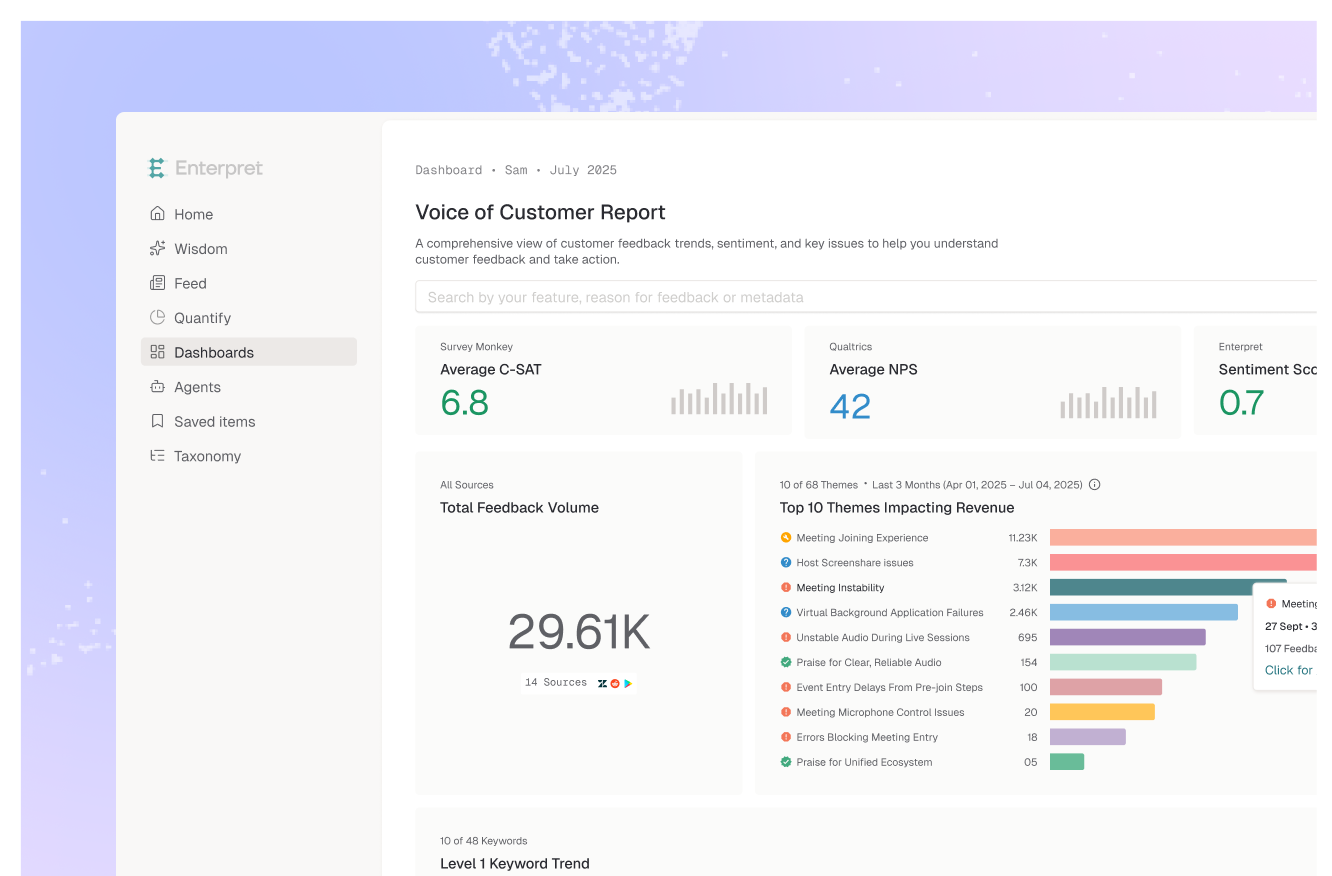
Teams can now bring product reviews from major retailers in the US, Canada, UK, Europe and Australia into Enterpret. Paste product links or product IDs, and Enterpret pulls every new review on that product, including from retailer product pages at Argos, Very, Orange, MediaMarkt, JB Hi-Fi and the Meta Store.
From there, the six steps stop being a spreadsheet project:
Reviews also sit next to support tickets from Zendesk or Intercom, surveys, returns notes and app reviews from the Apple App Store and Google Play. That is the upstream layer: one view of the customer, regardless of where they spoke. It is the same pattern behind how DTC brands analyze reviews, tickets, and surveys together, extended to products sold through retail.
Picture a hypothetical audio brand launching a smart speaker in the UK, Germany and Australia. The numbers below are illustrative.
Three weeks in, the brand sees 600 reviews across its own site and several retailer pages. After deduplication, it is 420 unique reviews. Many of the "extra" 180 were brand site reviews shown on multiple retailer pages.
On native reviews only, German buyers mention Wi-Fi pairing far more often than UK buyers. An alert flags "pairing fails after firmware update" as a new theme. Wisdom pulls the matching reviews and the support tickets that describe the same failure, and the quality team files a Jira issue with the evidence attached.
No double counting. One taxonomy, one story. That is what identifying trending product issues looks like when reviews are part of the picture.
Retail is where physical products meet their customers. The brands that win will treat every retailer page as a live customer signal, not a ratings badge.
Syndication will keep doing its job: getting reviews in front of shoppers. The opportunity is on the other side, turning those reviews into Customer Intelligence that product, quality and CX teams act on the same week. If you are pulling signals from many places, our guide to managing multi-source customer feedback is a good next read.
Bazaarvoice describes syndication as sharing reviews between participants in the Bazaarvoice Content Network. For example, a review written on a brand's site can be shared with retailers, who display it on their product pages with attribution to the source.
Deduplicate before you count. Match reviews on text, rating, reviewer name and date, keep one canonical record, and store every location it appeared in as a separate field. Then report volumes on unique reviews only.
Not when comparing retailer audiences. Use native reviews, written by that retailer's shoppers, to compare countries and retailers. Include syndicated reviews when you are analyzing what shoppers see on a page, or when you want total defect volume after deduplication.
For a quick read, yes. For tracking across retailers, it is risky: Enterpret's research found raw frontier models changed more than half of their top themes between two runs on the same 100 records, while grounding the agent in a persistent taxonomy cut theme churn by 86 to 88%. Stable categories are what make cross-retailer comparisons possible.
Building your own scrapers means maintaining them as sites change, handling rate limits, and checking each retailer's terms of use. Review those terms first and prefer approved or managed routes for collecting review data.
If you want retailer reviews, support tickets and surveys on one taxonomy, see how Enterpret works.
Research cited
Lorem ipsum dolor sit amet, consectetur adipiscing elit. Suspendisse varius enim in eros elementum tristique. Duis cursus, mi quis viverra ornare, eros dolor interdum nulla, ut commodo diam libero vitae erat. Aenean faucibus nibh et justo cursus id rutrum lorem imperdiet. Nunc ut sem vitae risus tristique posuere.


